Diving safety and rescue
scuba divingssifirst aiddiving safetyrescue diveremergency preparedness
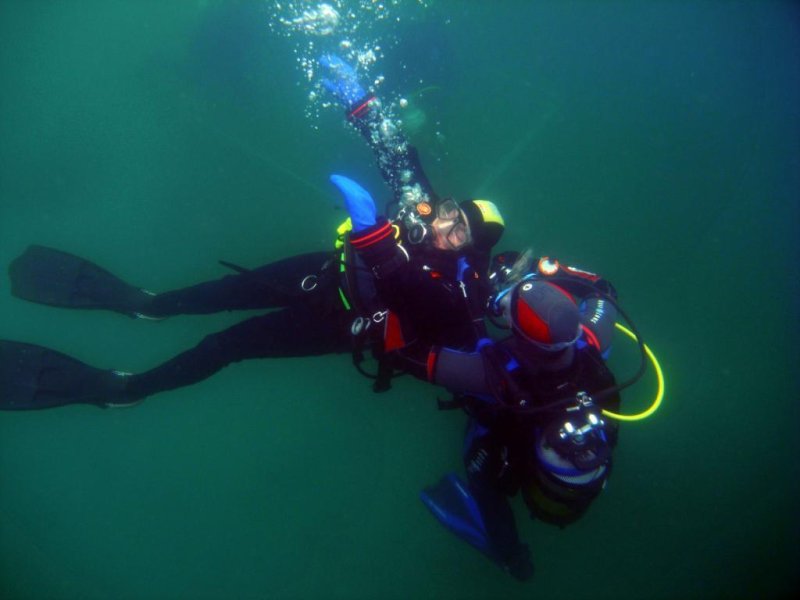
Stress & Rescue. Rescue Diver. Diving Safety & Rescue. Some names of different dive organisations for their "Rescue courses" that should help divers avoid dive accidents and/or provide effective assistance in case of emergency. "A rescue course does not a rescue diver make" is a statement we often hear and read. This is so true in the same way completing a first aid course does not make you a paramedic. So are rescue courses a meaningful supplement to dive training or do they just serve a more alibi function? DiveInside takes a closer look at today's rescue courses.
Some things are not forgotten. "I would like to thank you – training in the rescue course helped me today to spend only short time thinking about how to react to an accident: a man with a cardiac infarction in the water. I was able to get him out of the water and provided quick first aid until the ambulance was there. He is in the clinic, but stable. I think without the course, without the skills we had trained there, I would not have been able to help so effectively."
This e-mail, from a student to his instructors, motivates them to conduct their training with a higher level of commitment to all their students and to promote permanent refresher classes. The more often the procedures are practised, the more easily they become second nature. The more scenarios we design, the more swimmers and divers we will guide in tackling and using different equipment, thereby enabling students to be more prepared if an emergency arises. The key to quality enhancement is to anticipate situations in water sports based on realistic emergency situations, with different levels of intensity, speed and complexity. Any good instructor will probably agree with this.
Incidentally, many dive organisations have different names for almost identical course content. In some associations, the rescue course is included in the general training; in others, it is a special or additional course (a specialty). we will continue to use the term "rescue course" for reasons of readability; nonetheless, the other contents in the article refer to all courses / special courses / associations to the general context of this article.
Requirements: first aid and training level
The foundation for all rescue courses are the general first aid courses, which cover CPR (cardiopulmonary resuscitation). This technique became part of first aid training in the late 18th century: this was a time when drowning was much feared. First, water rescue organisations incorporated resuscitation techniques into their training. In almost all associations, the corresponding courses of the general relief / rescue organisations are recognised as a prerequisite, although some dive associations have their own instructional courses covering first aid and care afterwards. With regards to this, there are always opposing views: "Lay training by (medical) laymen" is a frequent counterargument to this offering of diving associations. These, in turn, argue that not only general skills but also water and dive-related topics should be included. Thus, the oxygen "medication" in diving emergencies and basic knowledge with the handling of AED / defibrillator is usually taught, in courses of (non-diving) aid organisations not necessarily. Tip: Instructors are often also medical professionals like paramedics. Hence, one should find out the background and experience of the instructor teaching the course before making a booking. If the conditions are right, first aid courses of the dive associations can indeed bring real added value for divers.
The second prerequisite is basic dive training. In some associations, there is another proficiency level following the entry level certificate (for example, the AOWD, or Advanced Open Water Diver). In these cases, the idea is that a diver should not be self-absorbed before he can help his/her buddies or other divers. Those who still struggle with their own buoyancy will find it hard to bring a victim (someone experiencing problems) from depth to the surface in a controlled manner; the most probably will have difficulty providing efficient help to a diver in panic.
Counterarguments here: The teaching of rescue skills enables beginners to provide assistance at an early stage, at least in rescue situations at the water surface, when sending victims ashore or on the submersible, etc. Skills can be further enhanced in subsequent courses. For rescue divers of aid organisations, for example, skills should be reviewed on an annual basis.
Course curriculum / course size
The curriculum follows general standards: theory lessons, basic skills training in the pool and demonstration of the skills in open water. According to the objective that problems not arise at all, good theory lessons can prevent accidents. This covers equipment knowledge, proper dive preparation (which takes into account prevailing diving conditions), and a briefing that includes advice on how to react in emergency situations. The preparation of emergency plans for dive group leaders, diving medical aspects with treatment recommendations as well as the activation of the rescue operation right up to the accident report round off good theory lessons.
Course size: In general, small training groups in diving courses are beneficial for course attendees. However, for rescue courses, especially in open water scenarios, the opposite is true. In larger groups, students with different personalities learn to cooperate in emergency scenarios (with roles allocated based on existing experience level) and to render help effectively, as if it were a real-life scenario.
Another benefit for larger groups to practise emergency scenarios is the wide(r) range of equipment configurations (jacket vs. wingsystem, single vs. double tanks, classic second stage configuration vs. long hose (DIR) configuration, backmount vs. sidemount configuration, wetsuit vs. drysuit).
The more participants there are, the greater the possibility that scenarios catering to a variety of different equipment configurations can be found in the course. In order to be realistic and to teach rescue techniques catering to different configurations, it is recommended that instructors get divers to use different configurations when they pose as "victims" in rescue scenarios.
Practical: Transporting an unconscious diver to the surface
Klaus K. and Susanne W. have extensively practised the abovementioned skill in the pool training sessions, as well as the retrieval of equipment at the water surface and the rescue of victims from the water, followed by first aid. They feel well prepared. In the open water scenario, they have to locate two missing divers, bring them to the surface in a controlled manner, remove equipment and carry out first aid procedures. Filled of enthusiasm, they set off together. The "victims" are soon found – "unconscious" – at about 10m depth. Now, every minute counts. Susanne desperately looks for the "victim’s" inflator hose and inflator-button. The "victim’s" BCD is an Axiom i3 diving jacket and lacks a standard inflator system (It is filled by integrated inlet and outlet valves, in a deflator system). Valuable time passes, and the ascent is anything but "controlled." Klaus brings up his "victim", who is wearing double tanks, to the surface and pulls him quickly to the shore. On the way there, he tries to remove the equipment. He is not familiar with the harness system and fails to notice the crotch strap, losing valuable time as he releases it in shallow water…
Time factor and "solid ground"
Many rescue organisations agree that rendering help for divers who had suffered an accident can only be done on "solid ground" (just think of CPR, oxygen, wound care). For this reason, in all accidents, the priority is to get victims onto dry land or on board as quickly as possible. Thus, it is all the more surprising that some courses teach time-consuming exercises (conducted in the water), which are the opposite of a quick and effective supply outside the water.
Examples of this include exercises such as attempting resuscitation during transport in the water. According to well-known diving physician and Priv.-Doz. Dr. med. Claus-Martin Muth, Head of the Committee for Diving Medicine of the Gesellschaft für Tauch- und Überdruckmedizin (GTÜM):
"In fact, trying to adequately ventilate an unconscious scuba diver during transport is not only unsuccessful, but also delays adequate rescue dramatically. The better recommendation, therefore, is to swim as quickly as possible and then start breathing on land."
Implementation and exercises for everyone
We had the opportunity to attend and observe several rescue courses at different dive centres. The various direction and mediated rescue techniques differed only marginally, but the emphasis and solutions presented have been different. We will discuss some specific tips and skills separately below. Our experiences show that it can be advantageous for one's own training – regardless of one’s proficiency level – to undergo refresher courses at different training centres and / or clubs.
Rescue skills at a glance:
Self-rescue situations:
• Dissolve spasms / Antispasmodic actions • Establish positive buoyancy • Respiratory control
• Use of alternative air supply
(Pony bottle, stages)
• Vertigo (dizziness): overcome, stabilisation
Trigger rescue chain:
• Rescue chain
• Team building for rescue operations
• Accident management and interview
Surface aids:
• Approach and situation assessment
• Contact
• Calm the diver
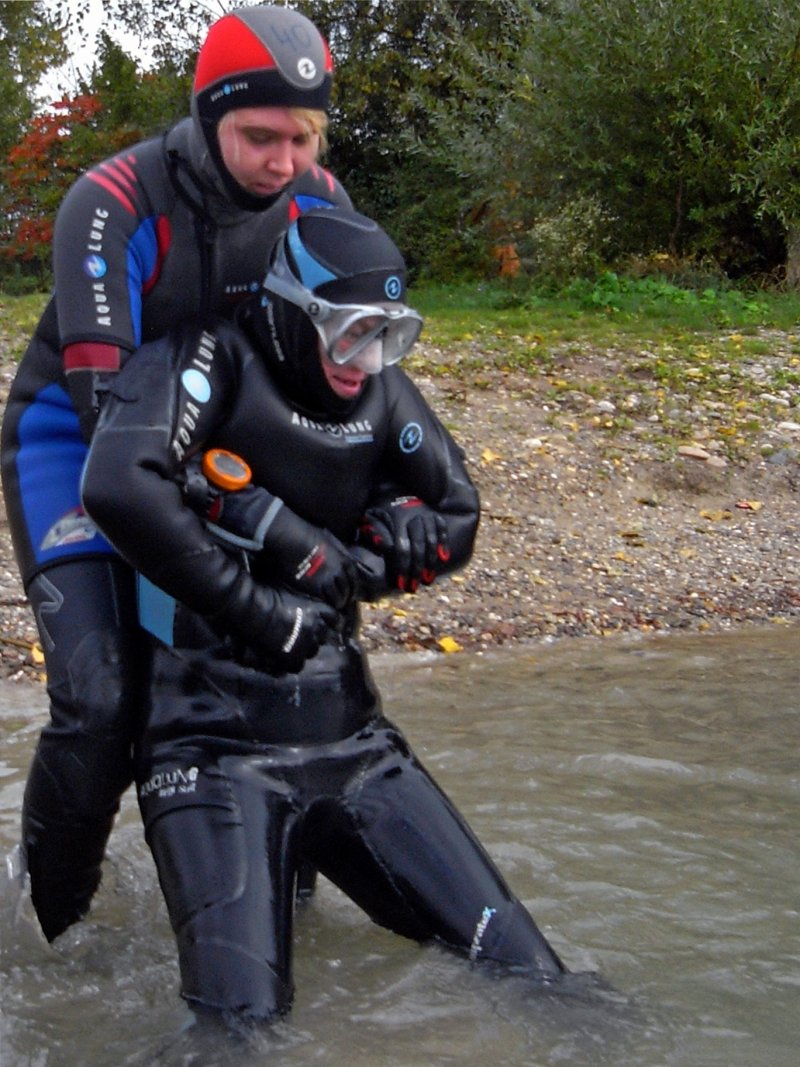
• Assistance and transport, removal of equipment
• Exits (land / boat)
Dealing with panicking victims:
• Approach with withdrawal option
• Liberation techniques
• Fixation
• Transport without risk to oneself
Assistance from the shore, jetty or boat:
• Assistance by handing in and throwing out rescue aids and ropes
• Entrances into the water, with victim(s) in view
• Assistance and rescue in the water with and without aids
• Various towing / sliding techniques
• Exits
Underwater assistance:
• Approach / situation assessment / making contact
• Panicking diver
• out-of-control ascending diver
• Air donations / Air sharing (out-of-air situations) and controlled ascent
• Missing diver, conducting fast and efficient search
• Transport of unresponsive diver to the surface
Exits:
• Exit with divers
with and without help (onto land, platform, jetty)
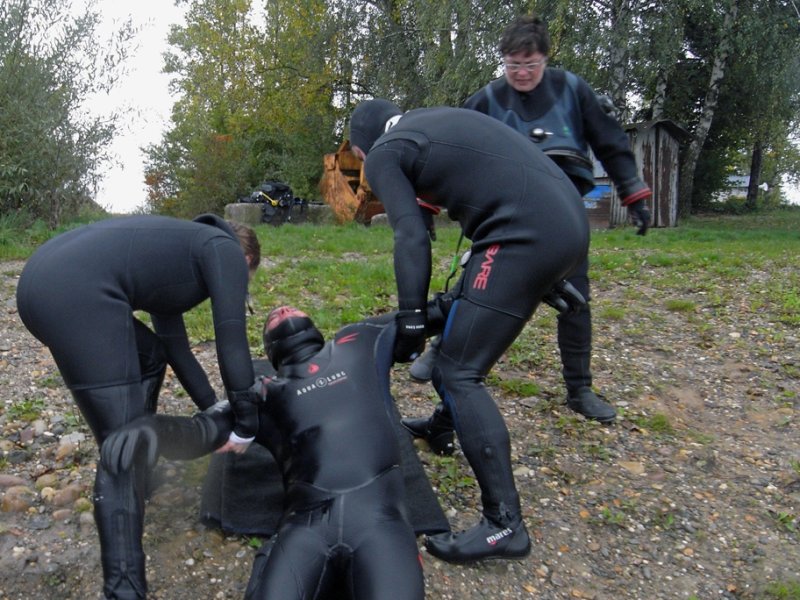
• Transport to appropriate location where first aid is rendered
First / possibly second supply:
• Help for pressure-related injuries
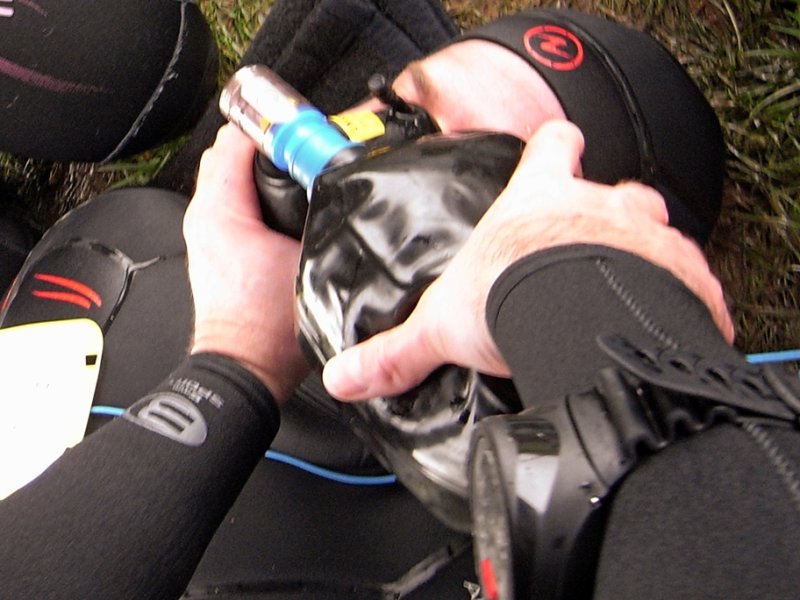
• CPR and ventilation (with ventilation mask)
• Suspected DCS:
Administering emergency oxygen
RESCUE SCENARIOS (open water):
• Realistic emergency scenarios involving all course participants
(team building), assistants and "victim guests" wearing different
equipment
• Example 1: Finding and finding a missing diver in one
Accident simulation, rescue with entire aid chain (chain of survival?)
• Example 2: Accident simulations according to the above-surface and
underwater emergency situations using entire auxiliary chain
Practical: Rescue skills beyond the standard instruction
Some exercises, which are not in the textbook, but which we have noticed in our course observations, are mentioned here:
Imagine you need a stretcher after you have landed your victim. What can you do?
Take two long poles (tent poles, long branches, etc), place them on a blanket about 50 to 60 cm apart, and fold them in so that the ends overlap. Place the victim on it, which fixed by his body weight, the blanket, the transport stretcher is done.
Wrapping: Upon reaching the shore, you discover that the jetty is very high and there is no ladder. What can you do?
Use a blanket, mattress, canvas, or any suitable item within reach. Standing at the end of the jetty, throw the blanket into the water and then pull the rest of the blanket under the victim. Catch up with the other end from the top. In this way, the victim is gently "rolled up."
Conclusion
Being able to provide help in an emergency is not only a moral obligation, but also an obligation imposed by our legal system. Successfully providing assistance also creates deep and lasting satisfaction, as the e-mail at the beginning of this article impressively demonstrates. The better prepared we are for emergencies, the more capable we would be at rendering help. And honestly, wouldn’t we ourselves want to be helped by well-trained dive buddies should we need help? The question is not whether, but when and how often we expose ourselves to this training.
Regardless of the range of courses available, it is advisable, possibly with more experienced dive partners, to complete a training session on rescue skills on your own initiative, in order to be able to render assistance whenever necessary.
이 기사는 자동 번역되었으며 약간의 오류가 포함될 수 있습니다. 의심스러운 점이 있으면 원문 영어 버전을 참조하십시오.