Bioherm structure at Great Barrier Reef three times larger than expected
environmentmarine lifecoral reefgreat barrier reefhalimeda bioherms
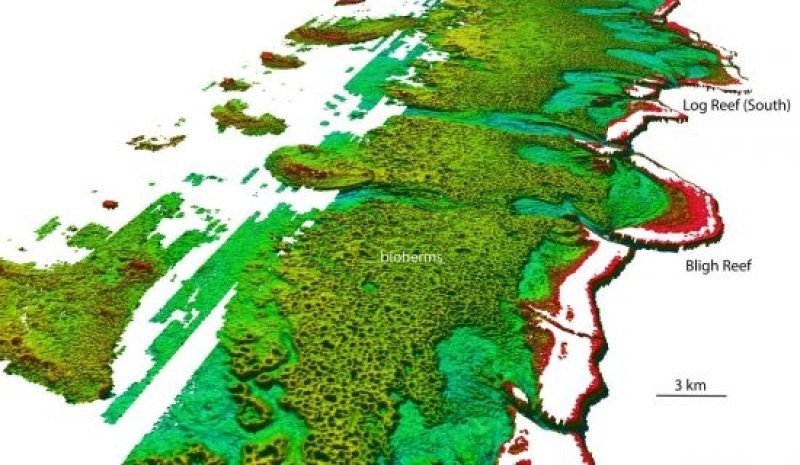
North-westerly view of the Bligh Reef area off Cape York. Depths are coloured red (shallow) to blue (deep), over a depth range of about 50 metres. (c) www.deepreef.org (Bathymetry data © Australian Hydrographic Service)
New research has revealed the existence of vast fields comprising circular mounds in the north of the Great Barrier Reef (GBR) – in essence, it is another reef structure just behind the famous reef.
Actually, scientists have already known about them since the 1970s and 1980s. Called Halimeda bioherms, the donut-shaped mounds measure 200 to 300 metres across and are up to 10 metres deep at the centre. They are formed by the growth of Halimeda, a green algae made up of living calcified segments. Over time, after death, the algae form into limestone flakes which are eventually transformed into the large mounds, called bioherms.
Scientists had no idea about the actual shape, size and vast scale of the structures till now. The team of scientists, hailing from James Cook University, University of Sydney and Queensland University of Technology, have been making use of high-resolution seafloor data for this project. Their findings have been published in the recent issue of Coral Reefs journal.
Lead author Mardi McNeil, from Queensland University of Technology, said, "We've now mapped over 6,000 square kilometres. That's three times the previously estimated size, spanning from the Torres Strait to just north of Port Douglas. They clearly form a significant inter-reef habitat which covers an area greater than the adjacent coral reefs."
The good news aside, the question of the bioherms' resistance to climate change has arisen. Being calcifying organisms, they may be susceptible to ocean acidification and global warming. University of Sydney's Associate Professor Jody Webster wondered whether, and to what extent, the Halimeda bioherms have been thus impacted.
The new discovery has paved the way for new avenues of research. Dr Beaman elaborated, "For instance, what do the 10- to 20-metre thick sediments of the bioherms tell us about past climate and environmental change on the Great Barrier Reef over this 10,000-year time scale? And, what is the finer-scale pattern of modern marine life found within and around the bioherms now that we understand their true shape?"
Subsequent research would be in the form of sediment coring, sub-surface geophysical surveys and autonomous underwater vehicle technology to find out more about the bioherms' physical, chemical and biological processes.
Further Informationen: www.jcu.edu.au
Link to study: http://link.springer.com/article/10.1007%2Fs00338-016-1492-2
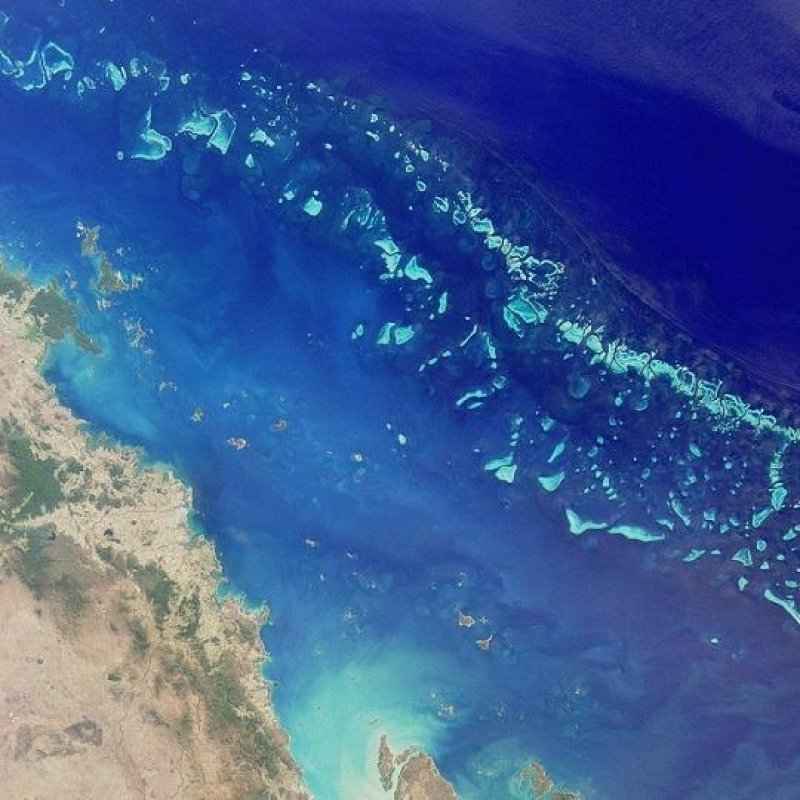
Bioherm structure behind Great Barrier Reef three times larger than expected (c) NASA
Ez a cikk automatikusan lett lefordítva, és apróbb pontatlanságokat tartalmazhat; kétség esetén kérjük, tekintsd meg az eredeti angol változatot.