Huge cold water coral mountains under water
environmentmarine lifecoral reefoceancold water corals
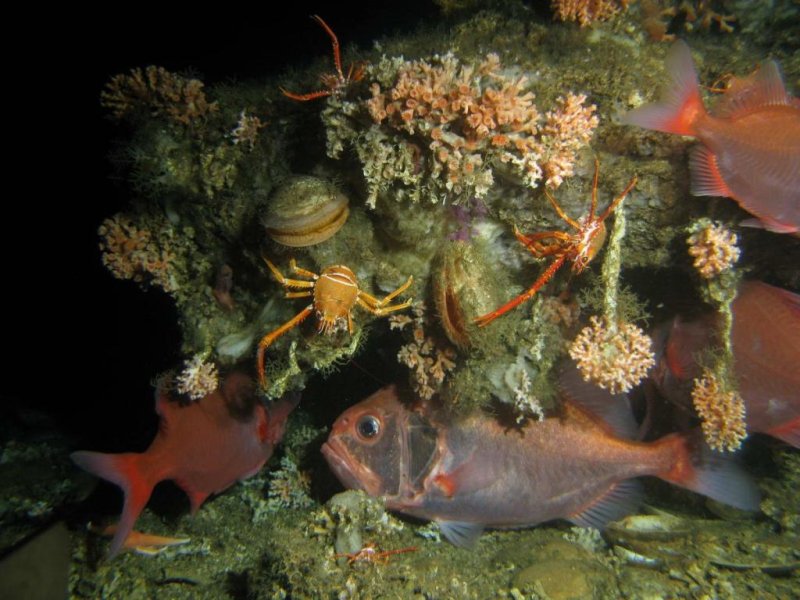
The hard corals Lophelia pertusa and Madrepora oculata on a coral mound off Mauretania. The reefs, built by these hard corals, serve as a habitat for fish, crabs, shells and many other inhabitants. (c) Tomas Lundälv
International research team examines coral reefs off Mauritania On a length of about 400 kilometres, the seabed in front of the coast of Mauritania covers the world's largest contiguous cold water coral structure. Dr. Claudia Wienberg from the MARUM Center for Marine Environmental Sciences at the University of Bremen and her colleagues have investigated how the cold-water corals of Mauritania developed over the past 120,000 years. Unlike tropical corals, which live in shallow, light-flooded waters, you can find cold water corals in water depths of several hundred to a thousand meters. More than half of the known, today living coral species exist in complete darkness in the deep sea. They too are busy engineers building impressive coral reefs. Significantly involved in reef formation is the cold-water coral species Lophelia pertusa. It belongs to the stony corals and forms strongly branched, bushy colonies. Where many of these colonies coexist, reef-like structures are formed, which provide life coats for various other species such as soft corals, fish, crabs and sponges. A cold water coral sits firmly attached to the substrate on which the larva once settled. Coldwater corals prefer to grow on their peers, creating huge structures on the sea floor over periods of millennia to millions of years. Alps in front of Mauritania The world's largest contiguous cold water coral structure with a length of approximately 400 kilometres exists along the Mauritanian coast. Here the coral hills reach heights of 100 meters. "The size of the hills and the length of these structures are really special. In fact, one could actually speak of cold-water coral mountains here, "says Dr. Claudia Wienberg from MARUM. "Before Mauritania, the individual cold-water coral hills probably grew together over time. There is no such thing anywhere else in the world's oceans. "Wienberg was part of an international team of scientists who intensively sampled this area aboard the research vessel" MARIA S. MERIAN "to learn more about the development of cold water corals. In a study published in the science journal Quaternary Science Reviews, she and her colleagues are now presenting the results. Oxygen deficient staggered corals at rest Prof. Dr. Norbert Frank and his team from the University of Heidelberg analyzed coral fragments from the surface and from different depths of the seabed and determined their age. With these and other studies, the scientists were able to trace how the cold-water corals in Mauritania developed in the past 120,000 years. In the past, there were always phases in which the growth rates peaked at 16 meters per 1,000 years. Not even the currently largest cold-water coral reef off Norway is growing so fast. Almost 11,000 years ago, the growth of the Mauritanian coral hills stagnated. At that time, the corals probably disappeared completely from the hills. It is only today that isolated cold-water corals appear again. The growth of corals depends on various environmental conditions, such as water temperature, oxygen content, the food supply and the prevailing currents, which transport food to the stationary cold water corals. Of all the influences, the researchers made the low oxygen content of about 1 millilitre of oxygen per litre of water as a critical factor. "That's extremely little. Originally it was assumed that at 2.7 millilitres per litre, the lowest limit is for cold water corals, in which they survive, but can no longer build reefs, "said Wienberg. "The scattered cold-water corals on the hills show that they can survive, at least temporarily, very low oxygen levels, but they are not feeling well." The results show that the high phases of the cold water corals in which the hills grew up coincide with times in which oxygenated water masses flowed from the north into the area. Whereas in the past, as in the past, cold-water corals were surrounded by oxygen-poor masses of water from the south, the hills did not grow or grew very slowly. Depending on the prevailing climate, the front between these water masses shifted from north to south and vice versa, and the corals were surrounded by oxygen-rich, then again low-oxygen water. According to Wienberg's theory, cold water corals resorted to extremely low oxygen levels in smaller ravines between the large hill structures. In these canyons, there are now many more cold water corals than on the hills. The floating coral larvae are mobile for a certain distance before finally settling down. For example, migratory movements from the hills to the canyons and, under the influence of the northern body of water, may have taken place. "According to scientific forecasts, the zones with low oxygen content in the oceans will continue to expand," said Wienberg. "Even though cold-water corals show a high tolerance, this is a crucial stress factor for these deep-water ecosystems. Additionally they have to withstand the increased water temperatures due to climate change and the increasing ocean acidification. " Link to the study: doi.org/10.1016/j.quascirev.2018.02.012 See also: Seawater Density affects Cold Water Corals
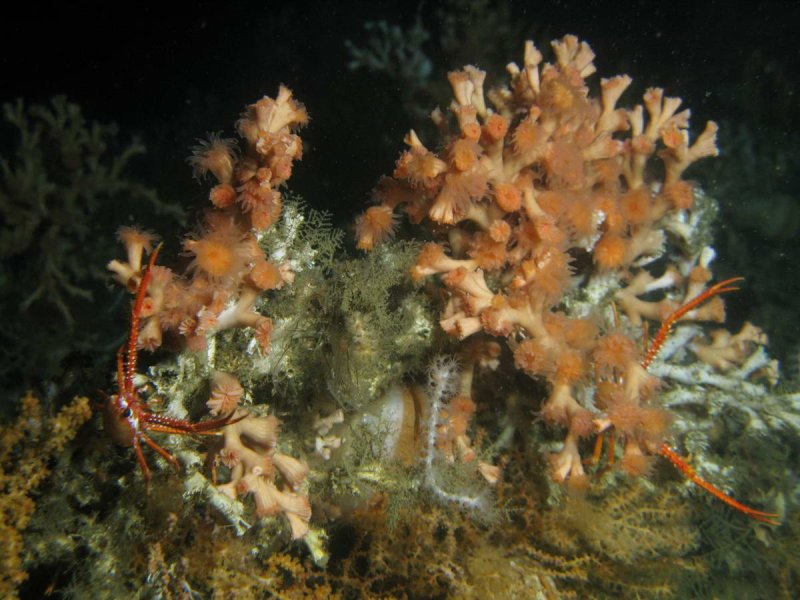
The stone coral Lophelia pertusa in a canyon off the Mauritanian coast, photo (c) Tomas Lundälv
Bài viết này được dịch tự động và có thể chứa một số lỗi nhỏ; vui lòng tham khảo bản gốc tiếng Anh nếu có thắc mắc.