Increased deoxygenation of the oceans
environmentmarine lifemarine conservationoceanclimate change
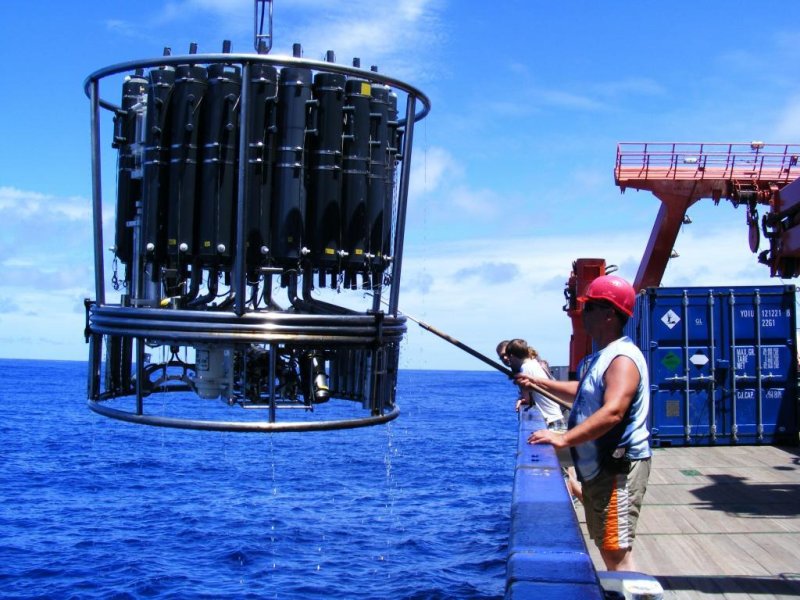
Water sampling with a wreath maker, © Martina Lohmann, GEOMAR
A new study reveals dangers, but also solutions The areas of extreme oxygen depletion are growing both in the open ocean and in coastal areas. This is the result of the research study of an international scientific team. In the most comprehensive study to date on this topic, which appeared in the journal Science, the authors also show the possible consequences of this development as well as possible solutions. Around a year ago, Kiel oceanographers published a study that showed that the ocean has lost two percent of its global oxygen in the past 50 years. Now an international team of scientists has once again looked at global oxygen evolution in the oceans. "Our data shows that in the past half-century, the amount of water in the open ocean, in which all oxygen is lacking, has grown more than fourfold," says Prof. Dr. med. Andreas Oschlies from the GEOMAR Helmholtz Center for Ocean Research Kiel, one of the authors of the new study. In coastal waters, including estuaries and marginal seas, low-oxygen sites have increased more than tenfold since 1950. "We also expect oxygen levels to continue to fall outside these areas as the Earth continues to warm," explains Oschlies. "Oxygen is fundamental to life in the oceans," says Denise Breitburg, lead author and marine ecologist at the Smithsonian Environmental Research Center in Washington, USA. "The drop in oxygen in the ocean is therefore one of the most serious effects of human activity on the Earth's environment." For their study, the participating authors evaluated about a quarter of a million data sets and also carried out GEOMAR climate model calculations for oxygen concentrations in oceans. Scientists cite global warming as the cause of increasing oxygen depletion. Warmer surface water contains less oxygen. It also makes the stratification of the ocean more stable, which reduces mixing and circulation and makes it harder to ventilate the interior of the ocean. Another factor is the over-fertilization of the oceans, especially near the coast. It leads to algal blooms, which consume much oxygen after the death of the algae. Of course, the increasing oxygen depletion of the ocean also has an impact on the livelihoods of people, especially in developing countries. Smaller artisanal fisheries may not be able to move if little oxygen destroys their fishing grounds or forces fish to seek out other habitats. Also coral reefs, an important tourist attraction in many countries, could die without sufficient oxygen. In order to limit the further expansion of oxygen poverty and to reduce its consequences, the researchers involved propose three measures. "It is very important, of course, to combat the causes, ie the nutrient load and climate change," emphasizes Oschlies. At the same time, protecting endangered regions or species could reduce the pressure on ecosystems. In order to be able to carry out these measures successfully, an improved monitoring of the oceanic oxygen content is also necessary, according to the author team. "Unfortunately, we still have too few observations from the ecosystems in the open ocean. You would have to change that for effective protection, "says Oschlies.
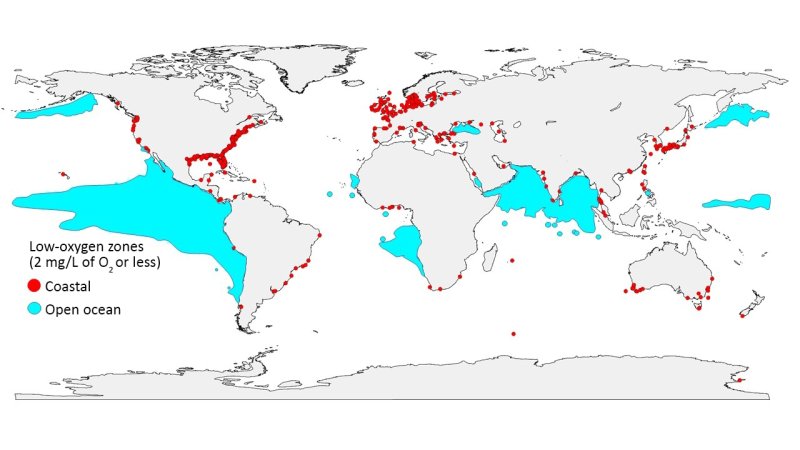
The areas of extreme oxygen depletion are growing both in the open ocean and in coastal regions. © GO2NE working group. Data from the World Ocean Atlas 2013, Fig. By R. J. Diaz
Bu makale otomatik olarak çevrilmiştir ve küçük hatalar içerebilir; şüphe duymanız durumunda lütfen orijinal İngilizce versiyona bakın.