Volcano "F" is the origin of the floating stones
environmentmarine lifevolcanopumiceunderwater eruption
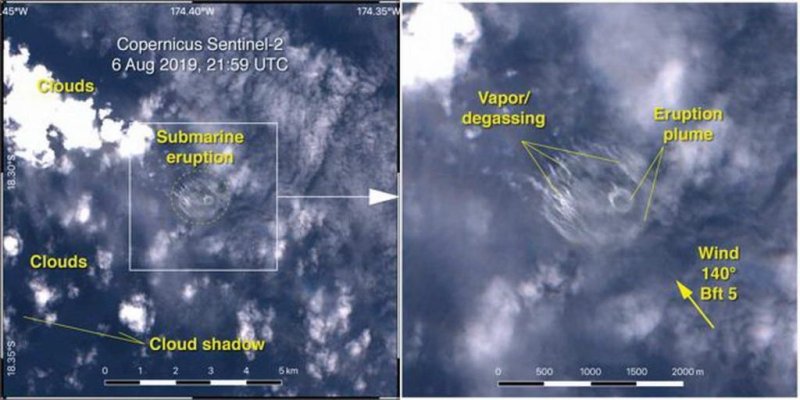
Pictures of the ESA satellite "Copernicus Sentinel-2" with clear traces of an underwater option on the water surface, (c) ESA
Researchers publish study on pumice raft in the Southwest Pacific Since August 2019, a huge cluster of pumice stones in the south-western Pacific is heading for Australia. Researchers from the GEOMAR Helmholtz Center for Ocean Research Kiel, together with colleagues from Canada and Australia, have now identified the origin of this so-called pumice stone raft. It is a hitherto nameless underwater volcano in Tongan waters. The study has now appeared online in the international journal ‘Journal of Volcanology and Geothermal Research’. Stones do not swim in the water. That's a truism. But there is hardly a rule without exception. In fact, some volcanic eruptions produce a very porous rock whose density is so low that it floats: pumice. An unusually large amount of it is currently heading southwest in the direction of Australia. When it was first sighted in the waters of the island nation of Tonga at the beginning of August 2019, it almost formed a closed area – a little island - on the water; we reported. Various underwater volcanoes were then discussed as the cause of the phenomenon. But the direct evidence for the exact origin of pumice stone was missing so far. Researchers at GEOMAR have now published evidence together with colleagues that uniquely identifies the pumice source. It is a hitherto unnamed underwater volcano just 50 kilometres northwest of the Tongan island of Vava'u. "In the international literature he appears so far only under the number 243091 or as volcano F," says dr. Philipp Brandl from GEOMAR, first author of the study. It was not until January 2019 that Dr. Brandl and several of his co-authors have been on the way in the region with the German research vessel "SONNE". The expedition focused on the formation of new crust in the geologically highly active region between Fiji and Tonga. "When I saw the reports of the pumice raft in the media during the summer, I became curious and started researching with my colleagues," says Brandl. When evaluating freely accessible satellite imagery, the team found it. On a recording of the ESA satellite "Copernicus Sentinel-2" on 6 August 2019, clear traces of an active underwater eruption can be seen on the water surface. Since the images are exactly geo-referenced, they could be compared with appropriate seabed surveys. "The eruption traces fit exactly to Volcano F," explains Dr. Brandl. For safety reasons, the researchers also compared this position with information from seismic measuring stations, which recorded signals of the eruption. "Unfortunately, the network of such stations in the region is very thin. There were only two eligible for matching. But their data confirm the track to the volcano F", said Dr. Brandl. The pumice stone can occur in volcanic eruptions when viscous lava is foamed by volcanic gases such as water vapour and carbon dioxide. This creates so many pores in the cooled rock that its density is lower than that of water. "In an underwater eruption, of course, the probability is particularly high that pumice stone is formed," explains Dr. med. Brandl. With the help of further satellite imagery, the team continued to follow the path and spread of the pumice raft until mid-August. It drifted slowly west and reached an area of up to 167 square kilometres. This also allowed the team to draw conclusions about the size of the underwater eruption. It corresponded to a volcanic eruption index of 2 or 3, which corresponds to the recent eruptions of the Italian volcano Stromboli. With the current direction and speed the pumice island will probably reach the the Great Barrier Reef off Australia's east coast in the end of January or early February 2020. Biologists in particular are eagerly awaiting this event because pumice rafts may play an important role in the spread of organisms in the Pacific. The Kiel team of geologists would like to examine samples of the pumice stones in order to determine the geochemistry of volcano F more precisely. "Maybe Australian colleagues will send us some pieces next year," says Dr. Brandl. Further information Solving the mystery of floating rocks

Illustration of the "volcano F" based on older bathymetric data, graphic: (c) Philipp Brandl / GEOMAR

The volcanic island Fonualei, which is not far from the underwater volcano "F", (c) Philipp Brandl / GEOMAR

Only in January 2019 did the German research vessel "SONNE" west of Tonga carry out an expedition under the guidance of GEOMAR, (c) Philipp Brandl / GEOMAR

Propagation of the pumice raft on a photograph of the satellite "Copernicus sen
Questo articolo è stato tradotto automaticamente e potrebbe contenere piccole imprecisioni; in caso di dubbi, consulta la versione originale in inglese.