Deep-sea mining has serious consequences for marine ecosystem
environmentmarine lifemarine conservationocean
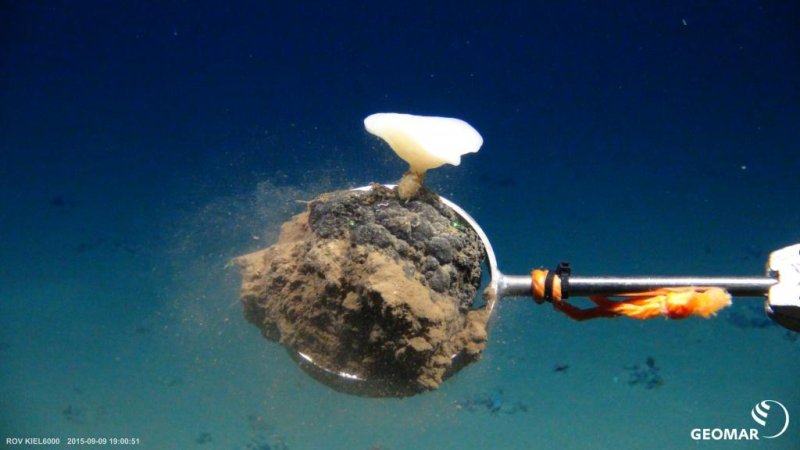
Manganese nodules are the habitat for many life forms, © ROV-Team, GEOMAR
Concrete measures required to protect marine environment Increasing globalization and the greater use of high-tech materials has increased the demand for rare metals. Thus, the search for ore deposits from the deep sea is becoming increasingly important. As a result, the applications for exploration licenses submitted to the International Seabed Authority (ISA) has tripled in the last five years. What environmental risks would the mining of metallic raw materials from the deep sea have and how can mining be made as environmentally friendly as possible? These questions were discussed by researchers from eleven European countries within the framework of the project "MiningImpact". Their findings and assessments have now been published in a paper in the international journal Science. The deep sea still holds surprises for science. Thus, until now, there is a common perception that the large deep-sea beds in the central Pacific are very uniform and sparsely populated. This is a mistake, as researchers in the MiningImpact project discovered: The ecological diversity of the deep-sea beds is enormous, especially in areas with many manganese nodules lying on the ocean floor. Manganese nodules do not only consist of manganese, but in addition to iron, there are coveted metals, such as copper, cobalt or nickel. There is a very special and fragile ecosystem around the manganese nodules, and it would be destroyed on a large scale if the area was mined. It consists of very different on the tubers stuck but also mobile organisms. The regeneration of the ecosystem would take many decades to hundreds of years. In order to protect marine ecosystems and their biodiversity, precautionary measures are indispensable, according to the scientists. They recommend the establishment of protected zones that are comparable to the environmental conditions and species communities in future mining areas. In addition, additional protected areas within the license areas are required. According to the authors, technologies for monitoring deep-sea mining are already in place, but a corresponding transfer of knowledge between industry and science as well as a standardisation of the exploration procedures is necessary. The measures are addressed in particular to the International Seabed Authority (ISA). It manages the seabed resources in international waters outside the Exclusive Economic Zones (200 nautical miles) of individual states. The agreement also obliges ISA to ensure effective protection of the marine environment from the possible consequences of marine mining. Concrete environmental regulations for the protection and conservation of the deep-sea environment, including their biodiversity and ecological integrity, have not yet been agreed upon by the ISA. However, the authors of the study are optimistic that their findings will be added to the current work of the agency.
บทความนี้ได้รับการแปลโดยอัตโนมัติและอาจมีข้อผิดพลาดเล็กน้อย โปรดอ้างอิงจากฉบับภาษาอังกฤษต้นฉบับหากมีข้อสงสัย