Weirdest Sea Creatures: 8 Ocean Oddballs That Look Unreal
ecology
iStock-MadKruben
The ocean is home to more than 250,000 known marine species, and many more are still waiting to be discovered. Dolphins, turtles, and colorful reef fish may steal the spotlight, but some of the weirdest sea creatures look as if they slipped straight out of a science fiction movie. From jaws that shoot forward in an instant to fish with transparent heads, the deep ocean proves that reality can be stranger than anything imagined on screen.
Table of Contents:
When people talk about the weirdest sea creatures, the goblin shark is hard to leave off the list. Often called a “living fossil,” it is the only living member of a shark family whose roots stretch back roughly 125 million years. Its head ends in a long, flattened snout that gives it an almost prehistoric appearance before it even opens its mouth.
Packed with electroreceptors, this blade-like structure picks up faint electrical signals from nearby prey in the darkness. In a split second, the jaws shoot forward in a slingshot-like motion, snapping at fish and squid before sliding back into place.
Goblin sharks live far below recreational diving depths, from a few hundred meters to nearly 2,000 meters (6,560 feet), so encounters with humans are exceptionally rare. With its unusual profile and sudden jaw strike, the goblin shark shows just how strange life can become in the deep ocean.
Curious about sharks beyond their unusual appearance? The SSI Shark Ecology Specialty explores shark behavior and helps divers better understand the animals they may encounter underwater.
The barreleye fish fits right in with the weirdest ocean animals, yet it can look almost ordinary at first. That changes the moment you look closer. The top of its head appears transparent, revealing two bright green, tube-shaped eyes beneath the clear dome. They look almost like tiny periscopes inside its head, giving it a truly alien appearance.
The eyes point upward as the fish searches for faint silhouettes drifting overhead, then rotate forward when it feeds. In water where daylight has faded to little more than a dim glow, that movement helps it find prey in the darkness.
The barreleye lives around 600 to 800 meters (1,970 to 2,625 feet), feeding on small crustaceans and other drifting prey. Footage from remotely operated underwater vehicles finally showed those green eyes moving inside a living fish, revealing another extraordinary detail of this deep-sea oddball.
The tripod fish looks unusual even by deep-sea standards, thanks to a surprisingly simple way of saving energy. Instead of constantly swimming, it uses three extremely elongated fin rays like stilts, holding itself above the seabed as if it were standing on three thin legs.
Facing into deep-ocean currents, it waits for tiny crustaceans and planktonic prey to drift within reach. At depths of 1,000–4,700 meters (3,280–15,420 feet), food can be scarce, so conserving energy means staying still instead of chasing every passing meal.
Perhaps the strangest part is how long the tripod fish can remain almost perfectly still, balanced above the soft sediment as the current carries food past. In the deep, waiting becomes a hunting strategy of its own.
Despite its dramatic name, the vampire squid is no fearsome predator. Its dark red body, large reflective eyes, and webbing stretched between its arms give it the look of a tiny creature wrapped in a cloak, more eerie than dangerous.
Instead of chasing large prey, it feeds mainly on marine snow, a slow shower of dead plankton, mucus, waste, and other organic particles drifting down from above. Long, sticky filaments reach into the darkness and collect the falling food.
Vampire squid live around 600 to 900 meters (2,000 to 3,000 feet) in low-oxygen water. When threatened, they pull their webbed arms outward and change their shape within seconds, turning that soft cloak into a bizarre defensive display.
Few bizarre ocean animals look as impossible as the gulper eel. Its whip-like body trails behind an enormous mouth that can balloon into a deep, scoop-like pouch, making the animal look almost all mouth.
Flexible tissues let its mouth and throat stretch dramatically, drawing in prey with a large volume of water. Adults feed mainly on crustaceans, along with fish, cephalopods, and other invertebrates. Its tiny eyes suit a world where vision plays a smaller role in the darkness.
Gulper eels live hundreds to thousands of meters below the surface and can reach around 1 meter (3.3 feet) or more in length. At the end of that long tail, a luminous organ glows in the dark and may help draw prey closer.
If a giant underwater pill bug sounds strange, meet the giant isopod, a deep-sea oddball built for life far below. These crustaceans are relatives of the small isopods you might find in a garden, but some species can grow to around 50 centimeters (20 inches).
With segmented armor, seven pairs of walking legs, and large compound eyes, they look almost prehistoric as they move across the dark seafloor. They are scavengers, feeding on fish, squid, whales, and other organic material that sinks down from above.
In the deep, the next meal can be a long time coming. Some captive giant isopods have gone several years without eating, then gorged when food finally appeared. That feast-or-famine ability helps them endure the long gaps between meals.
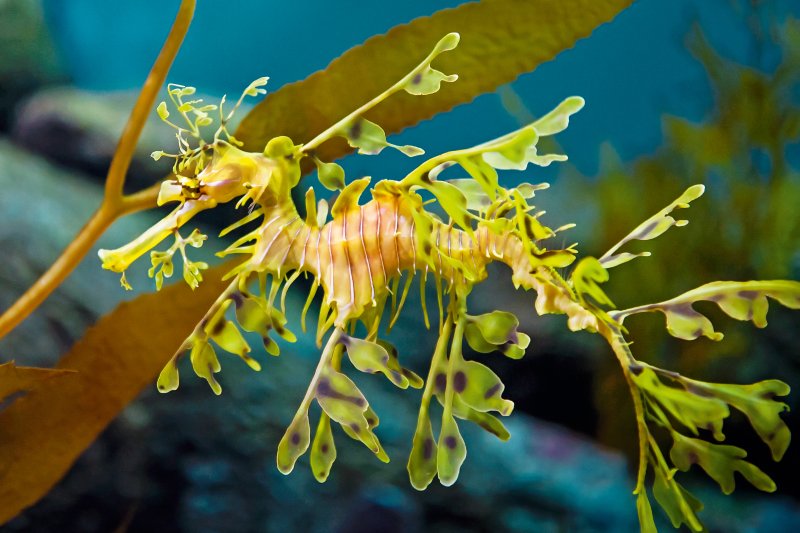
Unlike most animals here, the leafy sea dragon is one of the weirdest sea creatures a diver can actually hope to meet. Endemic to southern Australia, it can vanish so perfectly into kelp that you may stare straight at one before its shape suddenly comes into focus.
Leaf-like appendages cover the body, breaking up its outline as they sway with the surrounding vegetation. They are camouflage, not paddles. Small, almost transparent fins near the neck and tail provide propulsion, letting the animal drift through the kelp with barely a hint of movement.
The female places her eggs onto a special brood patch beneath the male's tail, where he carries them until they hatch. With their delicate leaf-like shapes and almost weightless movement, leafy sea dragons have become favorite sightings for marine-life divers.
Planning a leafy seadragon trip? Explore Leafy Seadragon dive sites on Scubago to find South Australian locations where divers can look for these masters of camouflage. SSI's stress-free international dive trips guide helps with logistics, and you can review DiveAssure insurance options before travel.
The final entry looks almost too delicate for the deep. Often nicknamed the pink see-through fantasia, Enypniastes eximia is one of the weirdest ocean animals, with a partly translucent body that can reveal its sediment-filled intestine.
Its soft body is perfectly suited to life near the abyssal seafloor, where it feeds on organic material in the sediment. Broad, fin-like flaps lift it away from the bottom, allowing it to swim through the dark water before settling back down to feed.
This species lives so deep that most people will only ever see it through deep-sea camera footage. Each new observation offers another glimpse of a fragile-looking sea cucumber swimming through darkness thousands of meters below the surface.
Want to see more of this deep-sea oddball? SSI's feature on Enypniastes eximia, the “headless chicken monster,”follows a rare sighting from the Southern Ocean.
These creatures show how many surprises the ocean still holds. Water covers more than 70 percent of the planet, yet huge areas of the deep sea remain unexplored. New marine species are discovered every year in forms that seem even stranger than those already known.
If these animals have sparked your curiosity, the SSI Marine Ecology Specialty helps explain how organisms, habitats, food webs, and ecosystems connect. Use the SSI Center Locator to find a Training Center or SSI Professional and keep building your understanding of the underwater world.
The ocean does not need fiction to feel otherworldly. Far below the light, bizarre ocean animals hunt with slingshot jaws, stand on fin stilts, drift behind transparent tissue, or rise above the seafloor in the darkness. And beyond the places we have explored, stranger creatures are almost certainly still waiting in the deep.
- SSI Marine Ecology Specialty – Learn how marine organisms interact with their habitats and discover the connections that shape life beneath the water.
- The Fascinating World of 8 Deep-Sea Creatures – Meet more remarkable animals adapted to darkness, pressure, and life far beyond recreational diving depths.
- SSI Center Locator – Find an SSI Training Center or Professional near you and explore the training options that can take your marine-life knowledge further.