Underwater 360 Camera: A Pro Photographer's Experience
scuba divingfreedivingextended rangemermaid
insta360
Table of Contents:
-
Underwater 360 Camera: Staying Aware While Filming
-
Reliving Your Dive Through Post-Production Framing
-
Insta360 X6: Underwater 360 Camera Highlights
-
Protecting the Reef Through Responsible Camera Positioning
-
The Diver's Takeaway
-
Personal Take: My Experience with 360 Cameras
-
How Underwater 360 Camera Stitching Works
-
My Underwater Camera Setup and Endless Possibilities for Divers
-
Conclusion: A New Perspective on Underwater Filming
-
About the Author: Timo Dersch
-
Dive Deeper
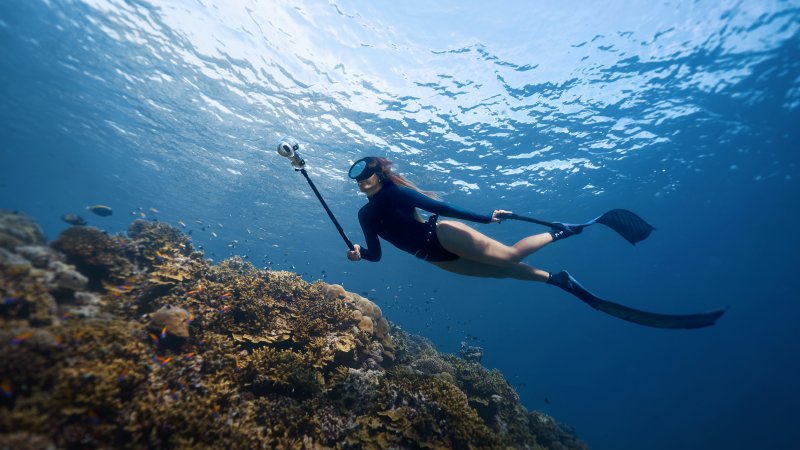
We have all been there. You are suspended in the deep blue, hovering above a flourishing coral garden. Out of the corner of your eye, a curious reef shark glides past, or a massive school of trevallies suddenly swirls into a shimmering silver cloud. You swing your action camera around, hoping to catch the moment, only to find you have captured empty water and a blur of bubbles.
Traditional fixed-angle cameras leave you torn between watching the scene unfold with your own eyes and staring through a viewfinder, missing the full sweep of the underwater world. An underwater 360 camera lets you capture what happens all around you.
As divers, our training teaches us situational awareness: keeping an eye on our buddy, checking our gauges, maintaining buoyancy, and scanning the blue for passing pelagic life. Why should filming our dives be any different? With 360-degree capture, underwater videography becomes less about chasing the perfect shot and more about staying present while the ocean unfolds around us.
With a standard directional camera, framing can easily steal your attention. You focus on keeping your subject in the shot, leaning awkwardly forward or finning backward to find the perfect angle. Before you know it, your buoyancy suffers, your buddy slips out of sight, or you lose track of your decompression limits.
A 360-degree camera takes much of that framing pressure away. Once it is securely mounted, it records the reef around you without constant adjustments. Instead of chasing every movement through the viewfinder, you can keep your attention on your breathing, buoyancy, and buddy while the camera captures the scene from every angle. Safety still comes first.
Good buoyancy control remains essential when filming underwater. The SSI Perfect Buoyancy Specialty helps you maintain better control and positioning, so you can focus on your dive without disturbing the reef.
One of diving's greatest joys is sharing your memories with non-diving friends or reliving a spectacular wall dive later that evening. With 360-degree footage, editing feels less like cutting clips and more like stepping back into the dive.
In post-production, you can reframe the footage to focus on a moray eel poking its head out of the wall, then pan out to reveal the towering drop-off behind you. Just like your memories of the dive, the footage brings together the vast underwater scenery and the smallest details of marine life.
Want to explore underwater photography further? Read SSI's Underwater Photography: 7 Beginner Tips To Get You Started for practical advice on camera handling, composition, and buoyancy control.
Image Name:
insta360-x6-underwater-camera-dive-case.jpg
Alt Text:
insta360
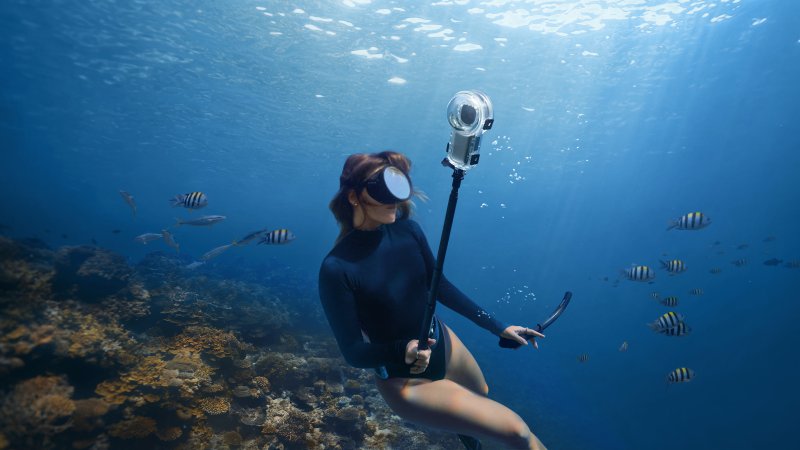
For divers looking to capture every angle, the Insta360 X6 offers stunning 8K 360-degree footage with dual custom 1/1.1-inch sensors. Waterproof to 20 meters (66 feet) without a housing, it can reach 60 meters (197 feet) with the Invisible Dive Case Pro. The case corrects underwater light refraction, helping create seamless footage without visible stitching lines.
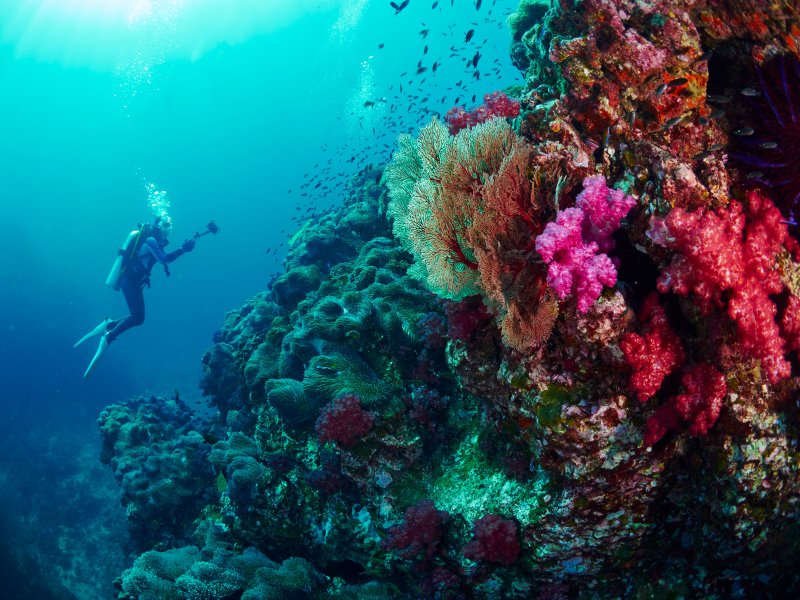
With any underwater camera, you might be tempted to get "just a little closer" to delicate corals or marine life. But an underwater 360 camera captures the scene from every direction, so you can film the reef without pushing your lens into crevices or hovering dangerously close to fragile branching corals.
iStock-para827-Reef-Diver
Mounting your camera on a stable pole or securing it safely to your equipment lets you capture sweeping views of the reef while keeping a respectful distance. This helps protect fragile marine life from accidental fin strikes or touches, reflecting SSI's commitment to ocean conservation and responsible diving.
Underwater videography should never pull you away from the quiet wonder of being beneath the surface. With 360-degree capture, you can spend less time staring at a viewfinder and more time enjoying the reef around you. You can keep a respectful distance from fragile marine life and bring home footage that captures the ocean in all its beauty.
As a professional underwater photographer, I had been curious about 360-degree cameras for years, but each time I tried one, I set it aside because the results never convinced me. The image quality was poor, the stitching unreliable, and I could not find much practical use for the footage. That changed when Insta360 released the X4 in 2024. The stitching finally worked consistently, and the improvements in their live underwater color correction genuinely amazed me.
360-degree cameras use two ultra-wide-angle lenses with overlapping fields of view. Software merges these two images through a process called stitching, hiding the camera body and mounting stick along the stitching line. And boy, has 360 camera stitching improved! Earlier models sometimes revealed the edge of a dive housing or a hand gripping the pole. Now, the two images blend together almost seamlessly, leaving no visible trace of the camera or its mount. The result is immersive underwater 360 video. On land, the same technology makes those famous "fake drone shots" possible. Underwater, it can look as though someone else is filming you, even when you are holding the camera yourself.
When it comes to color, I still find it hard to believe the footage comes straight out of the camera without professional color correction. Water that once looked greenish now reveals vivid colors. That striking difference comes from AquaVision 3.0, an algorithm that analyzes the footage and automatically adjusts the white balance. Instead of a washed-out green cast, the underwater scene comes back to life in color. I am also impressed by how it handles poor visibility. If you have used editing software before, imagine a "remove haze" slider working automatically as you film.
My little 360-degree camera sits on top of the housing of my big workhorse camera. I mount the little guy on a small ball arm in the middle of the large underwater photo housing, right where my regular action camera used to be. Now I can focus entirely on photographing marine life without constantly checking my 360 camera.
In this video of the sea lions, for example, I am watching them interact, ready to capture their behavior with my main camera. Meanwhile, my Insta360 X5 records everything happening around me, giving me behind-the-scenes footage without distracting me from the action.
This setup is convenient for me as an underwater photographer, but it also opens up possibilities for other divers who need their hands free. Imagine a technical diver mounting a 360-degree camera on a dive scooter, keeping both hands available for scooter control and gas management. Or a freediver pulling along a descent line with a chest-mounted camera, capturing the dive from different perspectives without having to frame every shot.
If you do not mount your camera on another camera housing or dive scooter, the Invisible Selfie Stick is a great alternative. Of course, the stick is not actually invisible. The software removes it from the footage, just as it hides the mount on my camera housing.
The extendable stick is particularly useful for filming marine life. Instead of approaching an animal with a large camera setup, you can keep your distance and capture its natural behavior, from feeding to unexpected encounters, without getting too close.
Image Name: underwater-360-camera-humpback-whales.jpg
Alt Text: Two humpback whales swimming underwater during an ocean encounter
Since the improvements in 2024, I have taken a 360-degree camera on every adventure. It has helped me capture moments I would otherwise have missed, like this incredible encounter when two humpback whalessuddenly appeared and caught me completely by surprise.
I am genuinely impressed by what the engineers and programmers have achieved. And I see great potential for recreational divers who simply want to capture stunning underwater footage, even without professional photography or videography skills.
How do you capture your underwater adventures? Do you enjoy the challenge of traditional wide-angle framing, or have you already experimented with 360-degree cameras to tell your diving stories? Share your favorite techniques in the comments below!
Timo Dersch is an award-winning underwater photographer and scuba diving journalist. He works with diving, nature, and adventure publications, including National Geographic, GEO, Scuba Diver, Tauchen, and many more.
Follow Timo Dersch on Instagram to explore more of his underwater photography and adventures.
Ready to capture your own underwater adventures from a new perspective? Explore the SSI Photo & Video Specialty and learn how to bring your underwater stories to life.