Floating summer school sets sail for Cape Town
environmentmarine researchoceanographyplankton diversityenvironmental conditionsmarine disciplines
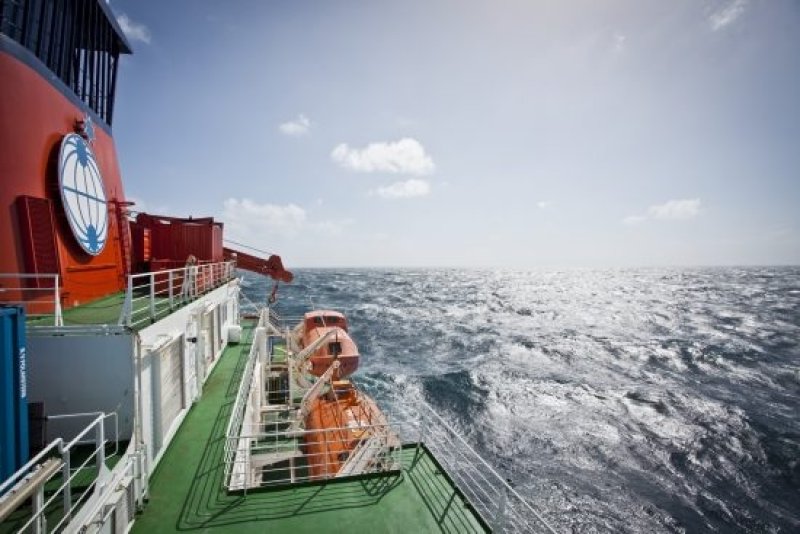
Yesterday, 29 October 2015, the research ship Polarstern left its home port of Bremerhaven with 32 students from 19 countries. It will sail to Cape Town, South Africa, and is expected there on December 1st. During the journey, the students will learn about the current methods and devices available for oceanography.
Accompanying them are nine teachers from the Alfred Wegener Institute for Polar and Marine Research, the Helmholtz Centre for Polar and Marine Research (AWI), the Free University of Berlin and Ireland’s Galway-Mayo Institute of Technology. This is the current batch of the floating Summer School. Four hundred and seventy applications from all over the world had been received for the 32 available openings in the North-South Atlantic Transect Training Programme (NoSoAT). After an earlier training expedition to investigate cold-water coral communities in the Atlantic with the Irish research vessel Celtic Explorer in 2014, this is the second Floating Summer School offered by the AWI, together with POGO (Partnership for Observation of the Global Oceans), Japan’s Nippon Foundation and Ireland’s SMART (Strategic Marine Alliance for Research and training). This programme also receives support from the Stiftung Mercator Foundation. "We have students of all marine disciplines on board, from geology to atmospheric research," said Prof Dr Karen Wiltshire, Chairperson of POGO and Vice Director of the Alfred Wegener Institute. She is also one of the expedition instructors, and will be in charge of one of the five projects which the young researchers would have to complete while working in small groups. The main focus of the voyage is the analysis of plankton communities (small algae and animals living in the water column). The expedition members will investigate how changing environmental conditions (as the ship travels from the North Atlantic through the tropics to the South Atlantic) affect plankton diversity. To do this, students will measure the basic physical, chemical and biological parameters of the ocean. For instance, they will analyse the temperature and salinity of seawater and use plankton nets to identify living organisms under a microscope. They will also explore how satellite imaging can be used to find out about species diversity in the ocean and carry out their own experiments. "I am looking forward to setting up a working hypothesis with the students, defining the study design, conducting experiments, and testing the hypothesis in the analysis," said Prof Dr Karin Lochte. Her project will help to familiarise the students with scientific working methods. "We also want to stimulate interdisciplinary discussions among the young researchers. Besides the daily presentations, the Polarstern herself offers the perfect setting. We’ll be spending several weeks together on board, which will give us plenty of opportunities to develop exciting ideas for new projects and collaborations," said the AWI director Dr Lochte. From her past experience, she had observed how expeditions can bring about numerous lasting connections. In addition to the training, the researchers also undertake atmospheric research as the ship makes its way from Bremerhaven to Cape Town. "We’ll also be testing and calibrating sounders, which out colleagues on the subsequent expeditions to the Antarctic will use to detect schools of fish in the water column," said Dr Rainer Knust, Scientific Coordinator of the Polarstern at the AWI. Source: http://www.awi.de/
Tento článek byl automaticky přeložen a může obsahovat drobné nepřesnosti; v případě pochybností se podívejte na originální anglickou verzi.