Current environment spells bad news for coralline red algae
environmentmarine lifemarine conservationcoral reefocean
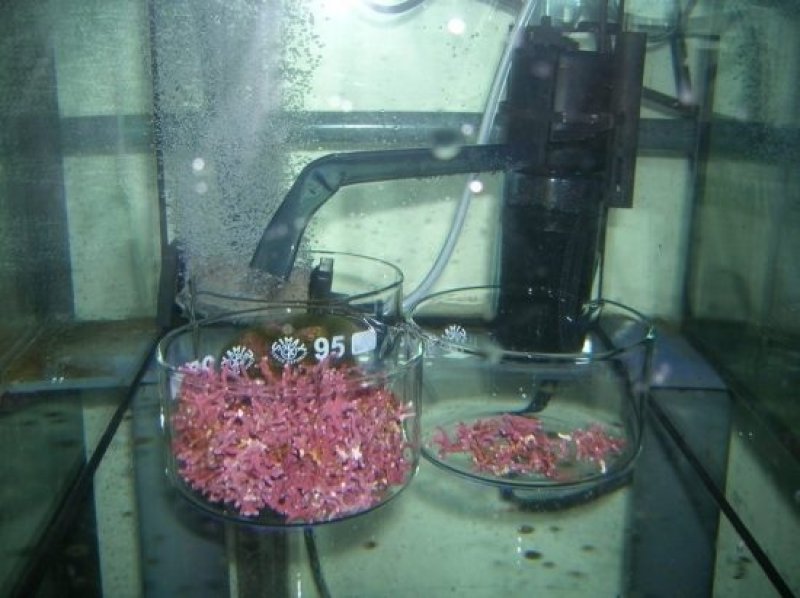
Samples of coralline red algae (Lithothamnion glacial) in the laboratory. (c) Federica Ragazzola
NGOs call for more rigorous implementation of legislation
Elevated levels of carbon dioxide in the atmosphere and increased ocean acidification is having a detrimental effect on the growth of coralline red algae (Lithothamnion glaciale), which is an essential builder within the marine environment.
Research has shown that the coralline algae's resistance to erosion would be lowered as the increased carbon dioxide concentration causes its skeletal structure to become more brittle and insufficiently calcified.
This has dire consequences for the marine ecosystem, as these coralline algae form maerl beds that are essential habitat, shelter and nursery areas for a wide variety of marine organisms, including some economically important fish species.
These findings are based on research and experiments conducted by scientists at the GEOMAR Helmholtz Centre for Ocean Research Kiel, Bristol University and the University of Western Australia. They have been published in the Scientific Reports journal.
The cell walls of coralline red algae usually consist of a form of calcite, which contains a large amount of magnesium. As they grow, they develop circular bands, somewhat like tree rings. The rings that emerge during summer contain more magnesium than those that grow during winter.
To measure the growth and accumulation of magnesium in the face of increased carbon dioxide conditions and ocean acidification, the researchers subjected the coralline red algae to two different conditions: at current and at projected levels of carbon dioxide concentration. Both the water temperature and light conditions were kept constant.
"Under elevated carbon dioxide concentrations, less magnesium was incorporated into the cell walls and the walls remained thinner than at current carbon dioxide levels. Even their structure changed," said Dr. Federica Ragazzola, biologist at the Institute of Marine Sciences at the University of Portsmouth. "We see two possible reasons for this: Either the algae exchanged the high-magnesium calcite against a less soluble composition or they lost part of the calcite due to acidification. But in any case, Lithothamnion loses its elasticity and hardness and can be damaged more easily," she said. The researchers therefore suspect that the algae would not be able to maintain its important role as an ecosystem builder.
Since changes in temperature and light intensity can be ruled out as reasons for the decline in magnesium concentrations, the researchers have proposed that it is the direct result of ocean acidification. This conclusion has implications when one considers the reconstruction of the climates of past geological eras.
"The ratio of magnesium to calcium in coralline algae has been used as temperature recorder. But since our samples were kept constantly at seven degrees Celsius, changes in magnesium concentrations cannot be related to temperature. Without pH information, temperature reconstruction from magnesium to calcium ratios of such algae could be rather misleading," said Dr. Jan Fietzke from GEOMAR.
Link to study: http://www.nature.com/articles/srep20572
Ця стаття була автоматично перекладена та може містити незначні неточності; у разі сумнівів зверніться до оригінальної англійської версії.