Is Scuba Diving Dangerous? Safe Scuba Diving During Your First SSI Course
scuba diving
predrag_vuckovic
Learning to scuba dive is one of the most exciting adventures you can experience.
The moment you take your first breath underwater and realize you can explore a new world is unforgettable. Coral reefs, colorful fish, historic wrecks, and quiet underwater landscapes suddenly become accessible.
Still, many beginners ask the same question before they start: “Is scuba diving dangerous?”
Scuba diving does involve risk. That is why proper training, good equipment, clear communication, and professional guidance matter. With the right support, safe scuba diving starts from your first course.
For most people, this journey begins with the SSI Open Water Diver course. During your training, you learn the essential skills needed to dive safely and confidently.
Underwater, you rely on your equipment, your training, your buddy, and the guidance of dive professionals. This is especially important during the early stages of learning.
If you are about to begin your first dive course, here is what you should know about staying safe during your SSI training and why proper dive coverage is part of responsible dive planning.
Table of Contents:
-
The SSI Approach to Safe Scuba Diving
-
Your Instructor: A Key Safety Factor
-
Understanding the Dive Buddy System
-
Common Challenges for New Divers
-
What Happens if Something Unexpected Occurs?
-
Why Dive Insurance Matters
-
Building Safe Scuba Diving Habits from Your First Dive
-
The Beginning of Your Diving Journey
-
Dive Smart, Dive Prepared
-
Dive Deeper[MB17]
Scuba Schools International (SSI) has designed its training system around a simple principle: divers should feel comfortable, confident, and capable before progressing.
That matters when answering the question, “Is scuba diving dangerous?” Diving becomes safer when new divers learn step by step and practice important skills before entering open water.
The SSI Open Water Diver course consists of three main components:
- Academic learning
- Pool or confined water skill practice
- Open water dives
Each stage builds your understanding of diving physics, equipment, safety procedures, and underwater awareness.
Before entering the ocean or a lake, you first practice in a pool or confined water environment. Your instructor guides you through fundamental techniques such as:
- Breathing through a regulator
- Clearing water from your mask
- Recovering and clearing your regulator
- Controlling buoyancy
- Communicating with hand signals
- Practicing emergency procedures with a buddy
These skills form the foundation of safe scuba diving.
By the time you complete your open water dives, you will have practiced them several times in controlled conditions. This step-by-step training helps new divers stay calmer and make better decisions underwater.
During your training period, before receiving your certification, you may receive StartDive coverage free of charge, provided by DiveAssure.
The DiveAssure StartDive plan covers decompression sickness that may occur during dives up to 18 meters (60 feet), with coverage of up to €30,000. Students should always review the current plan terms before training.
mares
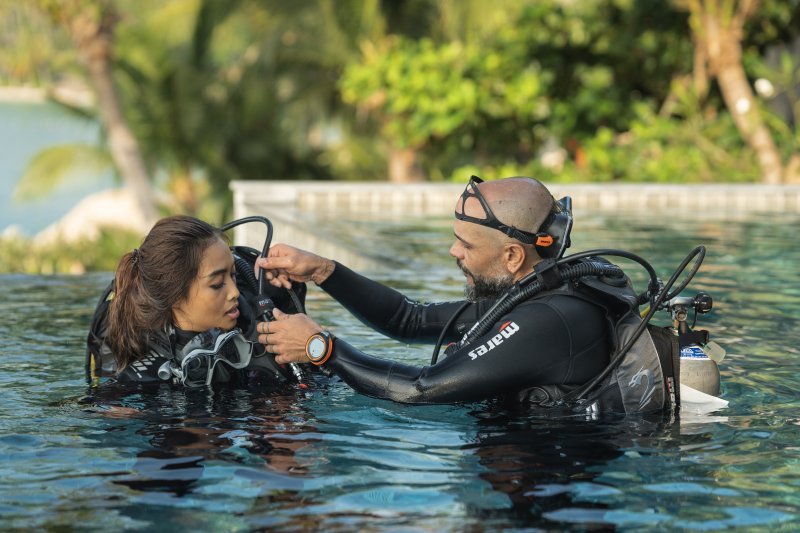
During your course, your SSI instructor plays a vital role in your safety and progress.
SSI instructors teach both the practical and theoretical parts of scuba diving. They help you understand what to do, when to do it, and why it matters.
Your instructor is trained to:
- Identify potential risks early
- Check that equipment is properly fitted and functioning
- Monitor students underwater
- Guide divers through skill practice
- Manage unexpected situations calmly
A good instructor will encourage you to ask questions and will never rush your progress.
You should always feel comfortable taking the time you need to learn. This is an important part of safe scuba diving. Building confidence is just as essential as learning the technical skills required for diving.
From your first dive onward, you learn one of diving's most important safety principles: the buddy system.
Divers dive with a partner who helps increase safety and awareness underwater.
Your dive buddy helps you:
- Check your equipment before entering the water
- Monitor your air supply
- Stay aware of your surroundings
- Assist if a problem occurs
Many training skills, such as air sharing and controlled ascents, are based on working together with a buddy.
The buddy system not only increases safety. It also makes the overall experience more memorable. Sharing underwater discoveries with someone else is part of what makes diving special.
If someone asks, “Is scuba diving dangerous?”, the buddy system is one clear example of how safe scuba diving depends on support, communication, and teamwork.
When you begin your diving journey, it may also be worth considering full diving accident coverage for future dives.
For more practical advice after certification, the SSI blog 9 Essential Tips to Become an Excellent Diving Buddy helps new divers understand how to become more reliable dive partners.
mares
Most SSI courses run smoothly, but new divers sometimes experience small challenges during training.
These are normal and part of the learning process.
As you descend underwater, pressure increases. Your ears must equalize to match this pressure.
If you descend too quickly or forget to equalize, you may feel discomfort. This can usually be avoided by:
- Descending slowly
- Equalizing frequently
- Communicating with your instructor
Your instructor will teach you how to equalize safely and comfortably.
Mask fogging is common for beginners.
Early in your training, you learn how to prepare your mask and how to clear water from it underwater. At first, this can feel unfamiliar. Once you understand the technique, clearing a mask becomes quick and manageable.
Buoyancy control is the ability to hover and stay balanced in the water.
At first, adjusting buoyancy using your breathing and buoyancy compensator may feel unfamiliar. With guidance and repetition, most divers quickly become more comfortable moving calmly underwater.
These small challenges are one reason beginners may ask, “Is scuba diving dangerous?” They are also the reason training exists. Safe scuba diving starts with practicing these situations before they become stressful.
Training dives are carefully supervised, but unexpected situations can still occur.
These might include:
- Minor injuries such as cuts or small pressure-related injuries
- Equipment issues causing stress or discomfort
- Medical concerns related to underlying conditions
- Ending a dive early due to discomfort or equipment problems
In rare cases, divers may require medical treatment.
This is why dive training organizations emphasize preparation and careful planning. Having comprehensive diving accident coverage, such as a DiveAssure plan, can help ensure assistance is coordinated quickly if an emergency occurs.
The SSI blog Dive Safety – 15 Essential Tips For New Divers is a helpful follow-up resource because it reinforces practical habits for safe scuba diving before, during, and after a dive.
Many new divers assume their regular travel or health insurance will cover scuba diving incidents.
In reality, many policies exclude diving or provide limited coverage.
Dive-specific insurance is designed to address the unique risks divers may encounter.
Some diving injuries require specialized treatment, such as hyperbaric therapy for decompression sickness.
Hyperbaric chambers are specialized facilities, and treatment costs can be significant, especially in remote locations or abroad. Dive insurance helps ensure these treatments can be arranged quickly if necessary.
Many dive locations are far from major hospitals. If urgent treatment is needed, evacuation by boat, ambulance, or aircraft may be required.
Coordinating and funding such evacuations can be complex without proper support. Dive-specific coverage ensures divers have access to emergency evacuation assistance when needed.
Many divers complete their SSI course while traveling internationally. If a medical issue occurs during a dive trip, navigating a foreign healthcare system can be stressful.
DiveAssure travel assistance provides multilingual medical coordination that can help divers communicate with hospitals and arrange treatment when needed.
Dive insurance is not meant to make diving feel risky. Instead, it provides reassurance.
When the right support is in place, you can focus on learning new skills, listening to your instructor, and enjoying your first dives.
For this reason, many dive centers encourage students to consider dive-specific coverage before beginning their training. It is a practical part of safe scuba diving, especially for new divers who plan to continue diving after certification.
For more background, the SSI article Scuba Diving Insurance – Do We Really Need It? explains why regular travel insurance and dive-specific coverage are not always the same.
predrag-vuckovic
Your SSI course is more than just a certification. It is the beginning of your life as a diver.
The habits you develop during training will remain with you throughout your diving journey.
Important habits include:
- Performing pre-dive safety checks
- Diving within your training limits
- Monitoring your air supply
- Communicating clearly with your buddy
- Planning dives carefully
- Continuing your diving education
Divers who follow these principles often enjoy many years of safe and rewarding diving.
So, is scuba diving dangerous for new divers? It can involve risk, as every adventure sport does. But training, awareness, safe scuba diving habits, and responsible planning help manage those risks from the beginning.
Earning your SSI Open Water Diver certification opens the door to new dive experiences.
You may explore tropical coral reefs, dive around volcanic islands, encounter marine life, or photograph underwater ecosystems.
The most important thing to remember is that great diving begins with preparation.
Training, awareness, and proper safety measures help keep your underwater adventures positive. By learning from experienced instructors, following safe diving practices, and making responsible decisions, you can keep building confidence with every dive.
Safe scuba diving starts with the choices you make from your first course onward: listen carefully, dive within your limits, communicate clearly, and stay prepared.
Your first dives will be unforgettable.
The calm silence underwater, the excitement of seeing your first reef fish or sea turtle, and the sensation of gliding through the ocean are experiences unlike any other.
Approach your training with curiosity and patience. Listen to your instructor, stay aware of your buddy, and always be prepared.
Good dives start with confidence, preparation, and calm decision-making.
Your underwater journey is just beginning. Dive safely and enjoy every moment of it.
If you are planning your next dive course or dive trip, make sure you are properly covered with DiveAssure.