Scientists discover the oldest colours in the world
environmentmarine lifeancient pigmentscyanobacteriageological recordphotosynthesis
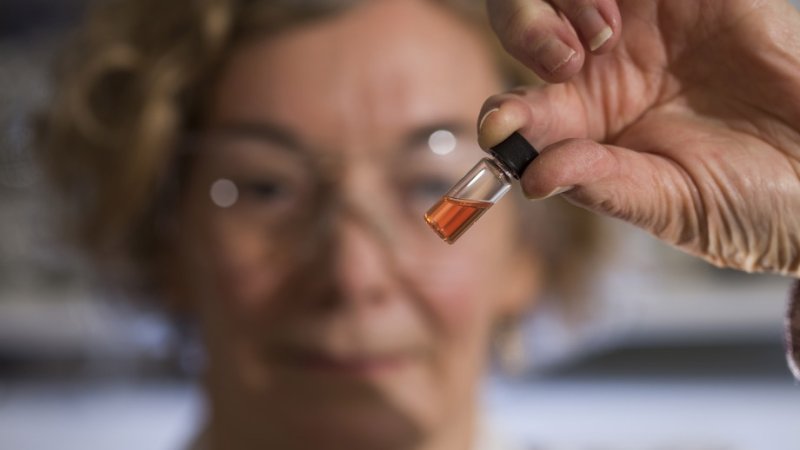
Pink pigments of cyanobacteria are 1.1 billion years old
Scientists have discovered the oldest colours: a geological record. The 1.1 billion year old bright pink pigments were extracted from rocks deep in the Sahara in Africa. Dr. Only Gueneli of Australia National University (ANU) points out that the pigments extracted from marine black shales of the Taoudeni Basin in Mauritania, West Africa, are more than half a billion years older than earlier pigment findings. Dr. Gueneli discovered the molecules as part of her doctoral thesis. The bright pink pigments are the molecular fossils of chlorophyll produced by pre-mature photosynthetic organisms in an ancient ocean that has long since disappeared, " Dr. Gueneli from the ANU Research School of Earth Sciences. The colours of the fossils range from blood red to dark purple in concentrated form and bright pink in diluted form. The researchers crushed the billion-year-old rocks into powder before extracting and analyzing molecules from old organisms. Exact analysis of the old pigments confirmed that tiny cyanobacteria, one billion years ago, dominated the food chain in the oceans, which explains why there were no animals at that time, " explains Dr. Güneli. Professor Jochen Brocks of the ANU and lead author of the new study, which appeared recently in the Proceedings of the National Academy (PNAS), says that the emergence of large, active organisms had been inhibited due to a limited supply of larger food particles, such as e.g. Algae. Although algae are still microscopically small, they are a thousand times larger in volume than cyanobacteria and are a much richer source of food. The cyanobacterial oceans began to disappear about 650 million years ago as the algae spread rapidly to provide the energy needed for the development of complex ecosystems in which large animals, including humans, could live on Earth ," explained Dr. Brocks. Link to the study: http://www.pnas.org/content/early/2018/07/03/1803866115 Video:
www.youtube.com/watch?v=HbKNm9tVNI8
Овај чланак је аутоматски преведен и може садржати мање нетачности; уколико имате недоумица, погледајте оригиналну енглеску верзију.