Dive Rescue Skills Every Diver Should Know (and How to Keep Them Sharp)
scuba divingfreedivingextended range
SSI
Every diver hopes they will never need to handle an emergency underwater, but preparation is what turns a stressful moment into a manageable one. Strong dive rescue skills are not just for professionals; they are essential for anyone who wants to be a confident, responsible buddy.
From recognizing early signs of stress to responding calmly when something goes wrong, these skills can prevent small issues from becoming serious incidents. This guide walks through the core emergency and dive rescue skills every diver should understand, why they matter, and how to keep your rescue skills sharp.
Table of Contents:
-
Why Do Emergency and Dive Rescue Skills Matter?
-
Basic First Aid for Divers
-
Recognizing Stress and Preventing Panic
-
Managing Common Underwater Emergencies
-
Surface Rescue and Exits
-
Essential Safety and Rescue Gear
-
How to Keep Your Dive Rescue Skills Sharp
-
What Training Do Divers Need?
-
Find Emergency and Dive Rescue Training Near You
Diving is an adventure sport that depends on teamwork. Even on calm days with perfect visibility, unexpected situations can arise, including equipment problems, fatigue, medical issues, or environmental changes. Solid dive rescue knowledge allows divers to respond quickly, protect themselves, and assist others without escalating risk.
Being prepared also changes how divers approach every dive. Awareness improves, communication becomes clearer, and small warning signs are noticed earlier. Many incidents are avoided entirely because a diver with dive rescue awareness recognizes stress before panic sets in.
Basic first aid is the foundation of all emergency response, both on land and at sea.
Divers should be comfortable with:
- Performing cardiopulmonary resuscitation
- Controlling bleeding
- Treating shock
- Managing common injuries such as cuts, sprains, and heat or cold exposure
First Aid skills are critical because professional medical help may be far away, especially at remote dive sites.
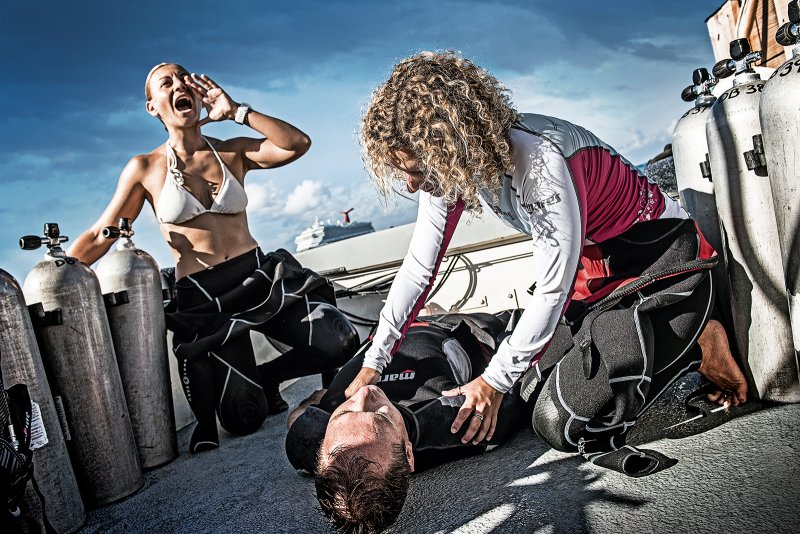
Knowing how to assess a situation calmly is just as important as hands-on care. First aid training teaches divers how to prioritize actions, protect themselves, and support an injured person until help arrives. In the context of dive rescue, first aid knowledge bridges the gap between bringing a diver safely out of the water and ensuring they receive proper medical attention.
Learn how to perform an emergency swimming ascent when a diver cannot share air with their buddy.
One of the most important dive rescue skills is recognizing stress before it turns into panic. Stress can show up as rapid breathing, erratic movements, wide eyes, or poor buoyancy control.
Underwater, these signs may be subtle, but experienced divers learn to spot behavioral changes quickly.
Intervening early often means slowing things down, establishing eye contact, and encouraging controlled breathing. Simple actions, such as holding onto a stable object or ascending a few meters (several feet), can dramatically reduce stress.
Preventing panic protects both the distressed diver and the rescuer, making this a cornerstone of effective dive rescue response.
LEARN MORE: 8 Top Ways to Make Shore Diving Easy
Out-of-air situations, equipment failures, and disorientation are among the most common underwater emergencies. Responding well depends on practiced skills, calm decision-making, and clear communication with your buddy. Air-sharing, controlled ascents, and buoyancy control are core rescue skills and should be practiced regularly.
Assisting an unconscious diver is more complex and requires formal training. Divers need to establish positive buoyancy, secure the airway, and manage a controlled ascent while monitoring depth and ascent rate.
These scenarios show why structured rescue training matters—guesswork underwater increases risk for both the rescuer and the diver in distress.
Demonstration of removing an unconscious diver from the water with assistance.
Many emergencies escalate at the surface, especially in waves, currents, or strong winds. Once a diver reaches the surface, the focus shifts to flotation, breathing, and signaling for help. Inflating buoyancy devices and removing heavy equipment may be necessary to keep both divers safe.
Exiting the water safely is another key part of dive rescue skills.
Ladders, shore exits, or boat recovery each present different challenges. Training helps divers choose the safest method based on conditions, ensuring that the effort of the rescue does not lead to exhaustion or further injury.
LEARN MORE: Why Every Diver Needs the NEW SSI Science of Diving Program
Having the right equipment can make a significant difference during an emergency. Tools such as dive knives or cutting devices help manage entanglement hazards, while surface signaling devices allow divers to attract attention quickly. A surface marker buoy, often called a safety sausage, is especially valuable during drift dives or low-visibility conditions.
These tools support dive rescue efforts by improving communication and reducing response time. Carrying and knowing how to use safety equipment is part of being a prepared diver.
At-a-Glance Gear Recommendations:
predrag_vuckovic
Carrying and knowing how to use basic safety equipment is part of being a prepared and responsible diver.
Rescue skills fade without use. Treat them like buoyancy or gas management—something you maintain, not something you learn once.
Before each dive, agree on simple rescue protocols with your buddy. Confirm air-sharing procedures, separation plans, and exit options. This takes minutes and removes hesitation if something goes wrong.
Build skill refreshers into regular diving. Practice controlled ascents, mask clears, and buoyancy adjustments in low-stress conditions so they stay automatic under pressure. After dives, review any moments of confusion or hesitation and adjust your approach next time.
Keeping rescue skills current makes you a calmer diver and a safer buddy. It also reduces stress when conditions change or small problems appear unexpectedly.
EXPEDITION NEWS: Antikythera: Scientific Diving on a 2,000-Year-Old Wreck
Practical experience is essential, but structured training brings everything together. These programs transform theory into real-world dive rescue capability, empowering divers to act when it matters most:
The SSI React Right program provides comprehensive training in first aid, cardiopulmonary resuscitation, oxygen administration, and emergency response. It builds the medical foundation every diver needs to support effective dive rescue actions.
The SSI Diver Stress & Rescue program focuses on prevention, situational awareness, and hands-on rescue scenarios. Divers learn how to manage stress, assist others, and handle complex emergencies with confidence.
Learning about emergency and rescue skills is a strong first step. Practicing them with qualified instructors helps make these responses automatic under pressure. Ready to build real-world dive safety skills?
Join SSI's React Right and Diver Stress & Rescue programs to learn how to help yourself and support other divers in emergencies. Contact your nearest SSI Training Centre to get started:
Find Your Nearest SSI Training Center Here
Dive Deeper into Your Skills