Scientists explore new underwater volcano in submersible
environmentunderwater explorationmarine geologysubmarine volcanohydrothermal activity
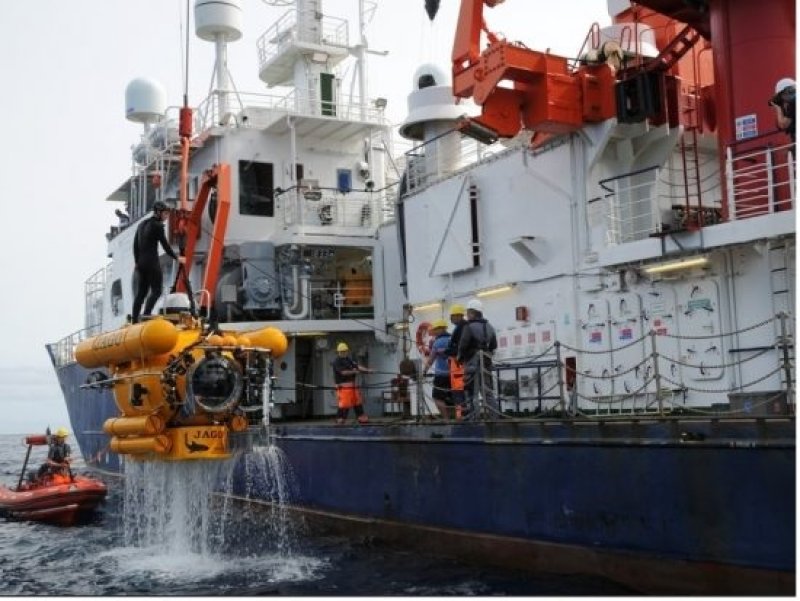
JAGO being brought on board the POSEIDON after a dive off El Hierro. Photo: Maike Nicolai, GEOMAR
A team of scientists embarked on a recent expedition off the coast of El Hierro to examine a new submarine volcano. The scientists, hailing from the University of Las Palmas de Gran Canaria (ULPGC), the Spanish Oceanographic Institute (IEO, Centro Oceanográfico de Canarias) and the GEOMAR Helmholtz
Centre for Ocean Research Kiel ventured underwater in the submersible "JAGO" to make their observations and collect samples firsthand. At the same time, they also examined a secondary crater which still continues to emit hot water over an area of 100 square metres. The island of El Hierro is the newest and most geologically active in the Canary Islands archipelago. It had remained silent for 500 years, until a new volcano emerged offshore, near the coastal town of La Restinga. Concerns over the town's safety led to extensive research on the matter. However, it was only now, more than four years later, that scientists were able to conduct an on-site investigation of the new volcano. Travelling on board the German research vessel POSEIDON, a team of scientists from various organisations were at the scene from February 7th to 15th. Using the JAGO submersible, they documented the site and ongoing hydrothermal activity, and collected samples of gases, liquids and other volcanic and hydrothermal substances. The VOLCANO project has monitored the volcanic unrest of El Hierro since the eruption in October 2011. But on the recent expedition, we benefitted from the unique opportunity to assess the ongoing activity at the seafloor using the submersible JAGO, said Prof Juana Magdalena Santana Casiano, a chemical oceanographer from the Instituto de Oceanografía y Cambio Global at ULPGC. She has studied the physical-chemical perturbations caused by
the submarine volcano that had caused significant changes in the composition of the local plankton communities. Our findings highlight the potential role of this degasification stage as a natural ecosystem-scale experiment for the study of the effects of global change stressors on marine environments, she added. In 2014, the remotely operated vehicle (ROV) Liropus 2000 documented what appeared to be extensive deposits of iron-oxide crusts, bacterial mats and low-temperature vents near the summit of the volcano. The following year, the plume of gas and highly acidic water shifted to the southeast portion of the summit, and now, it has focussed itself at a depression on the upper flank of the volcano. A sample of the fresh volcanic glass in the crater – taken by JAGO – indicates that this is the newest feature of the volcano. During their JAGO dives, Prof Casiano and Dr Fraile Nuez observed that this secondary crater had very fresh ash and scoria coated in iron oxides. Water at temperatures of 39 degrees Celsius was being emitted from the bottom of the crater, spreading over an area of several 100 square metres. There was more focussed discharge at smaller vents, with chimneys five centimetres high. There was a thin layer of bacteria on all the surfaces around the vents. Above the
crater, the water was clouded by a milky white plume, which is likely to comprise suspended particles of amorphous silica from the chimneys. Ever since the volcano started its new degasification stage three years ago, the scientists had recorded significant physical-chemical anomalies in the water column. JAGO allowed us to corroborate our first findings and to witness the process that created these
irregularities with our own eyes. Even more importantly, we were able to measure their origins, said Dr Nuez. However, the causes of the anomalies are still unknown. The water, gas and rock samples that have been collected are now being studied in the home laboratories of the participating institutions. All institutions are cooperating closely to find out more about the processes taking place at the seafloor. The new findings show that since the crisis of 2011, the volcano has been bathed in warm water as the subvolcanic magma cools. Thus it is important to continue monitoring the volcano to assess the impact of the ongoing activity, said Prof Mark Hannington, marine geologist at GEOMAR and chief scientist of the expedition. Info: www.geomar.de
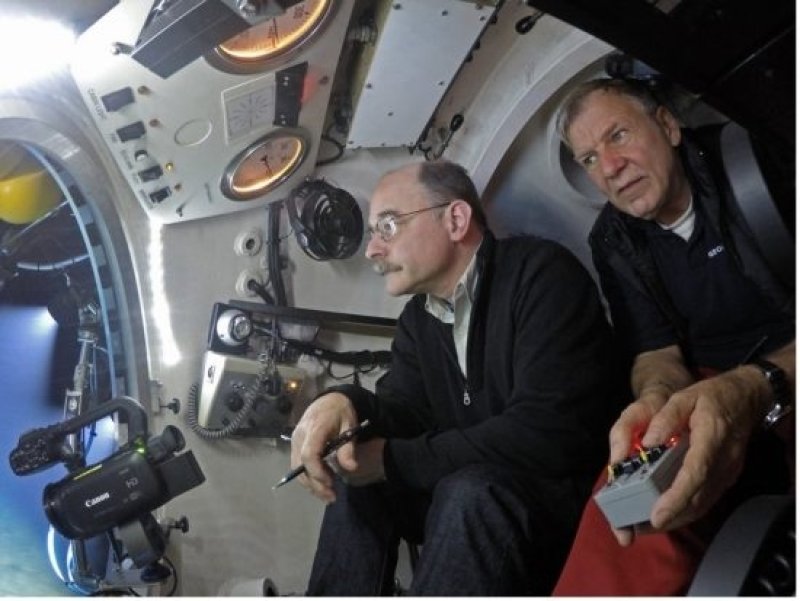
Prof. Mark Hannington and pilot Jürgen Schauer (GEOMAR) inside JAGO. Photo: JAGO team GEOMAR
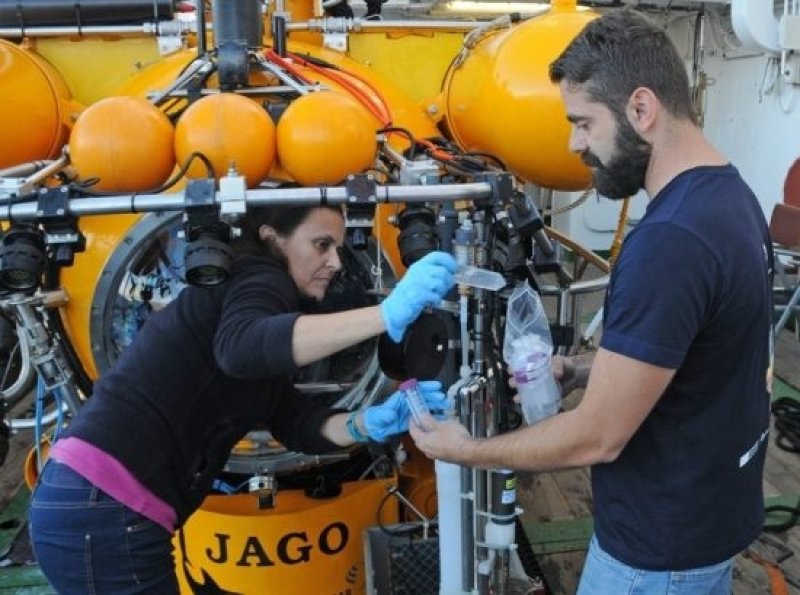
Prof. Juana Magdalena Santana Casiano (ULPGC) and Dr. Eugenio Fraile Nuez (IEO) tap gas and water samples after a JAGO dive. Photo: Maike Nicolai, GEOMAR
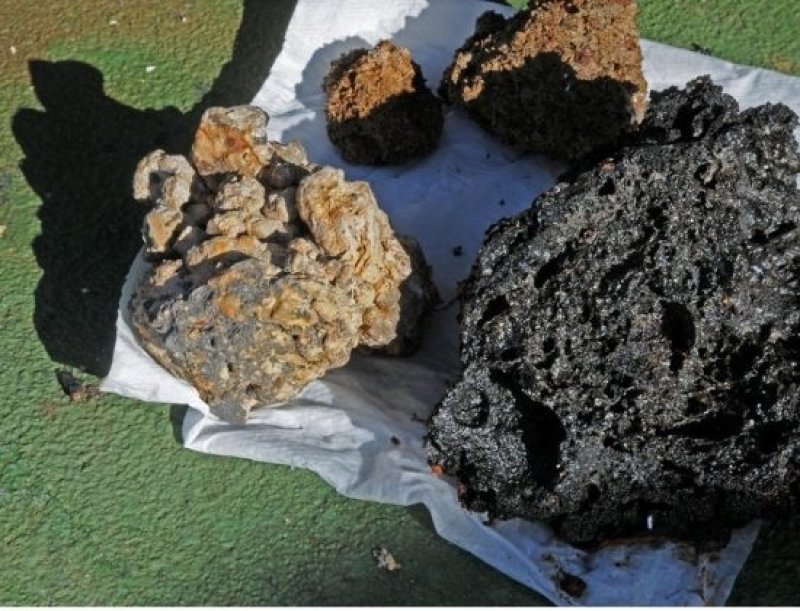
Rock samples from the submarine volcano off El Hierro. Photo: Maike Nicolai, GEOMAR
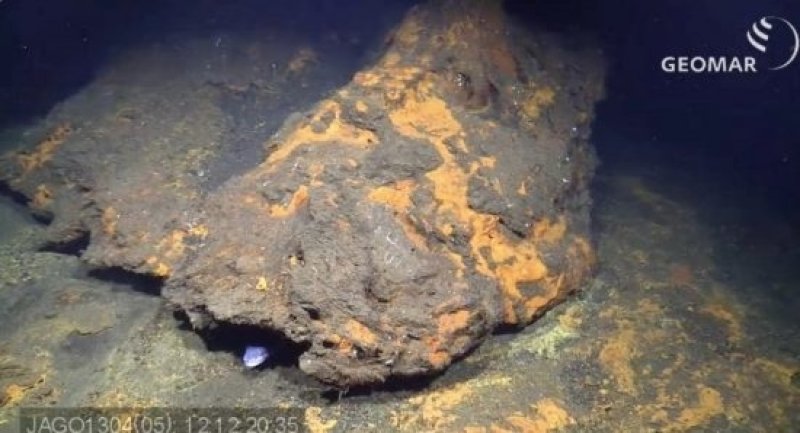
High concentrations of iron oxides can be seen in this area, which also serves as a home for conger eels (205m deep). In the photo, the head of one of these eels can be seen.
Овај чланак је аутоматски преведен и може садржати мање нетачности; уколико имате недоумица, погледајте оригиналну енглеску верзију.