How do you weigh a living whale?
environmentfreedivingextended rangetechnologymarine researchwhalesdrone photography
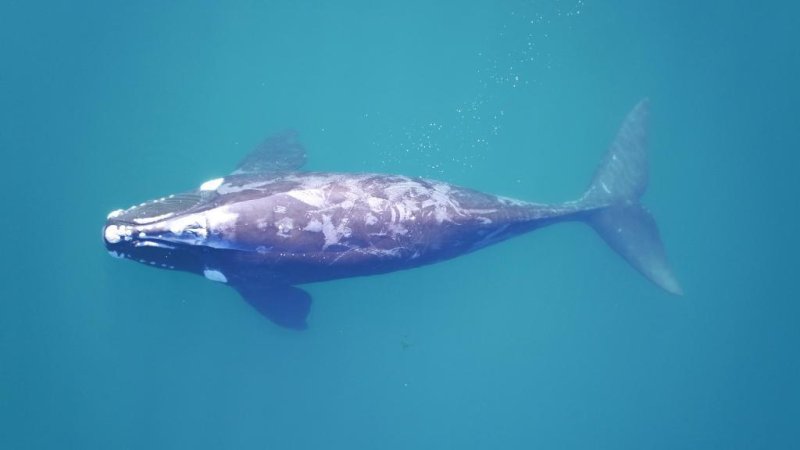
A southern right whale emerges in the clear waters off the Península Valdés coast, Photo: © Fredrik Christiansen, Aarhus Institute of Advanced Studies
New technique uses drone photos to weigh whales Fredrik Christiansen of the Aarhus Institute of Advanced Studies and colleagues have developed a method to accurately estimate the weight of free-living whales. Here, aerial images of drones are used. The new method has now been presented in the British Ecological Journal Methods in Ecology and Evolution. Because of their size alone, and because they live in the open ocean, so far the only way to get data about the body mass of whales has been to weigh dead or stranded individuals. By measuring the body length, width, and height of free-living southern right whales photographed by drones, researchers have now succeeded in creating a model (link to: https://sketchfab.com/3d-models/model-55a -southern-right-whale-3bddfdfafc6c43758df9b94bc9e0fe9e), which accurately calculates body volume and mass of whales. "Knowing the body mass of wild whales is striking new paths of research, and we will now be able to study the growth of the animals to calculate their body mass increase over time and the energy requirements for growth. We will be able to analyze the daily energy needs of whales and calculate how much prey they need to consume," explains Fredrik Christiansen of the Aarhus Institute of Advanced Studies, lead author of the study. Baleen whales, which include species such as the blue whale, are the largest animals on earth; their body mass as key-factor to their success as an animal group. However, the data on their size has historically been limited to dead specimens, with most samples being from whaling, accidental bycatch or stranding. Collecting data on dead whales has limitations and inaccuracies due to physical distortions of the carcasses caused by bloating and deflation. To calculate the body volume and mass of southern right whales, Christiansen and his associates first took aerial photographs of 86 individuals off the coast of Península Valdés, Argentina. The clear waters and large numbers of whales gathering there every winter at mating season make it an ideal place to collect high quality images of the whales from which they measure length, width and height. These measurements could then be used to accurately model the body shape and volume of the whales. "We used this model to estimate the body volume of whales caught in scientific whaling operations for which body circumference and mass were known, and from these estimates of body size and mass we were then able to calculate the density of whales we were using - in turn, could calculate the weight of most of the free-living whales (which where photographed by our drones)," said Fredrik Christiansen. Although the model yielded body mass estimates with high accuracy, there were some limitations due to the relative proportion of various tissues in baleen whales. As Fredrik Christiansen explains: "We had to assume a constant body density of the whales, which is not realistic, because the proportion of different body tissues (fat, muscle, etc.) changes seasonally." Link to the study: https://besjournals.onlinelibrary.wiley.com/doi/10.1111/2041-210X.13298. Video: https://youtu.be/IrMyxqVds9I Southern Right Whale with calf in the clear waters of Península Valdés, Argentina, Video: © Fredrik Christiansen, Aarhus Institute of Advanced Studies

Southern Right Whale with calf in clear water, Photo: © Fredrik Christiansen, Aarhus Institute of Advanced Studies
Cet article a été traduit automatiquement et peut contenir des inexactitudes mineures ; veuillez vous référer à la version anglaise originale en cas de doute.