Scientists highlight threat to oceans before major climate change conference
environmentmarine conservationclimate changeocean acidification
To safeguard the future survival of our planet and ocean, ambitious climate objectives and a reduction in greenhouse gas emissions are needed, said marine biologists Prof Dr Hans Otto Pörtner and Prof. Dr. Ulf Riebesell, ahead of the Paris World Climate Conference at the breakfast meeting of the German Climate Consortium DKK) German Marine Research Consortium KDM) Pörtner , a biologist at the Alfred Wegener Institute, Helmholtz Centre for Polar and Marine Research and the newly elected Co Chair of IPCC Working Group II, described the projected risks for the oceans brought about by climate change: global warming, rising sea levels and ocean acidification. In addition to the tropical coral reefs, the sea ice regions in the Arctic are also considered to be the more vulnerable ecosystems.
Presently, the critical change thresholds for organisms and ecosystems and the resultant risks are analysed and represented in temperature. According to P örtner, the human-induced warming of global temperatures must be limited to 1.5 degrees Celsius, rather than 2 degree Celsius. He added that in the case of coral reefs, fifty percent of them can be preserved if the increase in temperature is limited to 1.2 degree Celsius—however, this figure does not take into account the effects of ocean acidification. Ocean acidification: Oceans changed by greenhouse gases One of the greatest climate risks for the oceans is acidification: 24 million tons of carbon dioxide is absorbed into the ocean every day. This works out to about one-third of the pre-industrial carbon dioxide released, thus mitigating the effects of climate change. Today, the carbon dioxide uptake of the ocean averages 28 percent higher than in pre-industrial times. If the emissions are left unchecked, the ocean’s acidity will more than double by the end of this century. The more acidic the oceans become, the less carbon dioxide they can absorb from the atmosphere. "The rate of projected ocean acidification is unprecedented in Earth's history," asserted Riebesell, Professor of Biological Oceanography at GEOMAR Helmholtz Centre for Ocean Research Kiel.
"Above all, calcifying organisms are among the losers of ocean acidification, in addition to corals, mussels, snails, sea urchins, starfish and many calcifying plankton."
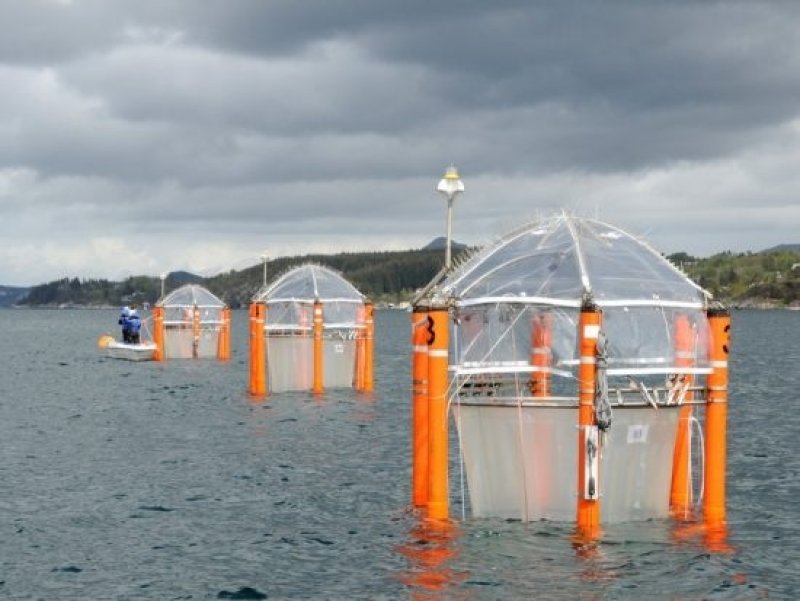
GEOMAR field experiment in Norway: Winners and losers of acidification Riebesell had first presented the results of a field experiment conducted in spring 2015 in the Norwegian Raunefjord, south of Bergen. It highlighted the effects of ocean acidification within several mesocosms (closed experimental systems set up to simulate biological, chemical and physical processes) in the fjord over the course of several months. It was discovered that some species
like the winged snails and calcareous algae would not be able to survive the effects of ocean acidification, unlike the picoplankton, micro-organisms at the bottom of the food chain. Hence, Riebesell concluded that small changes in the ecosystem could have huge consequences and revolutionise not only the food web in the ocean, but also affect aquaculture and fisheries. Climate change and ocean acidification
The problem of ocean acidification is the result of carbon dioxide emissions by human activities. The interaction of environmental factors on the marine organisms, as well as man-made changes (like eutrophication and pollution) leads to complex changes in the ecosystem, migration of species and an overall decrease in biodiversity. Even now, we are just starting to understand the implications of such changes in our environment.
Source: http://www.geomar.de
Αυτό το άρθρο μεταφράστηκε αυτόματα και ενδέχεται να περιέχει μικρές ανακρίβειες. Σε περίπτωση αμφιβολίας, ανατρέξτε στην πρωτότυπη αγγλική έκδοση.