Deep Sea: Five new species of sea slugs discovered
environmentoceannudibranchsmarine biologydeep sea
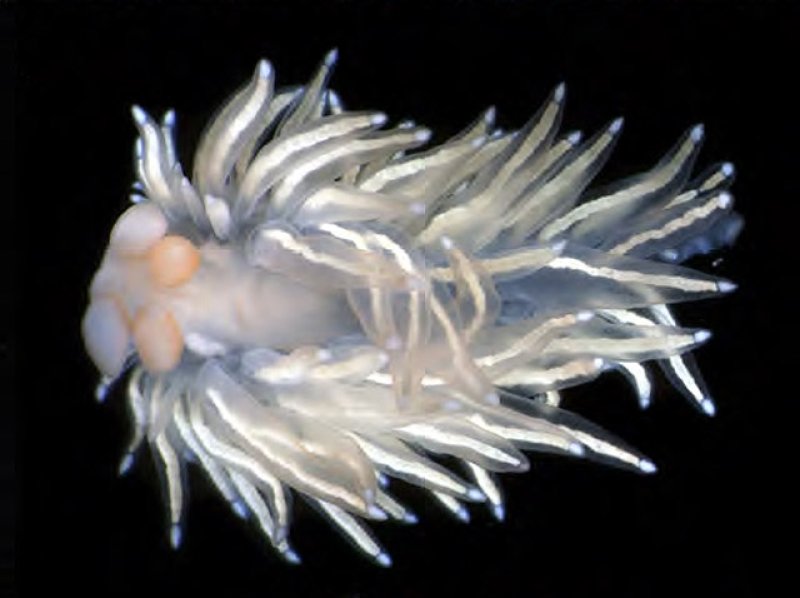
Cuthona methana Nudibranch (Laboratory Photo), © Nerida Wilson & Greg Rouse
The deep sea is still full of secrets A group of sea slugs – nudibranchs - are colourful, fascinating creatures. They come in a variety of bright colours and psychedelic patterns. Nudibranchs live in almost all oceans of the world, from shallow water to the deep sea. Like many other animals found there, the nudibranchs of the deep are poorly studied. Although scientists have named about 3,000 shallow-water slugs, only three deep-water species have recently been known throughout the Northeast Pacific. Marine biologists have now described five new species of nudibranchs living in the deep-sea, off the coast of California and Baja California. Four of these species were detected by MBARI remotely controlled UW vehicles, and two of them were named after MBARI scientists. The new species have now been described in the journal Zootaxa. Tritonia nigritigris Scientists found this elegant, frilly nudibranch on Guide Seamount, an underwater mount off the coast of central California. The animal crawled over ancient volcanic rock - at a depth of 1,730 meters. The slug was about 82 millimetres (3 inches) long. Looking at the delicate pattern of dark and light stripes on the animal's body, the scientists named this animal nigritigris, a combination of the Latin words for "black" and "tiger". Dendronotus claguei Exploring the Alarcón Rise, a volcanic ridge south of the Gulf of California, scientists found two of these small, pale slugs crawling over an inactive hydrothermal spring. The animals were named after the MBARI volcanologist David Clague, who helped discover and document the hydrothermal vents in the area. One of them was only 7 millimetres long, the other 18 millimetres. On this area full of debris at 2,370 meters, the researchers were able to observe very few animals, which raises the question of what the nudibranchs in this seemingly nutrient-poor environment did.
Ziminella vrijenhoeki MBARI researchers discovered one of these bright orange nudibranchs that lived on the carcass of a dead whale about 1,000 meters deep in Monterey Canyon. The roughly 20-millimeter-long nudibranch was found crawling on the whale bones and shared this macabre habitat with snails, crabs, other nudibranchs and bone-eating worms (Osedax worms). Another nudibranch of the same species was found on the seabed near another whale carcass eon the edge of Monterey Canyon. Scientists named these slugs after MBARI evolutionary biologist Robert Vrijenhoek, who studied whale carcass and Osedax worms in Monterey Bay for more than 10 years. Aeolidia libitinaria Like Ziminella vrijenhoeki (see above), this new nudibranch species was found near a dead whale in Monterey Canyon, but in shallow water - about 380 meters below the surface. She also shared her habitat with Osedax worms, as well as anemones, crabs, sea urchins and a variety of fish. The name of the species, libitinaria, derives from the Latin word for Undertaker and alludes to the animal's life on the bones of dead whales. Cuthona methana This tiny (4 to 6 millimetres long) translucent long-gull slug was observed by researchers from the Scripps Institution of Oceanography at Hydrate Ridge off the coast of Oregon. The newly named slugs crawled on rocks near a source of methane - hence the name Methana. Link to the study: doi.org/10.1371/journal.pone.0207249 Video: https://youtu.be/oo0mSLF_a9I
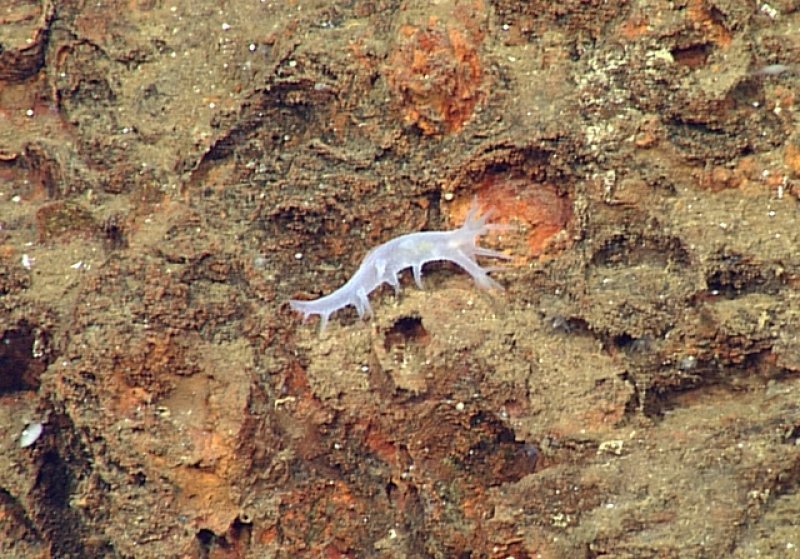
Dendronotus claguei on the Alarcón Rise, photo: © 2015 MBARI
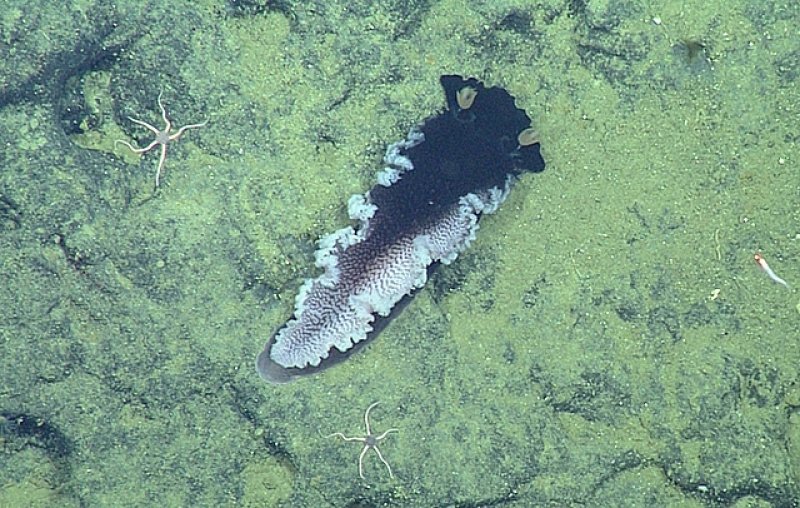
Tritonia nigritigris on an old lava flow at the Guide Seamount, Photo: © 2015 MBARI
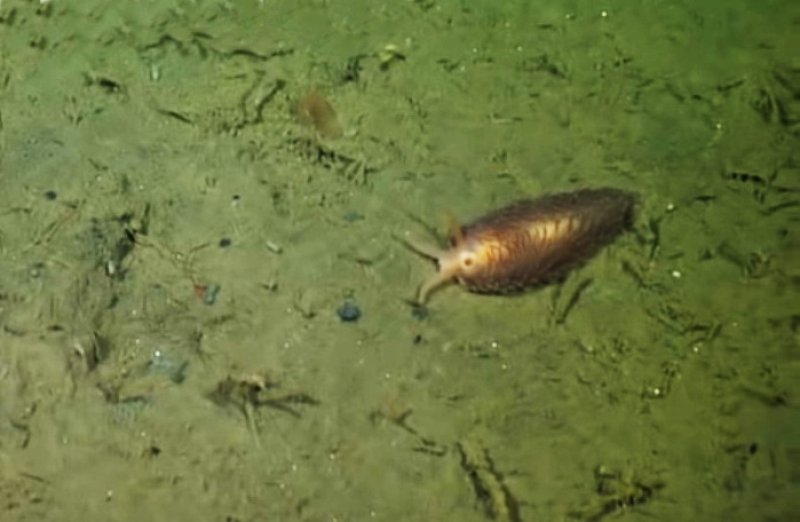
Ziminella vrijenhoeki near a dead whale in Monterey Bay © MBARI
Ця стаття була автоматично перекладена та може містити незначні неточності; у разі сумнівів зверніться до оригінальної англійської версії.