How To Use 360 Cameras to Capture the Ocean Like Never Before
scuba divingfreedivingmermaidtechnical diving
Insta360
Some dives are unforgettable: exploring a sunken ship, swimming through a school of fish, or discovering a hidden gem. But capturing those moments on camera? Not always easy. Traditional setups force you to aim, frame, and adjust, often pulling you out of the dive itself, or worse, missing the moment entirely. This is where a 360 camera shines. By filming in every direction at once, you do not have to choose what to focus on—you capture everything.
The underwater world is unpredictable. Fish dart, currents shift, and unexpected moments happen in every direction. With a 360 camera, you can record above, below, and beside you at the same time without worrying about lining up the "perfect" shot.
No aiming, no adjusting. Just start recording and focus on your breathing, your buddy, and the world around you while your camera quietly captures everything. Total freedom.
When you are back on dry land, that footage becomes your playground. Pan around the reef you swam past, replay the moment a turtle glided by, or cut together a cinematic clip for socials.
You might even see things you did not notice in the moment, offering a whole new perspective on your time underwater.
Insta360
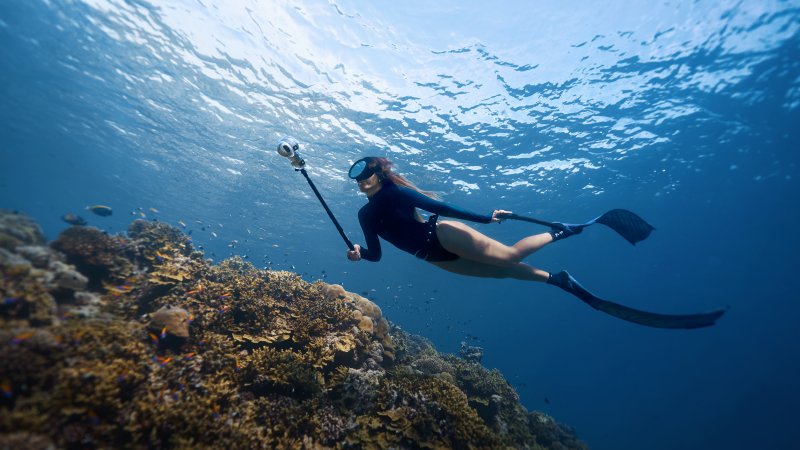
Steady movements, smart positioning, and the right lighting transform your 360 footage into something unforgettable.
360 cameras are not just about making immersive videos; they are also powerful tools for education. Reviewing your dives afterward can give you fresh insights on technique, buoyancy control, trim, and navigation, turning every dive into both an adventure and a learning opportunity.
If you are learning to dive or looking to refine your skills, 360 footage offers a unique way to break down techniques or safety drills in a way that is easier to understand. Many dive centers now integrate video analysis into training, allowing instructors to review dives from every angle and provide detailed, personalized feedback.
Even seasoned instructors can use 360 cameras to improve their lessons, engage students more effectively, and spot teaching opportunities they might otherwise miss.
Beyond training, 360 cameras are invaluable for ocean conservation and research. Divers can study wildlife or monitor ecosystems without disturbing them, and effectively showcase changes over time.
360 footage captures the underwater world in ways traditional cameras cannot, making it a powerful tool for education, advocacy, and storytelling.
When it comes to 360 capture, not all cameras are created equal. You need a setup that is tough and reliable enough to handle depth, pressure, and unpredictable conditions.
Many divers are reaching for Insta360 X5, which combines a waterproof build, high-resolution image quality, and easy AI tools that make editing a breeze.
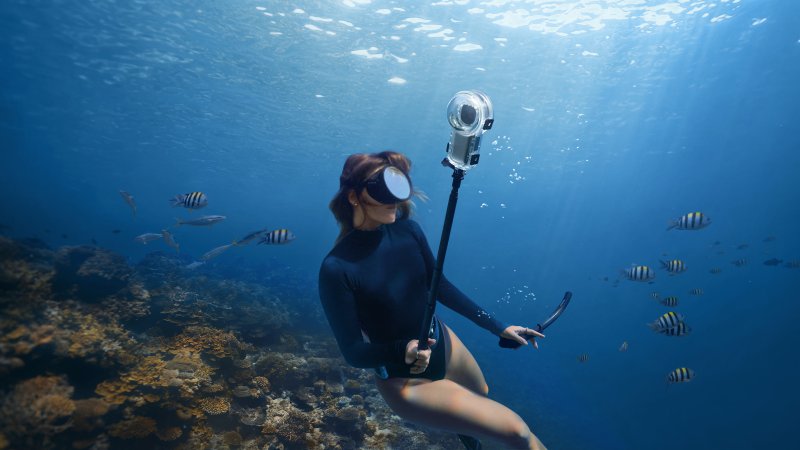
Pair it with the invisible selfie stick—which completely disappears in your footage—and you have got some pretty epic diving selfies. Add accessories like floating grips and dive cases, and you can enjoy your dive knowing your footage will remain smooth, safe, and stunning.
Looking for stunning backdrops for your 360 footage? Discover the 20 Best Diving Spots in the World
- Stay steady: Most 360 cameras have built-in stabilization, but smooth, controlled movements help reduce shake for more natural footage. Add a grip or selfie stick for extra control.
- Think of positioning: Try to keep your camera and selfie stick in a straight line. Tilting too much can make the "stitch line" (where the two lenses join) more visible in the final video. A good rule of thumb: avoid having one lens facing directly upward at the surface.
- Use a dive case: Light refraction can distort your footage. A dedicated dive case not only keeps your camera safe but also corrects refraction, so your 360 images stay sharp and true.
- Think about light: Natural light is your friend. Avoid backlit angles that darken your subjects. If your camera has a dedicated low-light mode, it can be a good idea to use this for shooting at depths.
- Get close: Water reduces clarity and color, so the closer you are to your subject, the sharper your shots. Just remember to respect marine life and keep a safe distance from fragile corals.
- Explore in the edit: One dive can give you endless angles, so have fun experimenting in post-production. You might see something you missed at the time.
Insta360
Steady movements, smart positioning, and the right lighting transform your 360 footage into something unforgettable.
360 cameras open up a new way to experience your dives. Instead of worrying about framing or missing the moment, you can stay fully present and let the camera do the work. Later, you get to relive the dive from every perspective and share the full story with friends, family, and followers.
Whether you are heading underwater for fun, training, or conservation, dive in, hit record, and capture the ocean like never before.
This article was written by Laura Nellis, a writer for Insta360. Images provided by @geek___tv and @ _ranii.editor_rani.