Underwater Navigation Tips – 7 Ways to Stay on Course
extended range
iStock-Global_Pics
Table of Contents:
You are enjoying a wonderful dive with your buddy, so caught up in exploring the reef that you barely notice the route you have taken. But which way leads back to the boat?
Good underwater navigation is about more than finding your way back to shore. It helps you stay together, follow your planned route, manage your air supply, and enjoy the reef without constantly wondering where you are.
Every diver can improve these skills on a familiar reef or at a new dive site. With a little preparation and practice, you can feel more confident about where you are going. Here are seven practical underwater navigation tips to try on your next dive.
Good navigation starts on land or at the surface, not halfway through a dive when you are looking along the reef, trying to figure out which way to go. Before descending, talk through the route with your buddy and agree on a clear objective. Identify your entry and exit points, direction of travel, maximum depth, planned turn time, and the features you expect to see along the way.
For example, on a simple out-and-back reef dive, follow the reef with it on your right shoulder as you swim out. On the way back, the same reef should be on your left. Agree with your buddy beforehand on what to do if visibility drops or you become separated. That way, you both know the route and have a plan if conditions change.
predrag-vuckovic
When visibility drops or the reef looks unfamiliar, a compass helps you keep your bearing. Before the dive, check how your compass works and set your planned heading. Hold it level in front of you, away from metal objects that could affect the needle. With the heading set on the bezel, turn your body until the north needle aligns with the index marks.
Practice swimming a short, straight line, keeping your compass heading steady. To find your way back, use the reciprocal heading, 180 degrees in the opposite direction. If you head out on 060°, your return heading is 240°. Rather than keeping your eyes fixed on the compass, glance at it regularly and look ahead to stay aware of your surroundings. With practice, diver navigation using a compass starts to feel more natural.
Learn how dive computers track depth, time, and even direction on models with a digital compass in Mastering Dive Computers: Your Guide to Safer, Smarter Diving.
Your surroundings can help you stay oriented without checking your compass every few seconds. As you swim along the reef, notice sand channels between coral formations, ridges rising from the seabed, and slopes leading into deeper water. Keep track of whether the reef is on your left or right, whether the bottom rises or falls, and where the sunlight is coming from.
Before moving away from the entry point, pause and look back. That stretch of reef may look surprisingly different on your return, so notice how its features appear from both directions. A large coral head, a distinctive rock formation, or a patch of sand can help you recognize your route back.
Avoid fragile features or ones that look too similar, and never touch or damage marine life to mark your route. Natural navigation helps you stay oriented, but it should support your planned route and compass, not replace them. Learning to recognize these details makes you more confident about finding your way underwater.

AdobeStock-Dudarev-Mikhail
The steady rhythm of your fins can help you estimate how far you have traveled underwater. First, agree with your buddy on what counts as one kick cycle, such as one complete movement of both legs. In calm, shallow water, swim a measured distance of 20 meters (66 feet) at your normal pace, counting each cycle. Repeat this a few times to get a feel for how far each kick cycle takes you.
Your kick count is an estimate, not an exact distance. A current, different equipment, changes in depth, or extra effort can all affect how far each kick cycle carries you. Still, counting helps you judge the distance between landmarks and estimate when to turn back. Keep the count simple so you can monitor your air supply, depth, buddy, and surroundings. Used sensibly, kick counting gives you a clearer sense of where you are along your planned route instead of leaving you guessing.
As you follow a reef slope, the seabed drops away beneath you, and your depth gauge or dive computer shows the change. For example, moving gradually from 8 meters (26 feet) to 15 meters (49 feet) can signal that you have left a familiar stretch of reef. Combined with natural landmarks and compass headings, depth gives you another clue to where you are along your route.
Time gives you another clue. If it usually takes six minutes to reach a distinctive rock formation at your normal pace, you can use that time as a rough reference on the way back. But a current or a change in swimming speed can throw off your estimate, so never rely on time or depth alone. Follow your dive plan and turn around with enough gas for a safe return.
Underwater navigation is a team skill. Before entering the water, agree who will lead, who will monitor the route, and how you will signal changes. Stay close enough to keep your buddy in sight and check in regularly with the hand signals you agreed on. If either of you becomes unsure which way to go, stop somewhere safe, establish neutral buoyancy, and check the route together instead of swimming on and hoping the way becomes clear. Good diver navigation means keeping track of your buddy and making decisions together, not simply following a compass heading.
If your buddy suddenly disappears from view, follow the separation procedure you learned in training instead of swimming around looking for them. Sticking to your agreed plan helps you respond calmly rather than improvising underwater. Good navigation depends just as much on teamwork as on your compass skills.
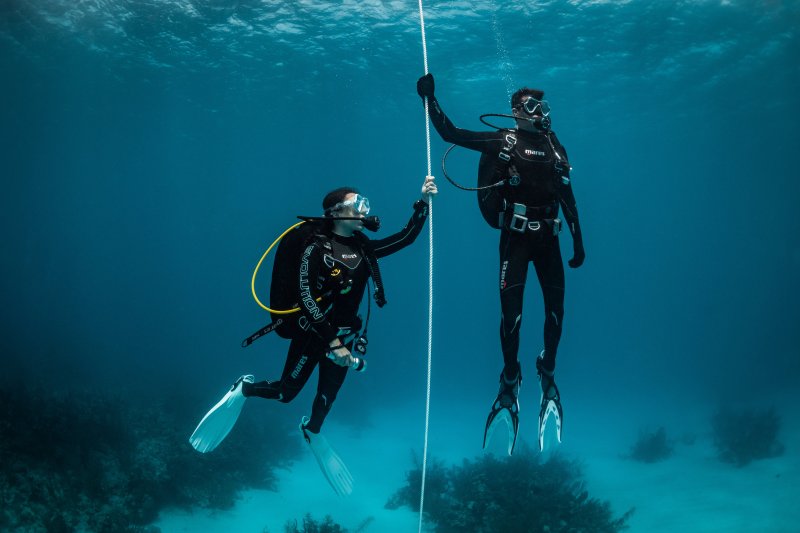
Scuba diver practicing underwater navigation with a compass in shallow water
For extra protection in case of a diving accident, read Why Dive Insurance Should Be Part of Your Diving Checklist and explore DiveAssure coverage options before your next trip.
You do not need a complicated dive site to improve your underwater navigation. In shallow, clear water with little current, you can focus on the landmarks passing by instead of struggling with the conditions. Practice a simple route out and back, then try tracing a square or triangle with your compass. Stay within your training and comfort level, and ask a qualified professional to supervise if you are still learning.
After the dive, compare your plan with what actually happened. Did you reach the landmark at the expected time? Did the depth change as planned? Did your compass heading bring you back to the exit? Discuss what worked and what you would change next time. Repeating simple exercises builds confidence more effectively than tackling a difficult route too soon. Regular practice improves diver navigation without turning every dive into a test.
predrag-vuckovic
Ready to improve your navigation skills? The SSI Navigation Specialty helps you develop compass skills, natural navigation, and route planning with an experienced SSI Professional. Practicing these techniques can help you feel more comfortable exploring unfamiliar dive sites and making thoughtful decisions underwater.
Good diver navigation does not mean you will never feel uncertain. It means planning carefully, noticing useful details, and knowing how to respond when conditions or plans change. Combine compass headings with natural landmarks, depth, time, and communication with your buddy. Practice simple routes in comfortable conditions and build your skills gradually. As familiar features become easier to recognize, you can follow your route more calmly and enjoy the dive with greater confidence.