Protected area for harbour porpoises established in Baltic Sea
environmentmarine conservationbaltic seaharbour porpoisesprotected area
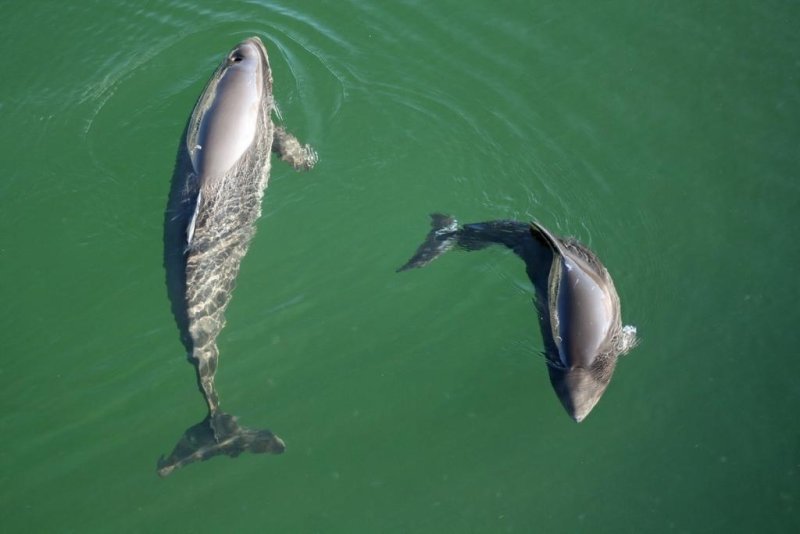
Harbour Porpoise mother with calf
(c) S.Koschinski
Area south of Gotland is important breeding site
The government of Sweden will set up a protected area for the
endangered harbour porpoises of the inner Baltic Sea.
Covering one
million hectares between Öland and Gotland, it will be Sweden's largest
protected area. The move came about after the SAMBAH project
announced that there were only about 500 harbour porpoises left in the
Baltic Sea, northeast of Rügen.
"The new protected area is particularly important for their
reproduction. During the mating and calving season, the animals are
concentrated in this area and they can now be effectively protected at
this critical phase from dangers such as becoming bycatch in fish nets
or from underwater noise, " said Dr Harald Benke in German. A whale
expert, he is also the Director of the German Oceanographic Museum.
For the first time, scientists had evaluated data from acoustic data
loggers for two years to assess the abundance and distribution of
harbour porpoises in the Baltic Sea. This was done within the framework
of SAMBAH. They discovered that the area south of Gotland appeared to
be an important breeding area for them.
As the German Oceanographic Museum is one of the world's leading
facility with experience in the acoustic recording of porpoises, we
were very pleased to work with the international network of the Baltic
Sea countries, thereby allowing such good results to be achieved by
SAMBAH, " said Michael Dähne, Curator for sea mammals at the German
Oceanographic Museum, in German.
In cooperation with the Federal Office for Nature Conservation (BfN)
and the Federal Ministry for the Environment, Nature Conservation,
Building and Reactor Safety (BMUB), the German Oceanographic Museum in
Stralsund has been studying the behaviour and distribution of harbour
porpoises in the Baltic Sea since 2002. The German Parliament had
recently called for the continuation of acoustic monitoring in a bid to
protect the harbour porpoises. The pioneering work in Stralsund, from
2002 to 2007, has proven the method to be particularly useful in
recording porpoise populations in areas with limited numbers of the
animals. As a result, the SAMBAH project was funded by EU funds (Life+)
and the BfN, and successfully implemented.
See here for further information

Harbour Porpoise
(c) Dr. Michael Dähne
Cet article a été traduit automatiquement et peut contenir des inexactitudes mineures ; veuillez vous référer à la version anglaise originale en cas de doute.