Hydrothermal Vent Discovered In Gulf Of California
environmentmarine lifehydrothermal ventscarbon emissionsvolcanic activity

Black Smoker (c) ROV Team, Geomar
While searching for carbon emissions related to volcanic activity in the Gulf of California, the German deep-sea research vessel Sonne discovered a underwater hydrothermal field that held several black smokers.
The ship was on a mission to investigate the theory that during the Paleocene Eocene Thermal Maximum (PETM) about 54 million years ago, the increased volcanic activity that took place then when the North Atlantic widened had triggered a rapid global warming.
The Guaymas Basin in the Gulf of California is a model region for the North Atlantic at the end of the Paleocene Epoch. Hence, an international research team, led by Professor Christian Berndt, geophysicist of the GEOMAR Helmholtz Centre for Ocean Research Kiel, was there to investigate the seafloor in the Guaymas Basin.
It was there they discovered the hydrothermal field measuring 500 metres long, which consisted of at least four mounds that were up to 70 metres high. "This is a major discovery, because it changes our views on how carbon is emitted from sedimentary basins. This will have profound consequences for the assessment of the relevance of magmatic systems in the Earth system," said Berndt, who was the chief scientist of the mission.
As a continental crust breaks up, there is a phase in the volcanic activity in which the igneous rock penetrates into the hot mantle of the earth to such an extent that volcanism starts. The heated rocks intrude into the sediments where they cause the pore water to boil.
This in turn causes large amounts of carbon that had been buried with the sediments to be released. The carbon-rich pore water then rises to the surface and into the atmosphere.
Since such systems were common when the North Atlantic opened up 54 million years ago, it is believed that they might have been at least partly responsible for the global warming at that time known as PETM. Presently, it is neither clear how intense these systems had been, nor what types of carbon compounds had been expelled. It is hoped that the investigations at the Guaymas Basin could provide answers, as it is a relatively young ocean that is presently opening and the first volcanic eruptions has already taken place in the sedimentary basins.
Using regional seismic data and sonar measurements, potential sites where the pore water may emerge were identified and inspected via HYBIS, an underwater robot. On its first dive, it discovered the new hydrothermal field, where the vents emitted hot fluids that immediately precipitated upon contact with the cold seawater. The hot fluids were enriched with methane that was injected high into the water column.
"This phenomenon was previously known from black smokers at mid-ocean ridges. A field of this size aside the spreading axis is very unusual," said Berndt. The size and activity of the system suggests that hydrothermal vents, when they occur in large numbers during the opening of ocean basins, could actually have an impact on the global climate.
Video general Info 'Black Smokers':
https://www.youtube.com/watch?v=xywO4j7k2g8
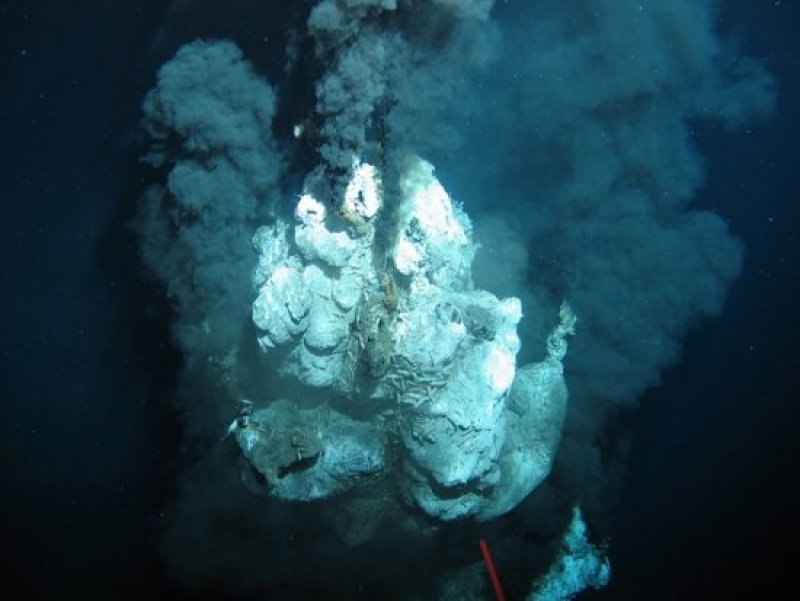
Black Smoker (c) ROV Team, Geomar
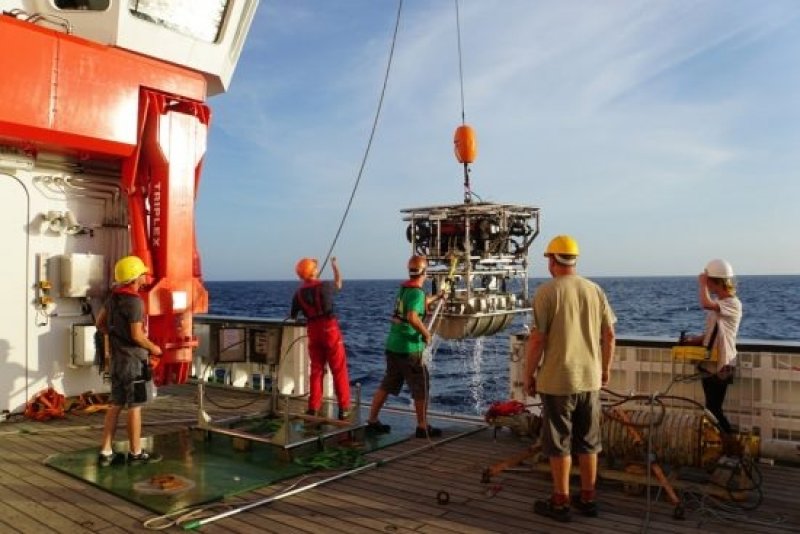
Deep sea mission: ROV Hybis (c) Jens Karstens, GEOMAR
Cet article a été traduit automatiquement et peut contenir des inexactitudes mineures ; veuillez vous référer à la version anglaise originale en cas de doute.