Newborn harbour porpoises attain full hearing abilities the fastest
environmentmarine lifessiporpoiseshearing developmentsensory development

Mother calf and her baby
(c) S. Koschinski
Fastest hearing development among mammals Although all mammals have the ability to hear, it is not something that
is fully developed at birth. Some species take weeks or months to fully
develop this ability. A recent study has revealed that newborn harbour
porpoises (Phocoena phocoena) have the fastest hearing development
among mammals.
A team of researchers from University of Southern Denmark discovered
that harbour porpoises take less than 30 hours to fully develop their
hearing abilities – this is the fastest in any studied animal.
According to biologist Magnus Wahlberg, hearing is the most important
of the senses for a porpoise, both for adults and calves, so it is
logical that a newborn calf spends energy on fine tuning and optimising
its hearing as fast as possible. He and his colleagues Lara Delgado-García (also from SDU) and Jakob
Højer Kristensen from the research and experience center Fjord&Bælt
in Kerteminde, Denmark have published a study on their discovery in
Journal of Comparative Physiology A.
The study involved two newborns (age 1-4 days old) and three adults
from the Fjord&Bælt center. The biologists non-invasively measured
their auditory brainstem response, stimuli consisting of clicks
centered at 130 kHz, which is the species' frequency band used for
echolocation and communication.
At the end of the study, the scientists were not able to detect any
significant differences in the hearing of the newborn and adult
porpoises.
With the new knowledge about porpoise hearing development, the
researchers expect other toothed whales to have the same ability. This
new information is important in understanding the sensory development
of newborn toothed whales shaped by evolution, as well as for designing
efficient protection mechanisms and legislations for species prone to
disturbance by anthropogenic noise from windmills, shipping traffic,
etc.
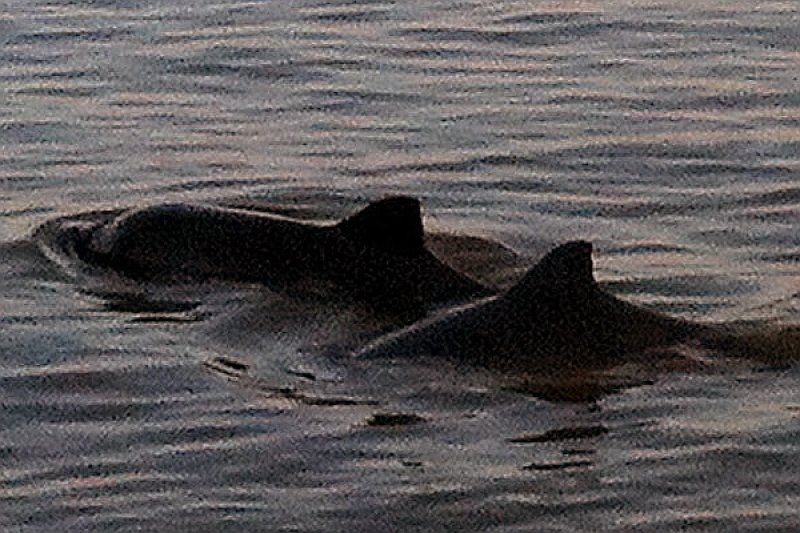
Harbour porpoises
(c) Sophia Wenger