Is "marine noise" for long-term predictions necessary?
environmentclimate variabilityocean-atmosphere interactionmarine noiselong-term predictions
Daily fluctuations in the sea surface temperature in the mid-latitudes influence the long-temporal variability in the atmosphere. Hence, the state of the oceans does have an impact on the future behaviour of the world’s climate. This is the result of a study by marine scientists that was recently published in the international Geophysical Research Letters journal.
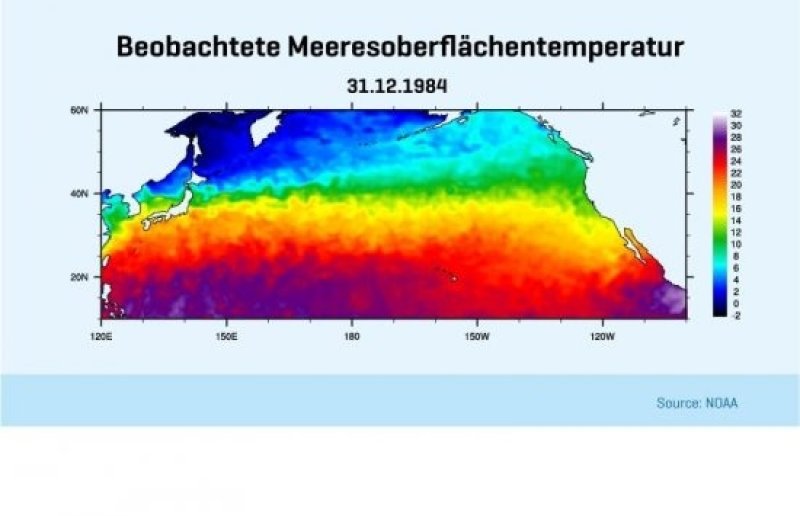
Interactions between the ocean and the atmosphere lead to climate variability on very different time scales, up to decades or centuries. However, it is still unclear the extent to which the short-term, daily fluctuations in the oceans exert a significant influence on the atmosphere; nevertheless, this is something that must be considered when devising predictions for long-term climate variability. A new study led by scientists at the GEOMAR Helmholtz Centre for Ocean Research Kiel shows that on a decadal timescale, daily variations of sea surface temperature have an impact on long-term reactions of the atmosphere. Consequently, simulating oceanic variations with high temporal and spatial variability is an important part of the conceptualisation of longer-term climate predictions on such timescales. Climate models are designed so that they remain relevant over the long term. This is only possible with high-performance computers. It also requires simplifications, for instance, compared to the models used for weather forecasts. This also applies to short-term fluctuations, the "ocean weather" that is not simulated by many ocean models. The researchers have now studied this "ocean weather’s" role on the atmosphere over the North Pacific. "Our simulations showed that the daily fluctuations in sea surface temperature, which were often regarded as insignificant, are able to influence the long temporal variability in the area of the North Pacific," said Prof Dr Mojib Latif, co-author of the study and Head of GEOMAR’s Research Division Ocean Circulation and Climate Dynamics. He described the "marine noise" as a kind of catalyst, with the atmosphere "feeling" the slow, decadal variations of sea surface temperature only if it perceived the rapid oceanic changes as well. The daily fluctuations in the ocean influence the low pressure systems in particular. "The lows are in some ways the "translator "between the slow changes in the oceans and the overlying atmosphere," said Latif. "Now it is important to figure out whether this result can be transferred to other ocean areas such as the North Atlantic," he continued. Furthermore, he hopes to motivate other research groups to conduct similar simulations.
Cet article a été traduit automatiquement et peut contenir des inexactitudes mineures ; veuillez vous référer à la version anglaise originale en cas de doute.