Sunlight Breaks Down Polystyrene Faster Than Expected
environmentplastic pollutionpolystyrenesunlight degradationmarine environment
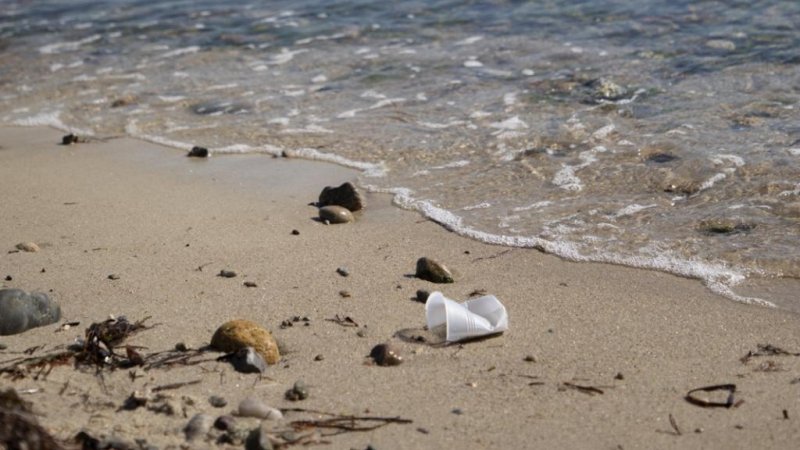
Polystyrene pollution at the Flutsaum, Photo: Jayne Doucette / Woods Hole Oceanographic Institution
Certain plastics are decomposed by sunlight A study published by researchers from the Woods Hole Oceanographic Institution (WHOI) shows that polystyrene, one of the world's most ubiquitous plastics, can be degraded by sunlight in decades or centuries, rather than thousands of years ago. The study was recently published in the journal Environmental Science and Technology Letters. Polystyrene has been routinely detected in the world's oceans since the 1970s. The idea that sunlight degrades plastics is not new, says Ward: "Just look at plastic toys, park benches or sun loungers that can be bleached quickly by the sun." The new study shows that sunlight can not only physically degrade plastics, but can also break them down chemically into dissolved organic carbons and traces of carbon dioxide, at a level too low to affect climate change. Once the plastic undergoes this transformation, its original shape disappears from the environment, creating completely new by-products that are invisible to the naked eye. The question of how this transformation works will be an important part of estimating how much plastic is actually contained in the environment. "At the moment, policymakers generally believe that polystyrene will last forever in the environment," says Collin Ward, marine chemist at the WHOI and lead author of the study. "That's part of the justification for banning them by policy." One of our motivations for this study was to understand whether polystyrene actually lasts forever. "We do not say that plastic pollution is not bad, only that the persistence of polystyrene in the Environment can be shorter and probably more complicated than we have understood so far, and the chance of decades of environmental damage is still there. " Earlier estimates of how quickly polystyrene dissolves were based on a different set of assumptions, Ward explains. Previous studies have focused largely on the role of microbes in degradation rather than other factors such as sunlight. That's not surprising, adds Chris Reddy, WHO's marine chemist and co-author of the current study. Plastic is just another form of organic carbon and microbes probably would "eat" it - but it warns that microbes are also smart and selective. The chemical structure of polystyrene is complex and bulky. "Although the structure of polystyrene is a difficult target for microbes, it has the perfect shape and size to capture certain frequencies of sunlight," adds Ward. The absorption of this energy can break up the carbon bonds. In the lab, the researchers tested five different samples of commercially available polystyrene. They dipped each sample in sealed glass containers with water and exposed them to a solar simulator, a lamp that emulates the frequencies of sunlight. Then the scientists collected CO2 and compounds that dissolved in the water. With a variety of chemical tools, including a mass spectrometer, Ward and colleagues tracked the origins of carbon atoms found in both CO2 and filtered water. "We used several methods to do this, and they all pointed to the same result: sunlight can turn polystyrene into CO2, but we need more research to understand what happens to the other products that dissolve in the water," so Ward. The study also found that additives to polystyrene, which can determine its color, flexibility and other physical properties, play an important role in degradation. "Different additives seem to absorb different frequencies of sunlight, which affects the speed of plastic degradation," says Reddy.
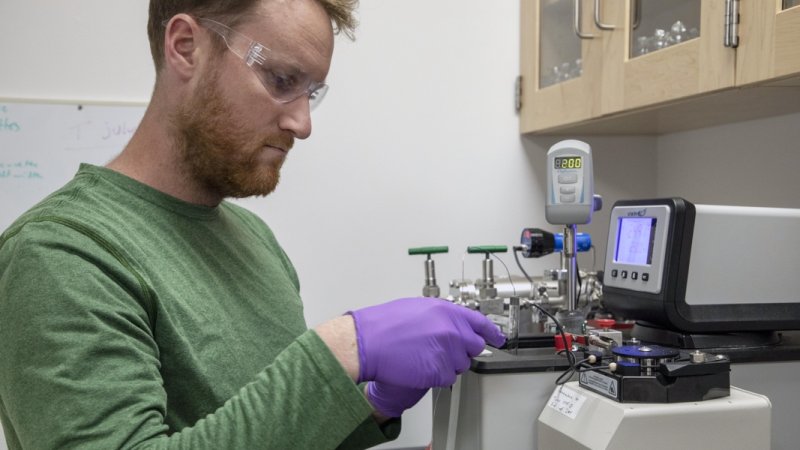
Collin Ward, WHO at the WHOI, works in his lab on styrofoam samples, photo: Jayne Doucette / Woods Hole Oceanographic Institution
Αυτό το άρθρο μεταφράστηκε αυτόματα και ενδέχεται να περιέχει μικρές ανακρίβειες. Σε περίπτωση αμφιβολίας, ανατρέξτε στην πρωτότυπη αγγλική έκδοση.