Atlantic: new findings on deep water formation and ocean currents
environmentclimate changemarine researchocean currentsatlantic meridional overturning circulation
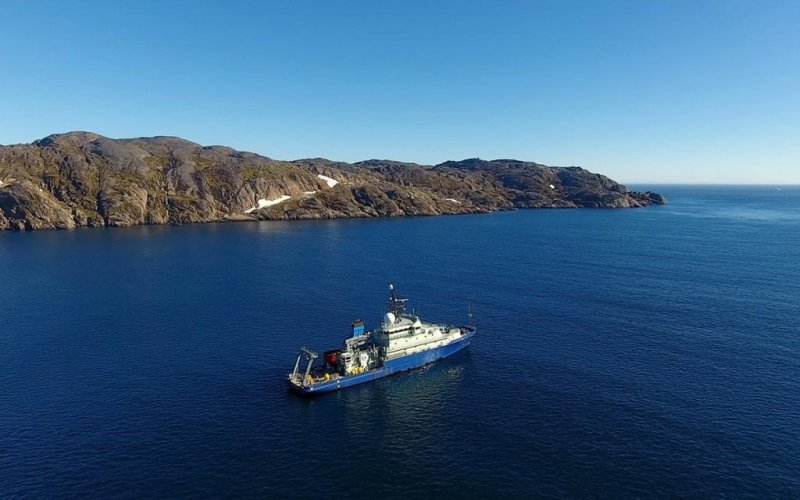
The research vessel "R / V Neil Armstrong" at Prins Christian Sund © Kent Sheasley, Woods Hole Oceanographic Institution
Long-term observations contradict previous views The subpolar North Atlantic plays a crucial role in global ocean circulation. By near-surface cooling, warm water is transformed into cold and heavy deep water, which flows equatorially in depth. Based on model data, it was previously assumed that the major part of the deep water is formed in the Labrador Sea. Long-term observations of an international consortium with the participation of the GEOMAR Helmholtz Center for Ocean Research Kiel now show that the major contribution to the meridional overturning circulation takes place in the eastern North Atlantic Ocean currents are mainly caused by wind and differences in the density of seawater. For the currents in the North Atlantic both processes are important. Warm, salt-rich water is transported far to the north via the Gulf Stream and its foothills. The water is cooled, which leads to an increase in the density of the seawater and therefore causes a decrease. The dense deep water then flows again towards the equator. This flow system is also referred to as Atlantic meridional overturning circulation (AMOC). It is of great importance for the climate, especially for the comparatively mild winters in Northern Europe. In certain regions, especially the Labrador Sea, surface water may sink to the deep sea. The supply of fresh water, such as the melting of landmesh as a result of global warming, reduces the density of surface water. A drying up of the deep water formation and thus the meridional overturning circulation would have a direct impact on the climate in Europe. The Atlantic meridional overturning circulation is a complex mechanism with many processes. Direct observations are therefore scarce, and many relationships have so far only been derived from model studies, " explains Dr. med. Johannes Karstensen from GEOMAR, one of the co-authors of a study that has now been published in the international journal Science. In order to verify these theoretical findings from models with observations, the first complete survey of the subpolar overturning circulation of the Atlantic was launched in 2014 with the participation of seven countries under the name "OSNAP" (overturning in the Subpolar North Atlantic Program). The OSNAP observation system is divided into two sections: across the Labrador Sea, from Canada to the southern tip of Greenland, and further more the eastern subpolar North Atlantic, from the southern tip of Greenland to Scotland. A large number of permanent measuring stations (anchorages) form the backbone of the system. At the stations, flow data as well as temperatures and salinity of the water are continuously recorded. In the 21-month time series of overturning circulation from the OSNAP measurements, we see astonishingly high variability. The most surprising result at the moment, however, is that the Labrador Sea, which we have always considered to be the most important deep water formation region, contributes only about 15 percent to the Atlantic meridional overturning circulation. We need to think about how to adapt the concept of deep water formation and circulation. It is important to better identify the processes responsible for the fluctuations in the OSNAP time series, " Dr. Karstensen said. For example, it is possible that the OSNAP measurement period from 2014 to 2016 only detected one specific condition of meridional circulation. A question which can only be determined by longer series of measurements ", explains Dr. med. Karstensen. In the summer of 2018, the OSNAP teams from Europe, the USA, Canada and China were once again travelling with the research vessels in the Subpolar North Atlantic. The data is currently being analyzed and it is expected that the OSNAP time series of the Atlantic Circulation Circulation will shortly be extended for another two years. " This region is one of the most sensitive parameters of our climate system. Here, relatively small and rapid changes can trigger global and long-term effects on the climate. Therefore, a comprehensive understanding of the processes in this region is so important. " explained Karstensen. The data compiled by the international team are incorporated into the reports of the Intergovernmental Panel on Climate Change (IPCC), whose next report will be drawn up in just a few years and will form the basis for recommendations for action on climate protection. Link to the study: https://doi.org/10.1126/science.aau6592.
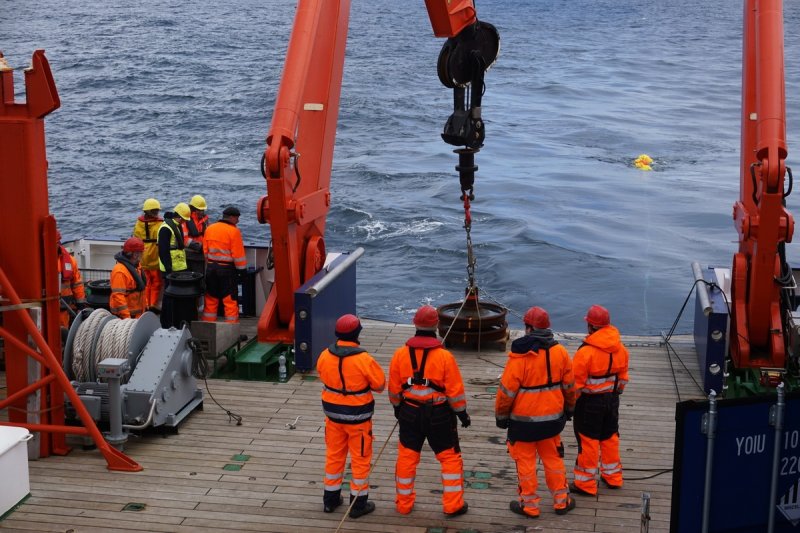
On board the "R / V Neil Armstrong" will be an oceanographic anchorage with instruments in front of the Greenlandic Coast © Joseph McCabe, Woods Hole Oceanographic Institution
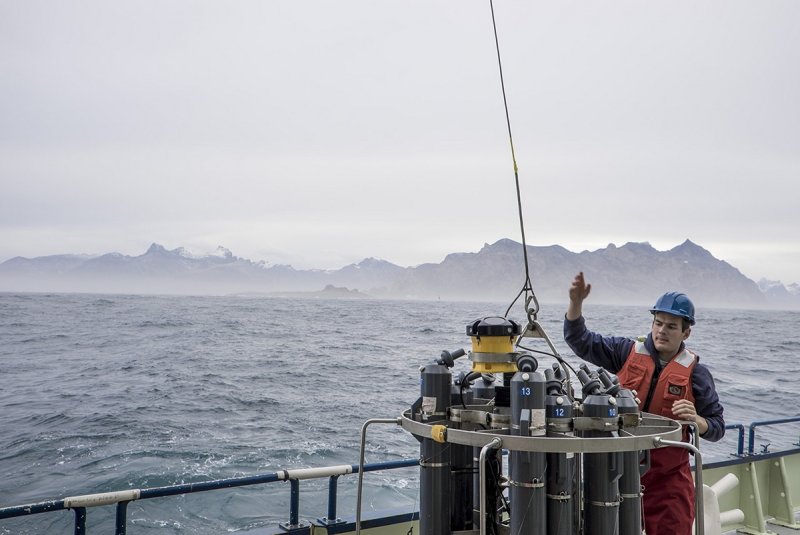
Nick Foukal of the Woods Hole Oceanographic Institution helps deploy a set of instruments that perform physical measurements in the water off the Greenland coast. © Carolina Nobre, Woods Hole Oceanographic Institution
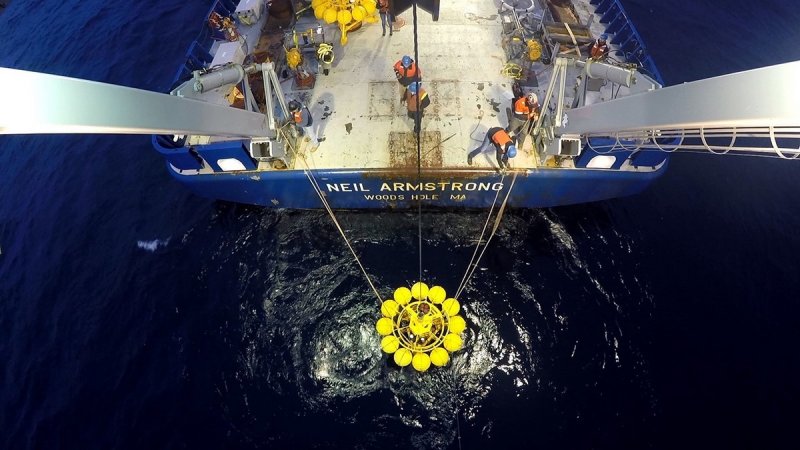
Application of an oceanographic anchorage in the Irmingersee with the German research vessel "MARIA S. MERIAN" in 2016 © Arne Bendinge
Tento článek byl automaticky přeložen a může obsahovat drobné nepřesnosti; v případě pochybností se podívejte na originální anglickou verzi.