Viruses affect functions in the marine ecosystem
environmentmarine lifeoceanmarine ecosystemviruses
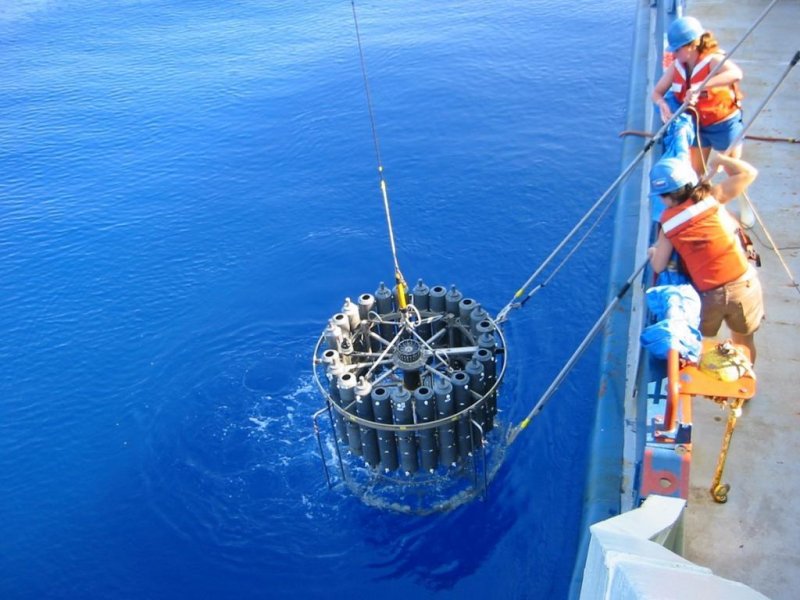
Scientists take water samples to test for unicellular predators, photo: © Marie Cuvelier
Scientists are showing a new picture of the role of viruses in the sea Viruses are known primarily as pathogens of diseases. Scientists of the GEOMAR Helmholtz Center for Ocean Research Kiel are now showing in cooperation with other German and international partners how viruses also influence the ecology of unicellular marine predators. This sheds new light on the role of viruses in ocean ecosystems. The oceans not only harbour large predators such as sharks. Also in the realm of microorganisms, some species feed on other living things. Collar flagellates, called in the jargon Choanoflagellaten, belong to these unicellular robbers. They are widespread in the sea and eat bacteria and small algae. Choanoflagellates are considered to be the closest living unicellular animal relatives and may become multicellular. For this reason, they are intensively researched to understand how multicellular organisms - including humans - have emerged. Under the direction of Professor Alexandra Z. Worden (GEOMAR / Monterey Bay Aquarium Research Institute, MBARI, USA), a team of scientists has now gained initial insights into the interaction of choanoflagellates and viruses. In a multi-year effort, the team succeeded in detecting the genome of a giant virus in the unicellular predators. The genome of the viruses had a size and a gene number comparable to the smaller bacteria. Even more surprising, however, were the many functions that the genome encodes. The study has now been published in the international journal Proceedings of the National Academy of Sciences USA. For the study, the scientists used high-tech instruments at sea time and again to record all predatory protozoa in the water using a laser-based visualization system. Then they separated these cells individually from other microbes. "Each individual wild-type predator cell was subsequently sequenced. A sample from the Pacific Ocean was dominated by an uncultured species of choanoflagellate, "explains Professor Worden. In these cells Dr. David Needham, first author of the study, the genome sequence of a giant virus. He was able to show that the virus encodes genes for microbial rhodopsin proteins and associated pigments. This composition of genes has never been proven in viruses. Other types of rhodopsin proteins are responsible for the perception of light as pigments in the eyes of many animals. In parallel with genome studies, evolutionary biology, and the spread of the virus, teams at the University of Tokyo, the RIKEN Center for Biosystems Dynamics Research, and other Japanese institutions analyzed the crystal structure of the protein and showed that it functions as a light-driven proton pump. "The work proves that the choanoflagellates, which otherwise feed predatorically on other organisms, also use sunlight as an energy source if they are infected with the virus," emphasizes Professor Worden. The researchers also expanded their knowledge of the distribution of these genes in giant viruses in the oceans - and showed that the rhodopsin proteins in eukaryotic cells probably have many specialized roles. Not yet clarified is the exact role of the virus in the host cell. "Is it for the energy transfer? Or a new light sensor that may promote motility or other behaviours?", Professor Worden sums up these important questions. More Information: https://www.geomar.de.

Preparing to collect water samples during dusk, photo: © Alexandra Z. Worden
Bu makale otomatik olarak çevrilmiştir ve küçük hatalar içerebilir; şüphe duymanız durumunda lütfen orijinal İngilizce versiyona bakın.