Greenland: Depth of meltwater input affects plankton bloom
environmentmarine lifeocean researchgreenlandglacier meltplankton blooms

Dr. Mark Hopwood during a measurement campaign on the coast of Greenland
(c) Thomas Juul-Pedersen / GCRC
Complex connection between glacier melt and nutrient input The unusual timing of heavy summery plankton blooms off the shores of Greenland suggests a connection between increasing amounts of meltwater and nutrient inputs into the sea. In a new study, an international research group led by the GEOMAR Helmholtz Center for Ocean Research Kiel shows that this connection exists but is more complex than widely believed. Whether increasing amounts of meltwater have a positive or negative effect on the summer plankton blooms depends on the depth at which a glacier sits on the seafloor. Observational data clearly shows that Greenland's ice sheet is slowly but surely losing the race to rising global temperatures. Every summer, glaciers transport more ice and meltwater into the ocean. There, among other things, it contributes to the global sea-level rise. But does it change the chemistry and biology of the oceans? According to a common theory, nutrients in meltwater provide plankton blooms off the shores of Greenland during the summer months. " This time is unusual for plankton blooms, so the context seems obvious, " Dr. Mark Hopwood, Chemical Oceanographer at GEOMAR. In a study recently published in the journal Nature Communications, Hopwood and colleagues from GEOMAR, as well as from the US, the Netherlands and Greenland, find that this is not so easy. " On the contrary, our samples and data clearly show that a further retreat of glaciers towards land will again lead to a decrease in the extent of the summer plankton bloom ," Dr. Hopwood. It was already clear that more factors than just the amount of meltwater influence plankton blooms. " The nutrient most lacking in plankton around Greenland is nitrate, while glacial meltwater contains mostly iron and silicon, " explains Dr. Hopwood. The fact that meltwater can still cause plankton blooms is due to the way some glaciers release it to the sea below the sea surface. The outermost tongues of more than 200 of the numerous Greenland glaciers lie directly in the sea and extend several hundred meters into the depth. Meltwater, which flows below the glaciers into the sea, is less dense than the seawater and therefore flows strongly towards the surface. It absorbs nitrate-rich deep water from the sea and thus ensures plankton growth in the light-flooded shallow depths. In our study, we first quantified the ratio of meltwater discharge and changes in nutrient supply in Greenland's coastal waters, " explained Dr. Hopwood. The result: the upwelled deep water contributes more than 90 percent to the nutrients, the actual melt water less than ten percent. Building on this result, the team has further calculated what happens when the affected glaciers continue to melt and retreat towards the coast. " The fertilizing effect of meltwater buoyancy only works if the glacier ends offshore at certain depths. If the glacier retreats to shallower water depths, this effect ends quickly. The optimal depth varies regionally, but is generally between 700 and 500 meters ", explains Dr. med. Hopwood. The study shows that further melting of the Greenland glaciers only leads to summery plankton blooms under very specific conditions, an effect that finally ends with extensive further melting ," Hopwood summarizes the study's findings. Link to the study: https://doi.org/10.1038/s41467-018-05488-8
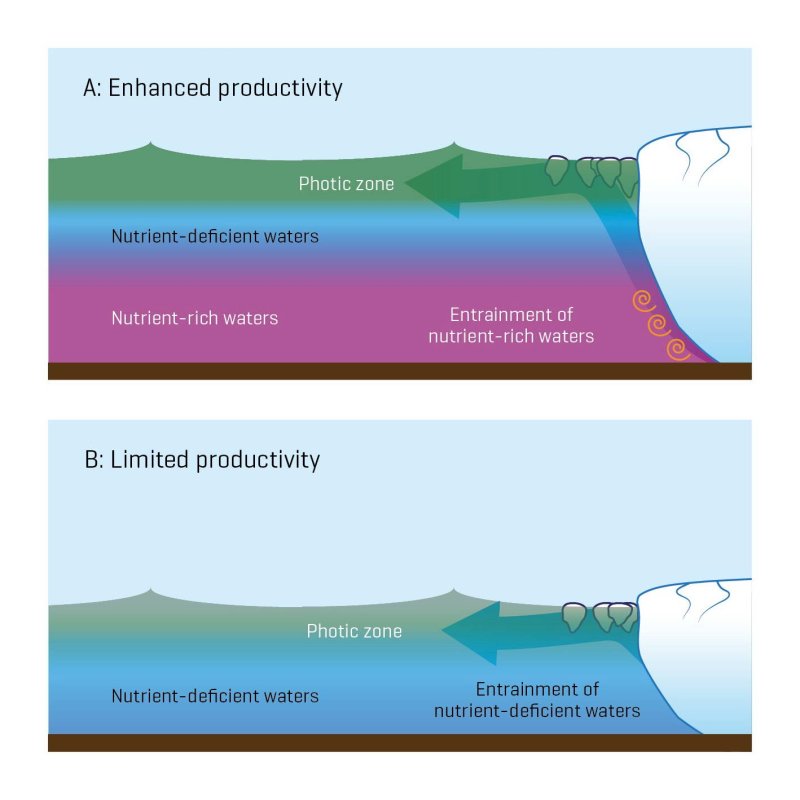
If glaciers strand off the coast at the right depth, melting water on the glacier front can cause planktonic blooms. On the other hand, if the glacier retreats to shallower depths, there is no fertilizing effect.
(c) Mark Hopwood / GEOMAR
Este artigo foi traduzido automaticamente e pode conter pequenas imprecisões; em caso de dúvida, consulta a versão original em inglês.