More Than 250 Pilot Whales Slaughtered So Far In Faroe Islands
environmentmarine conservationwhalingfaroe islandstradition
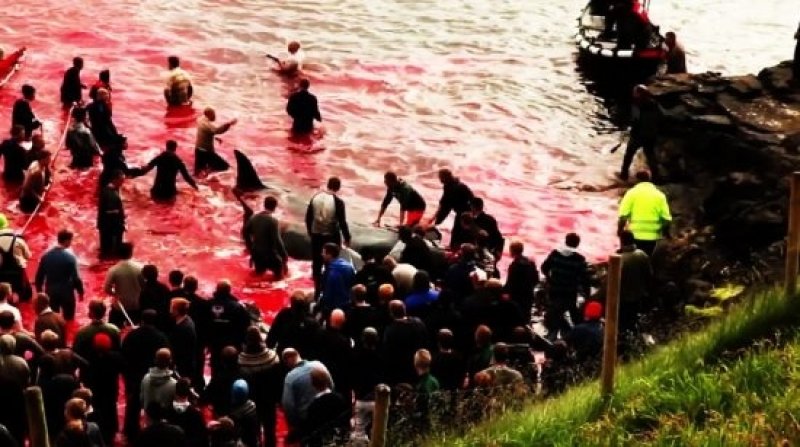
With blood on their hands, the fishermen in the midst of the brutally slaughtered pilot whales. (Screenshot Video Shepherd)
Annual Mass Slaughter Of Pilot Whales In Faroe Islands
On 23 July 2015, more than 250 pilot whales were brutally slaughtered at the beaches of Denmark's Faroe Islands.
The annual massacre is part of a local tradition dating back centuries. Although whaling is outlawed by European directives and international conventions, the Faroese, descendants of the Vikings, are allowed to continue an old tradition known as Grindadráp to kill up to a thousand pilot whales and dolphins every year. Usually, this takes place in July and August.
The Grindadráp is regulated by the law, so the fishermen are protected and monitored by the local authorities. They do not have to abide by prescribed fishing seasons, and quotas do not apply to them. Rather, they decide when to start the hunt and the number of whales to kill depending on weather as well as the movements and location of the whales.
If a pod of whale is spotted, the news would spread like wildfire.
Taking up arms, and using their boats, they form a semi-circle and the whales are driven into a bay where they are mercilessly lanced, sliced, stabbed and beaten to death. There are a total of 17 killing beaches on the Faroe Islands, all of which are under the supervision – and protection – of the authorities and military forces.
On July 23rd, more than 250 whales were massacred on two beaches in Bøur and Tórshavn, amid the protests of activists from Sea Shepherd, who put into action its 2015 Faroe Islands pilot whale defence campaign called Operation Sleppid Grindini. (The term 'sleppid grindini' literally means 'set the whales free', and is the traditional order used to call off a whale hunt).
Three crew members were arrested and two others were detained for attempting to defend the whales.
As the killing continues, many other organisations and individuals are calling for an end to the annual slaughter in the Faroe Islands. Some of these organisations include the NABU (Nature And Biodiversity Conservation Union https://en.nabu.de/), WDC (Whales and Dolphin Conservation http://us.whales.org/) and GRD (Society for Dolphin Conservation http://www.delphinschutz.org/).
Links:
http://www.sea-shepherd.de/grindstop
https://www.nabu.de/tiere-und-pflanzen/saeugetiere/robben-und-wale/11835.html
Video:
https://www.youtube.com/watch?t=11&v=AMItmBAiWY8
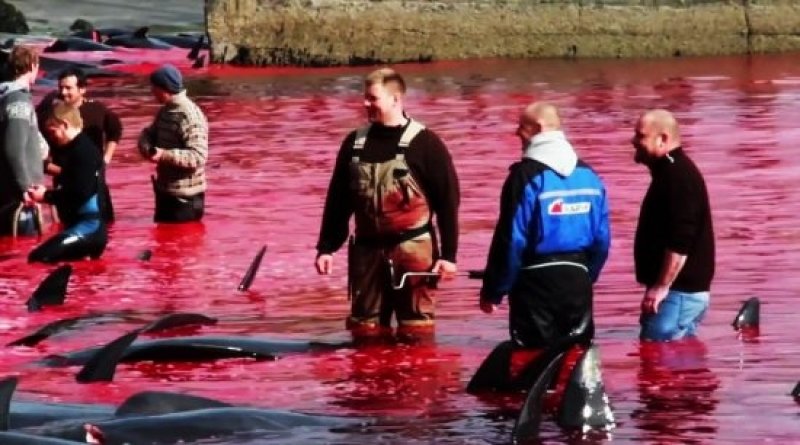
After the cruel slaughter: fishermen in a sea of blood (Screenshot Video Shepherd)
מאמר זה תורגם אוטומטית וייתכן שהוא מכיל אי דיוקים קלים; אנא עיינו בגרסה המקורית באנגלית במקרה של ספק.