Bladderwrack in the climatic stress
environmentclimate changemarine ecosystemsmarine biologyocean research
Healthy bladderwrack, (c) Uli Kunz
Fucus vesiculosus (Bladderwrack) shows coupled reactions to environmental changes Short-term heat waves, long-term warming and acidification, increasing over-fertilization and oxygen depletion - marine ecosystems are subject to many changes. The reactions of marine organisms to these factors are also diverse. Biologists from the GEOMAR Helmholtz Center for Ocean Research Kiel have now been able to prove to a large algae that their response to different environmental changes can be coupled positively and negatively - leading to an acceleration or slowing down their adaptation. The stress on marine ecosystems is increasing. The warming of the oceans, the sinking of the pH value of the seawater, the supply of nutrients and the loss of oxygen sets them to. Individual factors for certain species can certainly be an advantage. Other changes can also severely limit the habitat of the same species. The different effects make it very difficult to estimate future shifts in biodiversity. "One of the central questions is whether the reactions to different changes are positively or negatively related or whether they occur independently of each other," says Prof. Dr. med. Martin Wahl, marine biologist at GEOMAR. Biologists from GEOMAR and the University of Rostock have now published a study in the journal Scientific Reports, which shows for the first time that adaptations to several genetic alterations are linked to one key species in coastal ecosystems, the bladder wrack Fucus vesiculosus. "This can both accelerate and block bladder response to changes," explains Professor Wahl, lead author of the study. Fucus vesiculosus is a brown algae that lives on hard surfaces along the coasts of the North Atlantic and in the North and Baltic Seas. Like other algae, it plays an important role in the binding of carbon in the sea. It also forms the basis of ecosystem on the respective shorelines. In the Baltic Sea, but also in its other distribution areas, the stocks of Fucus vesiculosus since the beginning of the 21st Century have fallen sharply. The exact reasons for this have not yet been finally clarified. For their study, the researchers used a special test facility, Kiel Outdoor Benthocosms (KOB). It consists of a total of twelve experimental chambers in which coastal ecosystems can be simulated on a small scale. Thanks to complex control technology, several environmental parameters can be manipulated. As the KOBs are located on a pontoon in Kiel's inner fjord and are directly supplied with water from the fjord, the environmental conditions within the experimental reservoirs come very close to nature. In the experimental chambers, over a period of 12 months, the team exposed genetically distinct families of bladder wraps to elevated carbon dioxide conditions, resulting in lower pH levels in the water, heat phases, increased nutrient input, and periods of low oxygen levels. The reactions to the different changes were clearly linked. For example, families tolerating lower pH levels could tolerate warming and higher nutrient levels - and vice versa. At the same time, these families were much more susceptible to oxygen depletion. "In nature, this could mean that a bladderwrack population that has adapted to over-fertilization and summer heat is particularly badly damaged or completely destroyed in the autumn by buoyancy of oxygen-free water from deep," explains Martin Wahl. Overall, the team has not only found the first evidence that responses to various symptoms of global change can be coupled. "The study also shows that in the future we will still need research that studies the responses of organisms to multiple environmental or temporally offset environmental changes. Otherwise it will be difficult to make reliable statements about the future development of ecosystems in the sea", explains Professor Wahl.

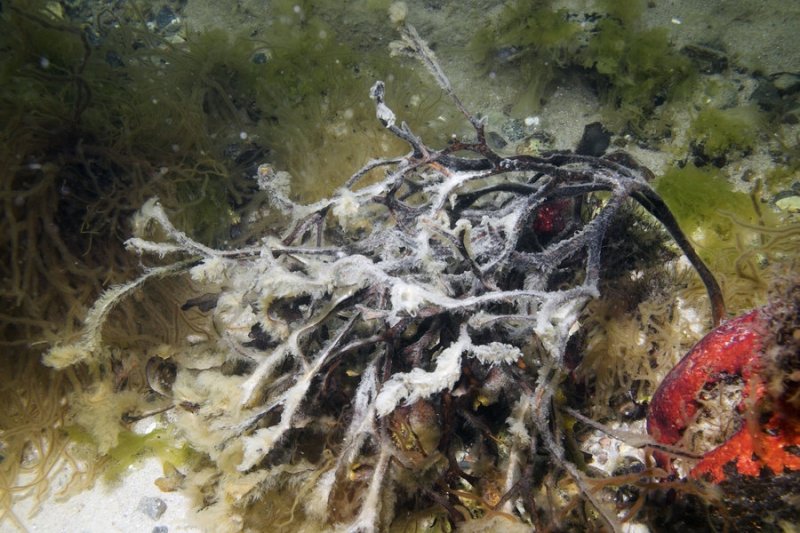
Sick bladderwrack, (c) Uli Kunz
מאמר זה תורגם אוטומטית וייתכן שהוא מכיל אי דיוקים קלים; אנא עיינו בגרסה המקורית באנגלית במקרה של ספק.