European eels use internal compass to reach destination
environmentmarine lifeoceanmigrationmagnetic orientationeuropean eels
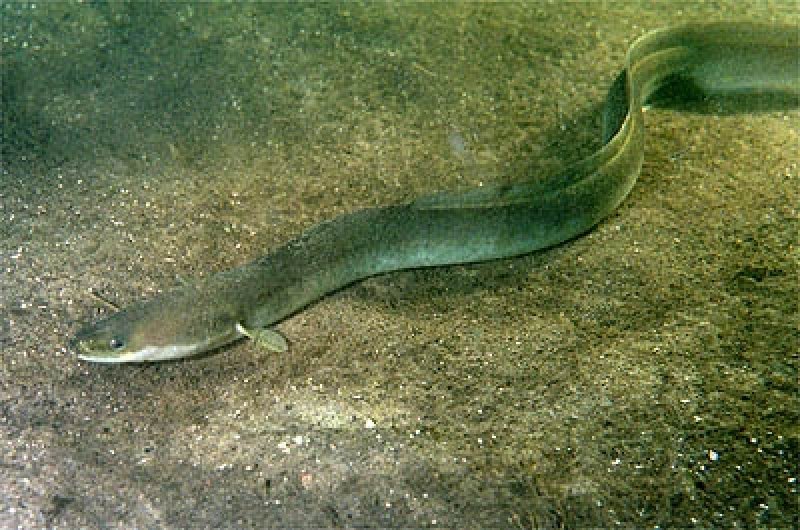
European eel (Anguilla anguilla) (c) Wikipedia, GerardM
Eels’ magnetic orientation follows Earth’s magnetic field In a new study, scientists have discovered how the European eel larvae in the Sargasso Sea can instinctively find their way to European coastlines to start their adult lives in the coastal estuaries there.
A new study by the Rosenstiel School of Marine and Atmospheric Science in the University of Miami (UM), in collaboration with the Norwegian Institute of Marine Research's Austevoll Research Station reveals how European eels (Anguilla anguilla) can sense Earth’s magnetic field, using it like a compass to orient themselves and find their way to the European coastline.
Senior author and UM Rosenstiel School Professor Claire Paris said, " This study is an important addition to our understanding of the mechanisms of eel migration and also to that of other species, if it turns out that their magnetic orientation is similarly controlled by a biological clock. "
The life cycle of the European eel starts in the Sargasso Sea. After hatching, the larvae swim thousands of kilometres across the Atlantic Ocean. When they are somewhere between the Canary Islands and northern Norway, they leave the Gulf Stream and swim towards the coast. When they reach the continental shelf, they will metamorphose into transparent glass eels. Some remain in the coastal areas while others move into the lakes inland.
Led by UM Rosenstiel School Ph.D. student Alessandro Cresci, the team investigated the European eel’s orientation behaviour. They observed the eels in a semi-enclosed, circular aquarium called a Drifting In-Situ Chamber, which was deployed in a Norwegian fjord. This device exposed the eels to an environment they would normally find themselves in before reaching the coast. The eels were then moved to the MagLab, a magnetoreception test facility that exposed them to a manipulated magnetic field in which the north-south and east-west axes were shifted by 90 degrees.
Even without any environmental cues, the eels correctly oriented themselves to the south, the same direction they would have swam in if they were in the wild.
It is incredible that these small transparent glass eels can detect the earth's magnetic field. The use of a magnetic compass could be a key component underlying the amazing migration of these animals. It is also the first observation of glass eels keeping a compass as they swim in shelf waters, and that alone is an exciting discovery, " said Cresci.
The objectives of the study was to learn how the European eels orientate themselves during their migration, and whether they use the Earth’s magnetic field as a frame of reference and change direction based on the tidal cycle to guide them on their journey.
See a link to the study here
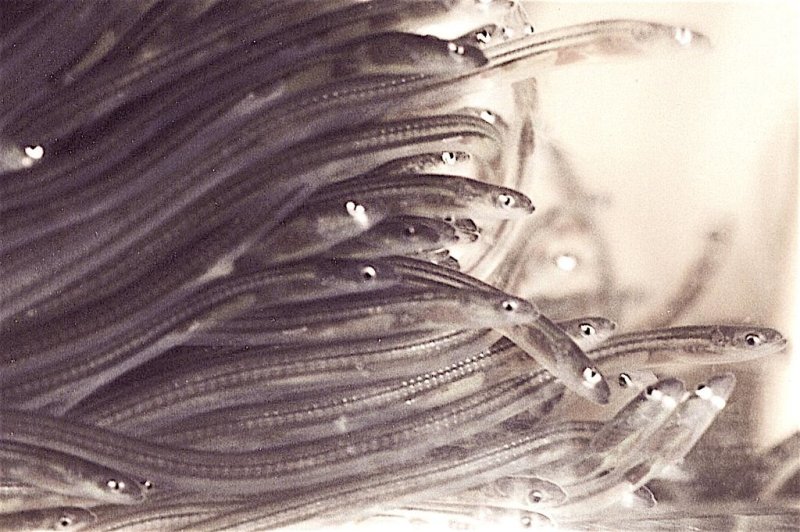
Glass eels at the transition from ocean to fresh water © Wikipedia, Uwe Kils
Cet article a été traduit automatiquement et peut contenir des inexactitudes mineures ; veuillez vous référer à la version anglaise originale en cas de doute.