Reducing plastic waste at sea
environmentmarine conservationoceanplastic wasterecycling
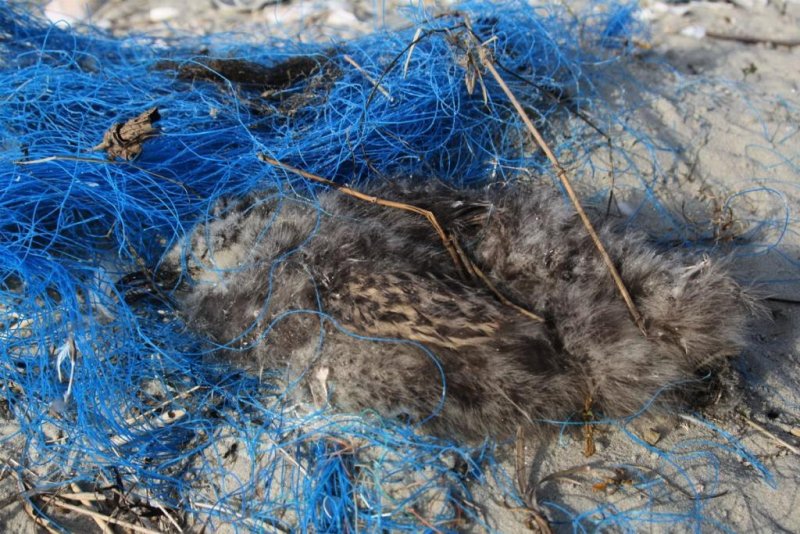
Carcass of dead gull on Trischen.
(c) NABU / J. Bear
NABU, politicians and businesses work together to find solutions
The problem of plastic waste in the oceans is massive. Every year, more
than ten million tonnes of discarded trash enter the oceans from land
alone. However, we still lack solutions to solve the problem. In March 2017, NABU, Magdeburg-Stendal University of Applied Sciences
and The Green Dot in Berlin held discussions with representatives from
the Federal Government and the Federal Environment Agency, as well as
the business sector to come up with possible solutions to tackle
plastic trash in the oceans for Germany and the rest of the world. The
focus was on how plastics would develop in the future and how plastic
waste could be prevented from entering the sea in the first place. The
latest results of NABU's Fishing for Litter project were also
presented.
It is now clear that we are facing a large wave of problems, and it is
not only in Germany. Germany processes more than 10 million tonnes of
plastics annually. Every year, Just as much is landed year by year
alone by land in the sea - with deadly consequences for birds and fish.
We call on the federal government and the businesses to start the
conclusion of the plastic age within the next decade. To achieve this,
we need an exit plan as soon as possible, so as to drastically reduce
the consumption of plastics in Germany, " said NABU President Olaf
Tschimpke. NABU has called upon the federal government to develop specific
reduction and exit plans to tackle the issue of plastics for both
industries with high plastic consumption as well as the packaging
industries. It also wants them to establish stricter regulatory
requirements for the use of plastics. Merely relying on voluntary
agreements from the industry is insufficient to address the problem.
Plastic in the sea decays into small particles. For example, a plastic
bag disintegrates in ten to 20 years; a plastic bottle needs up to 450
years. NABU, together with the Magdeburg-Stendal University of Applied
Sciences, is investigating the decay process and how marine waste can
be further exploited. To this end, scientists are studying trash that
have been retrieved from the North Sea and the Baltic Sea, during the
NABU's Fishing for Litter project. Items retrieved include lost fishing
nets, film and packaging.
Plastic decomposes quickly in saltwater. Under the microscope, the
changes can be detected on the surface. Bits of plastic have broken
off, ending up somewhere in the sea. In the worst case scenario, they
end up in the stomachs of birds and fishes, " said Prof Dr Gilian Gerke
in German. She is a professor in the Department of Water, Environment,
Construction and Safety at the Magdeburg-Stendal University of Applied
Sciences. At the same time, plastics that have been recovered from the
sea can also be recycled. However, for this to happen, the primary
objective must be that no garbage is to enter the ocean.
The management of waste and recycling can play a decisive role in the
fight against plastic trash. " We need to finally establish an effective
system for the collection and utilisation of plastics worldwide,
similar to what already exists in Germany. This is an essential factor
for healthy oceans, " said Michael Wiener, CEO of Green Dot.
This week's discussion in Berlin was an important milestone in the
Fishing for Litter project, in which more than 150 fishermen collect
garbage from the North Sea and Baltic Sea, as we have reported here. The trash is disposed of free of charge at the port. The objective
of the project is to study the routes taken by the garbage as they
enter into German seas, and to recycle the retrieved waste as
sustainably as possible. To date, more than 20 tonnes of waste have
been collected. In the summer, NABU will present further conclusions
drawn from the project.

Plastic waste on the Darss.
(c) NABU / F. Paulin
Este artículo se ha traducido automáticamente y puede contener pequeñas inexactitudes; en caso de duda, consulta la versión original en inglés.