St Lucia
scuba divingenvironmentmarine lifessicoral reefst lucia
(c) Steve Jones
European divers have been spoilt on the Red Sea and the Maldives. Although the Caribbean is a younger tropical location, there are things here that you cannot find anywhere else. This is certainly true for St Lucia. Many people don’t appreciate the extensive variety of marine life that exists in the Caribbean. Indeed, I’m inclined to agree, having spent countless hours underwater in the aforementioned Indian Ocean destinations and knowing the marine life intimately, I always find the Caribbean refreshingly "different".
In recent years, St Lucia has undergone extensive development, and is fast becoming a popular destination on many package tours. It is supported by an international airport in the south of the Island. Many international hotel chains have established luxury resorts on the island, mainly in the north, near the capital Castries. Nevertheless, the island is far from being overdeveloped. You only have to travel a short distance away from the tourist areas to see the rural side of the island, with its many picturesque fishing villages.
St Lucia is a mountainous green island, with a coastline pocketed with quiet bays. The most scenic area is in the south, near the town of Soufriere. It is here that you can find the most photographed landmark on St Lucia: the "pitons" – twin peaks that reach into skies almost vertically from the sea. It is also here that the Anse Chastanet Marine Park and resort resides, promising the best diving experience St Lucia can offer, conveniently located in a stunning setting. The Anse Chastanet Resort is situated in a secluded and private cove. The area is blessed with a house reef that many dive operators on the island travel for miles to visit. The dive centres are conveniently situated right on the beach. After kitting up, you can walk down the gently sloping sandy beach, following the sand out to the drop-off. Alternatively, you can take a route that follows the shoreline closely, alongside the caves and overhangs.
At the drop-off, you can work your way around the headland. The reef drops away well below the safe diving depth – there are no offshore sites on the island since St Lucia’s seascape falls away underwater as rapidly as the landscape rises above the water. The house reef allows a gentle dive, although you must always be wary of the currents as you make your way farther along the coastline.
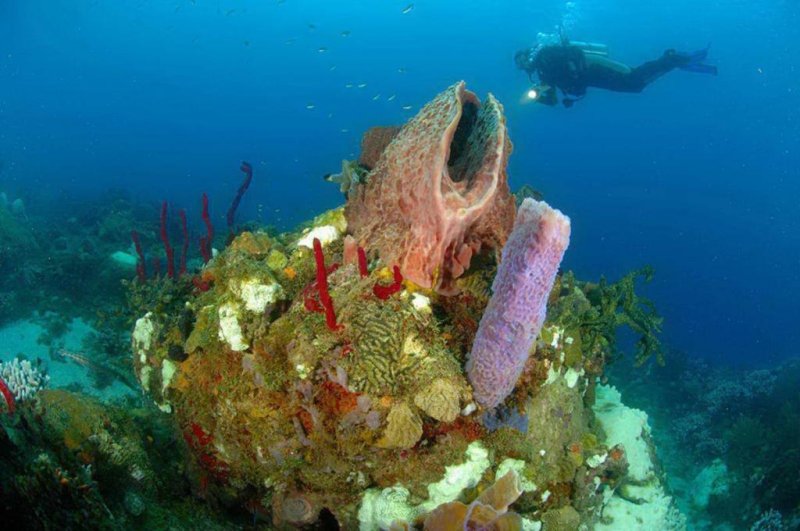
The rich biodiversity on St Lucia is immediately apparent – scorpionfish, morays, pufferfish and various species of shrimp are in abundance. Following the reef along to the left, we pass over a series of coral gullies where large barrel sponges are seen and schools of jacks skirt over the reef, preying on the reef fish. The small shallow caves are home to a rich variety of life. Resident schools of wrasse, needlefish and chromis all appear used to our presence. The marine diversity is possibly the result of nutrient-rich waters surrounding St Lucia, thanks to the volcanic nature of the island. Indeed, during the journey from the airport to the resort, we passed the world’s only "drive-in volcano". During the journey, the smell of sulphur only serves to emphasise the volcanic heritage of the island, despite the fact that there has not been an eruption since 1766.
The superb shore diving is not the only attraction here. Take a short boat ride around the headland from the resort’s bay to experience a view that is simply breath-taking as Petit Piton and Gros Piton, the twin volcanic spires eminently soaring out of the sea, dominate the landscape. Designated as world heritage sites by UNESCO in 2004, it is easy to see how this area is regarded as an outstanding example of cultural and natural heritage. You can dive at various locations around the base of the pitons – most are best done as drift dives. The dive site called "Superman’s Flight" gained its name after being used during the filming of Superman 2 and offers an excellent dive. Large sea whips drift lazily in the current, and hawksbill turtles can be spotted making their way along the reef.
The huge fish schools that are common in the Indian Ocean will not be found here. Rather, the beauty of the diving lies in the variety of smaller creatures and richness of the reefs, all set in majestic surroundings above the water.
St Lucia is shaped like a teardrop. In the past, it alternated between British and French colonial occupation. Now independent, English remains the national language, although a local French-based dialect ("Patois") is also in use. Aside from the diving, hiking, mountain biking and horse riding are popular activities here, owing to the largely mountainous terrain.
Across the bay from the pitons, the pinnacles represent a stunning dive. Four seamounts that nearly kiss the surface after rising over 300 metres from the seabed of Soufriere Bay, the reef is richly blanketed in various species of soft coral and sponges. Trumpetfish and filefish can be seen dancing between the colourful gorgonians. Large basket sponges rise from the reef itself, often providing shelter to shrimp or gobies.
Top Spots for St Lucia
Anse Chastanet Reef This reef is just a short walk from the dive centre. It comprises a plateau running down to eight metres before dropping off into deep water. It is covered in gorgonians, soft corals and sponges. A good site for macro photography, the reef is home to more than 150 different species of fish, including parrotfish, needlefish and scorpionfish, as well as moray eels.
Fairyland Continuing on from the Anse Chastanet reef, this area is covered profusely in corals and sponges. Best explored during a drift dive, the reef slopes gently from 12 to 18 metres before dropping off into deep water. Occasionally, turtles can be spotted at this colourful site.
Pinnacles A stunning dive on four coral pinnacles that rise abruptly from the depths to within a few metres from the surface. Trumpetfish, filefish and seahorses can be seen swimming between these pinnacles amongst the whip corals and gorgonians.
Superman's Flight This site is located at the base of the Petit Piton. The cliff face was used during the filming of the movie "Superman II". It offers a great drift dive along a steep slope covered in colourful coral life. Surfacing from the dive, you are greeted by truly spectacular scenery.

(c) Steve Jones

(c) Steve Jones

(c) Steve Jones

(c) Steve Jones

(c) Steve Jones
Bài viết này được dịch tự động và có thể chứa một số lỗi nhỏ; vui lòng tham khảo bản gốc tiếng Anh nếu có thắc mắc.