Countering the jellyfish threat
environmentmarine conservationinnovationsustainabilityresearch
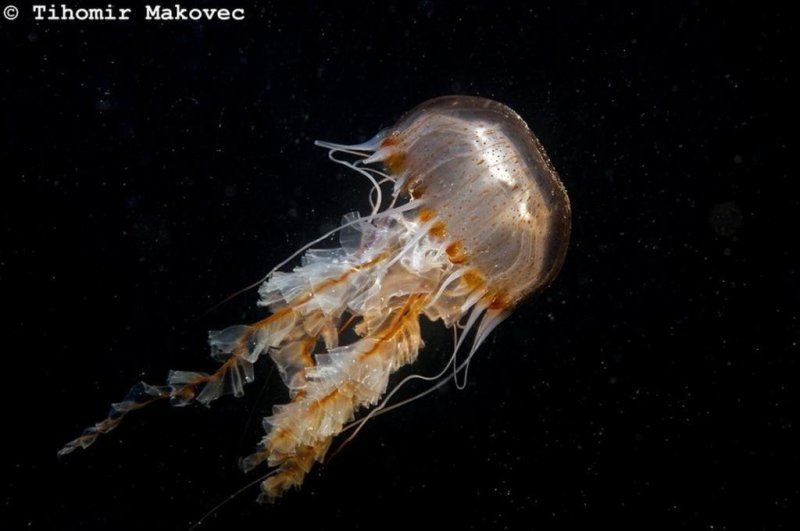
The compass jellyfish (Chrysaora hysoscella) is a very common species in the coastal waters of the Atlantic and Mediterranean. (c) Tihomir Makovic
European project focuses on finding innovative uses of jellyfish
Global climate change and human impact on marine ecosystems have resulted in a decrease in the fish population in the oceans. This in turn has led to a drop in the number of predators of jellyfish. As a result, jellyfish blooms are on the rise.
Many people regard jellyfish as annoying and even dangerous. The EU-funded GoJelly project, coordinated by GEOMAR Helmholtz Centre for Ocean Research Kiel, Germany, involves a consortium of 15 scientific institutions from eight countries. It aims to change this perception and to explore innovative ways to make use of jellyfish as a resource to produce microplastic filter or fertilizer, or to use them as fish feed. Its funding of six million Euros, over a four-year period, was approved by the European Union.
Rising water temperatures, ocean acidification and overfishing appear to favour the growth of jellyfish, which are congregating in huge swarms more and more often. Jellyfish have already destroyed entire fish farms on European coasts and clogged up the cooling systems of coastal power stations. Can a solution be found to this growing environmental threat?
" In Europe alone, the imported American comb jelly has a biomass of one billion tons. While we tend to ignore the jellyfish, there must be other solutions, " said GEOMAR’s Dr Jamileh Javidpour.
For all project partners, the project will begin with basic research. Currently, the life cycles of many jellyfish species have not been fully studied, so we cannot predict when and why a large jellyfish bloom would occur. "This is what we want to change, so that large jellyfish swarms can be caught before they reach the coasts," said Dr Javidpour.
At the same time, the partners will also consider what to do with the resultant biomass. One idea is to use it to counter another man-made threat. According to Dr Javidpour, " Studies have shown that the mucus of jellyfish can bind microplastics. Therefore, we want to test whether biofilters can be produced from jellyfish. These biofilters could then be used in sewage treatment plants or in factories where microplastics is produced. "
Other ideas include turning the jellyfish into fertiliser and bulking agents as soil water storage in agriculture, in dry areas or for aquaculture. "Fish in fish farms are currently fed with wild-caught fish which does not reduce the problem of overfishing, but increases it. Jellyfish as feed would be much more sustainable and would protect the natural fish stocks," said Dr Javidpour.
In addition, the researchers also considered putting the jellyfish on the menu. " In some cultures, jellyfish are already on the menu. As long as the end product is no longer slimy, it could also gain greater general acceptance, " the biologist continued. Furthermore, jellyfish also contains collagen, a substance that is highly sought after in the cosmetics industry.
Besides coordinating the project, Dr Javidpour and her team will identify the ecological drivers that affect the formation of jellyfish blooms in different geographical areas and ecological systems. Unique techniques to measure stable isotopes on low biomass of jellyfish as well as tracing biomolecules such as fatty acids will be applied. This information will be used to predict jellyfish blooms, with the objective of developing of an interactive map and app for predicting jellyfish aggregations. Currently, existing websites and apps only monitor blooms without attempting to forecast them.
" Jellyfish can be used for many purposes. We see this as an opportunity to use the potential of the huge biomass drifting right before our front door, " Dr Javidpour summarised.
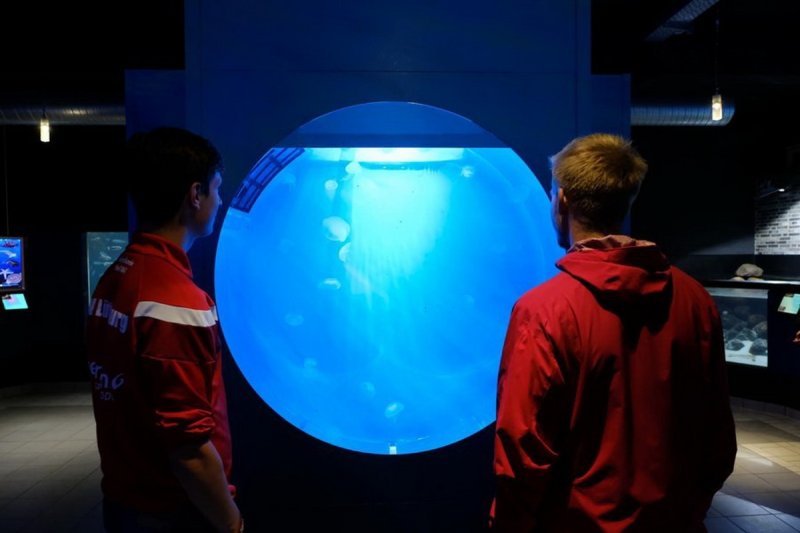
To conduct experiments on how selected species acclimatise to being in captivity and the future use of the jellyfish biomass during the "off season," an innovative cage will be built and used. (c) Jan Steffen, GEOMAR
Este artigo foi traduzido automaticamente e pode conter pequenas imprecisões; em caso de dúvida, consulta a versão original em inglês.