Coral activate specific genes in stressful conditions
coral reefsenvironmentmarine conservationgene activation
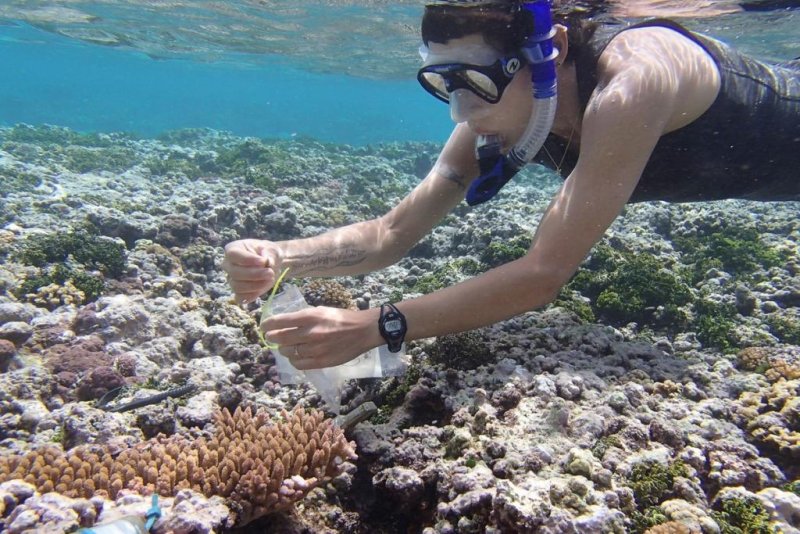
Stanford graduate student Lupita Ruiz-Jones takes a sample from the corals near Ofu Island, American Samoa (c) Zack Gold
Genes in corals help to predict whether the corals are experiencing stress
Scientists recently discovered a group of genes in corals that can help to predict whether the corals are experiencing stress and are in danger of bleaching.
Their findings, published in the recent issue of the Science Advances journal, has the potential to improve conservation strategies for coral reefs worldwide.
When corals are exposed to stressful environmental conditions, scientists at Stanford University observed a major change in which genes the corals activated within their cells.
"They started using a whole set of genes that they had just not been using before," said Steve Palumbi, a professor of marine sciences, and director of Hopkins Marine Station.
Under stressful environmental conditions, a coral’s normal cellular functions start to fail. In response, the group of genes identified in this study triggers a process (called the unfolded protein response), that works to restore normal conditions within the cell. If conditions continue to worsen, the corals bleach and eventually die.
"For the first time, we are able to ask those corals, ‘how are you doing?’ They don’t have a heartbeat. They don’t have a pulse. We need to know their vital signs in order to understand how they react to the environment," Professor Palumbi said.
In the seventeen-day study, he and graduate student Lupita Ruiz-Jones monitored the responses of three coral colonies in a lagoon on Ofu Island, American Samoa, to stressors like high temperatures, oxygen and ocean acidity.
On the seventh and eighth day, when tides were lowest and temperatures hottest, the corals’ genes initiated the cellular unfolded protein response. Then, on the ninth day, the tides rose and the corals’ systems returned to normal.
"It’s basically the organism recognising that something isn’t right," Ruiz-Jones said. "This response just shows how in sync corals are with their environment".
Hence, by monitoring corals and looking out for the emergence of these genes, scientists might get an indication of coral health – and an idea of when bleaching is likely to occur.
تمت ترجمة هذه المقالة تلقائيًا وقد تحتوي على أخطاء طفيفة؛ يرجى الرجوع إلى النسخة الإنجليزية الأصلية في حالة الشك.