Sea Slug Tethys Fimbria
scuba divingenvironmentmarine lifefreedivingextended rangemediterraneansea slugtethys fimbria
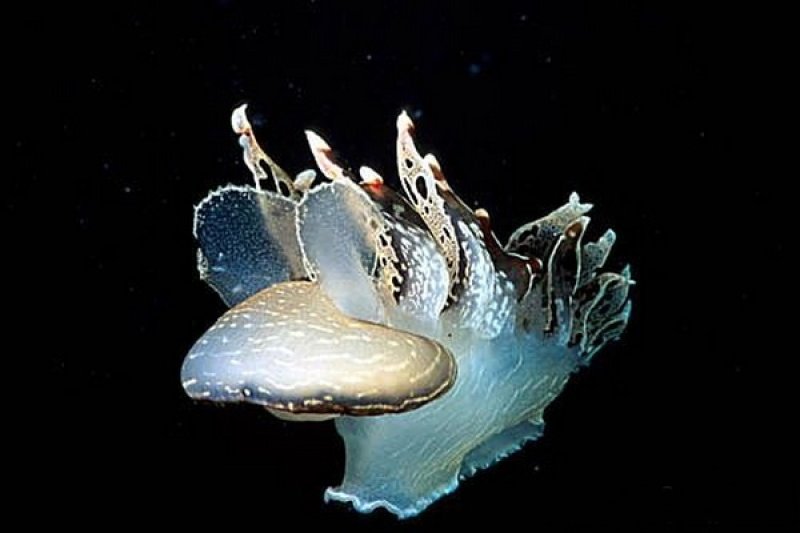
Sea Slug Tethys Fimbria
(c) Bucca Giuseppe
A sea slug called Tethys fimbria
If you are lucky to come across a Tethys fimbria when diving in the Mediterranean, it is like hitting the jackpot. Granted they are not that rare, but the sea slug normally live in areas which divers are not particularly fond of – monotonous sandy and muddy ground, and beyond the maximum diving depth for compressed air.
I still remember it well. It was 1999, and I was on our club trip to Pula in Croatia. I was at the house reef looking for critters. The reef was at 15 to 20 metres deep, in the Adriatic Sea's sandy and muddy bottom. I was on my own as the other divers thought that there was "nothing to see." But far from it! The shallow sea floor had no hiding places, so I spotted seahorses, mantis shrimp, baby cuttlefish, strange orange sponges and something very usual. That something looked like a combination of a dead cuttlefish, jellyfish and plastic bag – it was my first (and so far only) Tethys fimbria!
Information Fimbria
Scientific name: Tethys fimbria
Size: Up to 30 cm
Appearance: Looks like a "psychedelic plastic bag"
Habitat: sandy and muddy bottom. Usually very deep
Food: Crustaceans and small fish
Distribution: Mediterranean and along the eastern coast of the Atlantic
Appearance: May be mistaken for dying jellyfish or cuttlefish
Tethys fimbria are the largest nudibranches in the Mediterranean, they can be as long as 30 cm long! This is larger than the already impressive lumpfish in the Adriatic Sea, but still nothing compared to the Japanese cousin of the Tethys Fimbria – the Melibe japonica – which can grow up to 70 cm long!
A 70 cm long nudibranch – did they possibly mutate due to the nuclear power plants ;-)?
Tethys fimbria look sort of worn out: a big, off-white headcloth that covers over the prey, reminiscent of rabbit ears. It has distinctive appendages that move up and down as it hunts for prey.
Overall, it is more or less transparent, so the blood vessels inside its body can be seen. White dots on its skin round up its whimsical appearance.
Between January and March, Tethys fimbria appear in the shallower waters to spawn. This is the best time to find this sea slug. In fact, if you are lucky enough to actually discover one, you should also buy yourself a lottery ticket or visit a casino!
Video
The video was filmed by Anna Nokela of Quality Divers Dive Center, Najada Diving, Croatia. She tells us:
" We dive regularly wonderful dive sites in the National Park Kornati. One of them is „Kornat East" – an exciting site with a wall, cave, chimney that you can dive though, lots of fish schools and half caves, perfectly overgrown. We were controlling the site for Caulerpa Racemosa, which was growing on some spots last year. Luckily the cold winter did its job – no Caulerpa was found! The big sensation came as we return to the boat: directly next to our boat we found a huge nudebranch dancing in front of us. Luckily we had several cameras with us, so we could document this very fascinating animal. A marine biologist friend of ours told us later what we had seen: a Sea Slug (Tethys Fimbria ) that can be a good 30cm in length and is quite rare. "
See here for more information about Najada Diving

Sea Slug Tethys Fimbria
(c) Screenshot Video - Najada Diving

Sea Slug Tethys Fimbria
(c) Screenshot Video - Najada Diving

Sea Slug Tethys Fimbria
(c) Screenshot Video - Najada Diving
Bài viết này được dịch tự động và có thể chứa một số lỗi nhỏ; vui lòng tham khảo bản gốc tiếng Anh nếu có thắc mắc.