Monkfish
environmentmarine lifeoceancamouflagemonkfishpredator
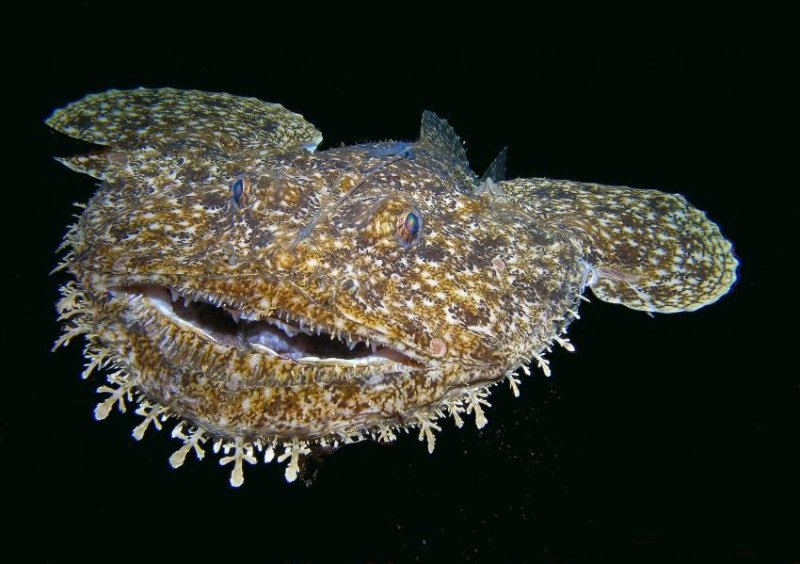
Monkfish (c) Steffi, Archiv Taucher.Net
The silent predator with the big mouth The flattened grotesque head opens up suddenly, revealing rows and rows
of teeth. Before the victim can react, it is sucked into the huge
mouth. A split second later, all is silent again, except for the
settling sediment and perhaps some glittering bits of the unfortunate
prey. Then, once again, the predator wiggles its lure, and awaits its
next victim.
Many have described the monkfish as an ugly fish. However, this isn't
necessarily true — it just looks a little peculiar. Its gigantic flat
head and large mouth with pointed teeth are disproportionately large
compared to its small body. In addition, there are the stiff appendages
on its head, which resemble the unkempt beard of a down-and-out sailor
in a tavern along the harbour. Its thoracic fins, used as feet, look
quite odd as the fish "walks" on them slowly and deliberately on the
seabed.
The monkfish Species: 28 in 4 genera
English: Monkfish (German: Sea devil)
Order: Lophiidae
Size: usually up to 1 metre
Appearance: Large, flat fish with huge head and mouth. Good at camouflage.
Habitat: Bottom-dweller, 10 to 1.000 metres deep
Food: mostly fish
Distribution: North-eastern Atlantic Ocean and neighbouring oceans
Often mistaken as: Wobbegong (carpet sharks) in Australia, and crocodile fish in Red Sea
Economic importance: Excellent food source
A fish fishing for prey Like the anglerfish, spines protrude from the top of the monkfish's
head. The first and longest filament, called an illicium, ends in a
fleshy growth called an esca. The monkfish wiggles this lure to attract
prey into the vicinity. Once an unsuspecting fish comes within reach,
the monkfish suddenly opens its mouth, creating a vacuum that causes
the prey to be swiftly sucked into its throat. The next second,
everything is over. All that remains is the unassuming,
peculiar-looking monkfish wiggling its lure, waiting for its next
victim.
Using its fins to move around Monkfish belong to the order of Lophiiforme. A direct translation of
the German name of the order (Lophiiforme) is "fins like arms", which
aptly describes how the monkfish moves. In the case of the closely
related anglerfish, such movement is particularly beautiful, as they
use their fins to slowly crawl and hop on the seabed. Note: This is
akin to our own arms, which can be considered as evolutionary
breast-fins, which evolved into front legs for our ancestors and which
have now become our arms. As for the belly fins, they became our legs ).
Reproduction When the monkfish reaches sexual maturity at about six years of age,
the male is about 40cm long and the female is about 70cm. When they
spawn, the couple releases about a million violet eggs which are
attached to a gelatinous sheet about the size of the flag on a flag
pole. Drifting freely in the ocean, the sheet is eventually torn apart
by the current and waves. The larvae are free-swimming, and convert to
a ground-based existence when they are about seven centimetres long.
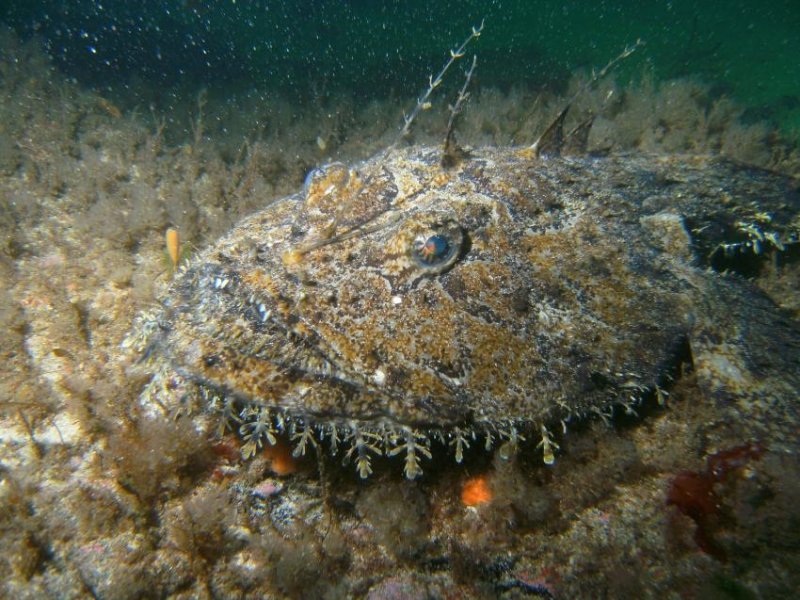
Monkfish (c) Budi, Archiv Taucher.Net
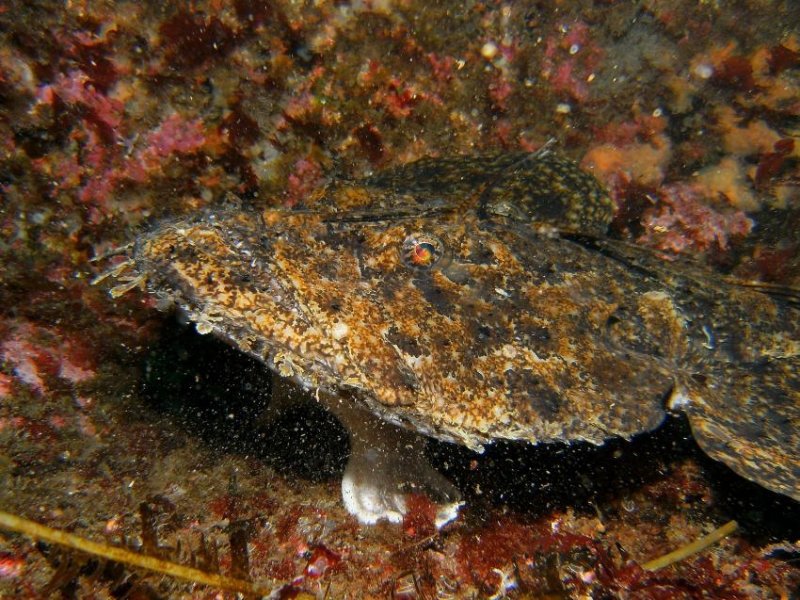
Monkfish (c) Budi, Archiv Taucher.Net
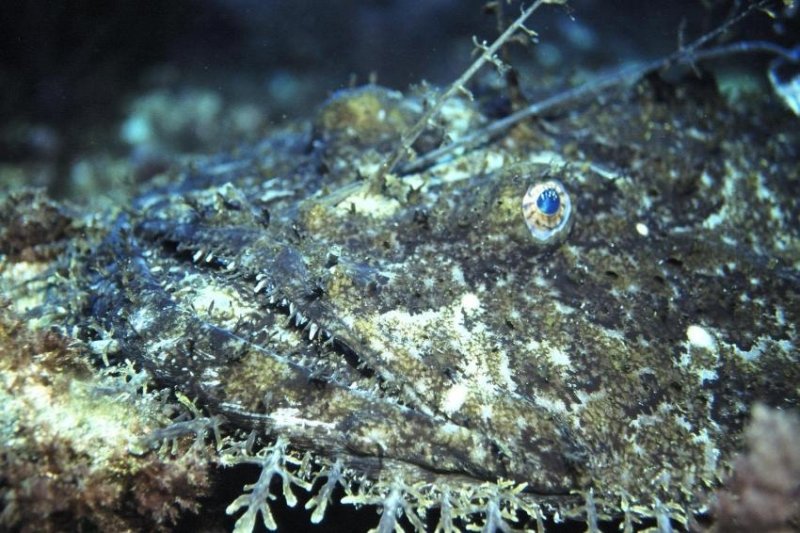
Monkfish (c) Olli, Archiv Taucher.Net
Bài viết này được dịch tự động và có thể chứa một số lỗi nhỏ; vui lòng tham khảo bản gốc tiếng Anh nếu có thắc mắc.