Deep-sea snail on the Red List of Threatened Species for the first time
environmentmarine conservationoceandeep-sea biodiversitythreatened species
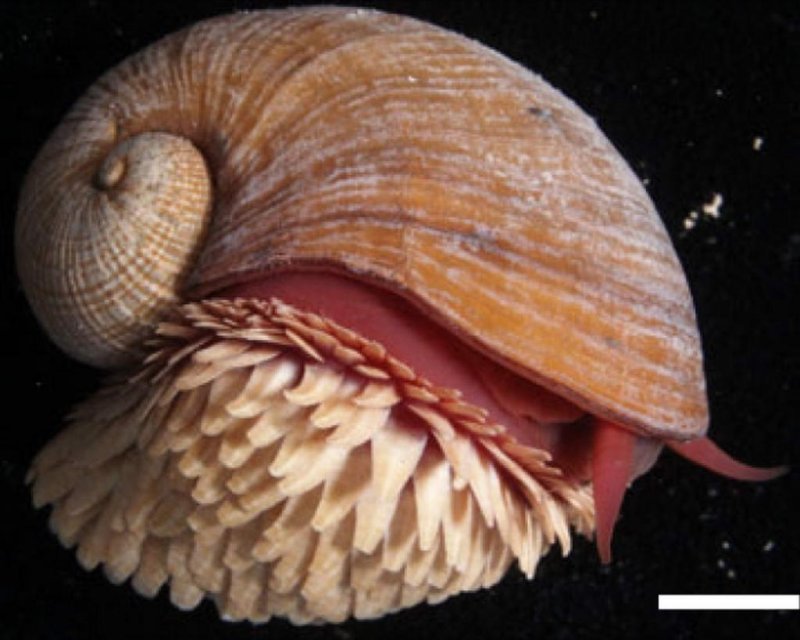
Scaly-Foot Snail (Chrysomallon squamiferum) (c) Kentaro Nakamura
The scaly-foot snail occurs only in three places in the Indian Ocean The World Conservation Organization (IUCN) published an update of the Red List of Endangered Species on 18 July 2019. The Scaly-foot snail was classified as threatened, a unique species with a „unique construction" with three layers. The foot is also very unusual as it is armoured with iron-mineralised sclerites at the sides. The snail is found only in hydrothermal springs in the Indian Ocean. Research initiatives leading to this classification were led by the Japan Agency for Marine Earth Science and Technology (JAMSTEC). The hydrothermal activity of the ocean floor in the Indian Ocean has been studied since the 1990s. The scaly-foot snail is known only from three hydrothermal springs, which are about two football fields in total. The unique deep-sea snail occurs at depths of 2,400 to 2,800 meters. Deep-sea hydrothermal wells are under pressure: The growing interest in extracting seabed sulphide has resulted in two of these three hydrothermal wells (Kairei and Longqi) being located in areas for which the International Seabed Authority has awarded mining exploration licenses. The cramped habitat of the scaly-foot snail must, therefore, be considered threatened - a reason to add the species to the Red List. The threatening deep-sea mining thus leads for the first time to the under-protection position of a species. The addition to the Red List serves as an important case study showing how the IUCN Red List can be used to conserve the deep sea, which has so far been largely unexplored. A study of this new development in the field of deep-sea biodiversity conservation has recently been published in the journal Nature Ecology & Evolution (JST). More Information: http://www.jamstec.go.jp.
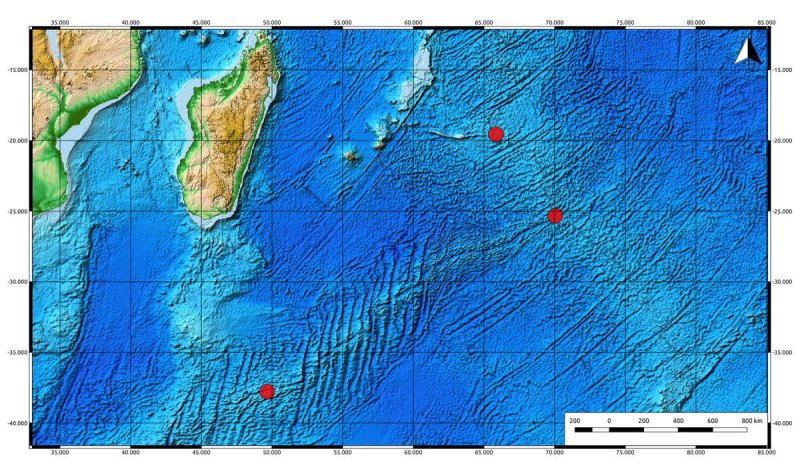
Distribution Map: Scaly Foot Gastropod

Three_populations of Scaly-Foot Snails (Chrysomallon squamiferum) (c) Chong Chen
Ця стаття була автоматично перекладена та може містити незначні неточності; у разі сумнівів зверніться до оригінальної англійської версії.