A new Jurassic pyncnodontiform fish
environmentfishfossilpaleontologyjurassic
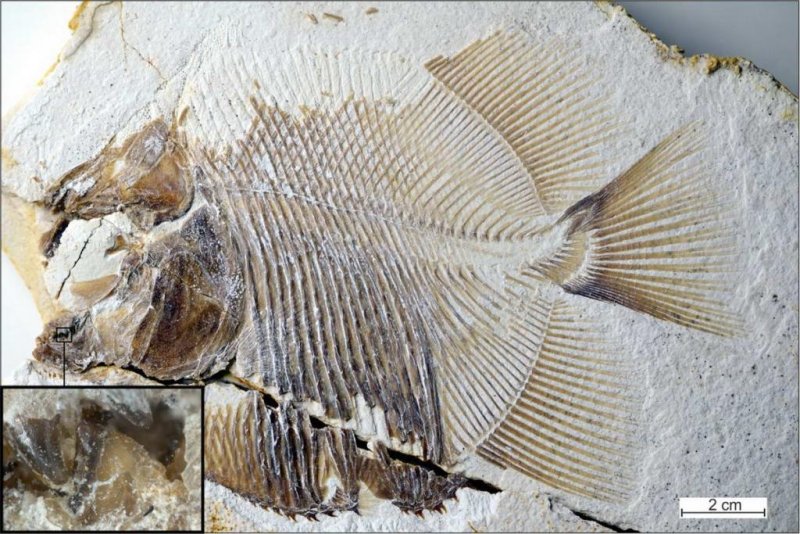
The new found fish: Piranhamesodon pinnatomus is exhibited in the Jura-Museum Eichstätt
(c) Jura-Museum Eichstätt
150 million year old fossil with teeth like a piranha In the approximately 150 million year old limescale in the quarry Ettling a sensational new species of fish was discovered during excavations of the "Jura Museum Eichstätt". A research team from the "Jura-Museum Eichstätt", the Australian James Cook University and the University of Erlangen investigated this fish species and recently described it in the journal Current Biology. Microscopic examination and CT scans of the fossil's jaws show long, pointed teeth. The dentition pattern, tooth shape, jaw morphology, and mechanics are all indicative of a feeding apparatus suitable for slicing flesh or fins, thus pioneering a new ecological niche. There is a possibility that this piranha-like fish used the aggressive mimicry camouflaged behind a seemingly harmless appearance, and then was able to attack more effective; an amazing parallel to the feeding behaviour of modern piranhas. Particularly amazing: The fish belongs to an extinct group of fish, which are known for plaster-like "crack teeth". It's like meeting a sheep with the fangs of a lion. For bone fish, this diet is very unusual. The carnivores among them usually crack shell-bearing invertebrates or swallow their prey - usually other fish - in one piece. Bite out pieces of meat or fins is something only extremely few species are able to do. The new findings represent the oldest tradition of a bony fish that was able to bite out pieces of other fish. In the same limestone deposits of the Ettlinger quarry also the victims of this new found carnivore fish were found - fish whose fins were bitten. "This is a surprising parallel to modern piranhas, who feed mostly on the fins of other fish, not the meat, it is a remarkably smart move as the fins regrow, a clean renewable food source, eat a fish and it is dead; nibble his fins and you have food for the future," explains Prof. David Bellwood of Coral CoE at James Cook University. More information: www.jura-museum.de und www.coralcoe.org.au Link to the study: www.cell.com/current-biology/fulltext/S0960-9822(18)31208-9
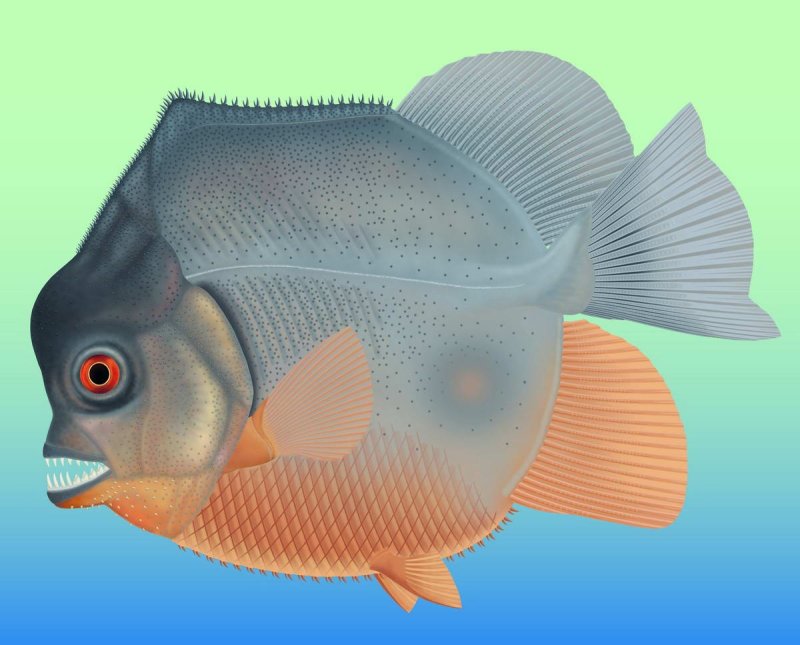
The piranha-like fish from the Jurassic probably fed on the fins of other fish
(c) G. Horsitzky, Jura-Museum Eichstätt
Ця стаття була автоматично перекладена та може містити незначні неточності; у разі сумнівів зверніться до оригінальної англійської версії.