Year of Science 2016*2017: Seas and Oceans opens
environmentmarine conservationclimate changepollutionocean research
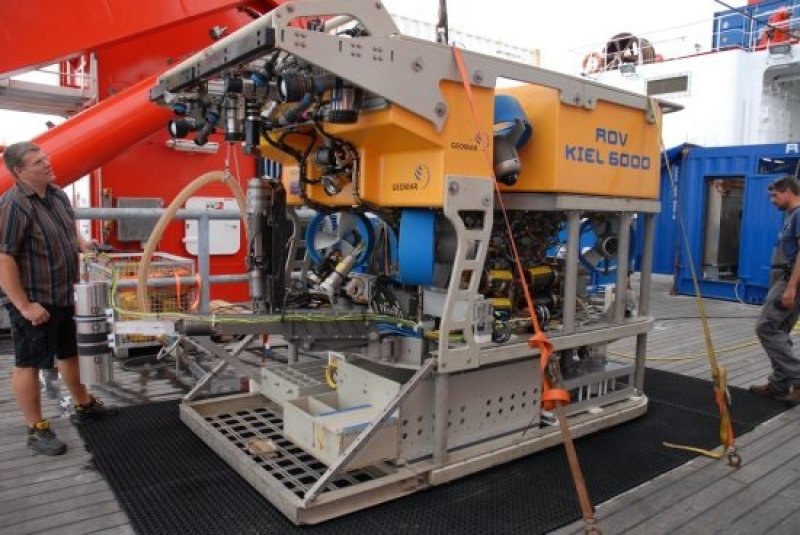
The ROV Kiel 6000 (c) Peter Linke/GEOMAR
More funds to be allocated to oceanic research
In the coming years, the focus of research will be on The Future Oceans, said Federal Research Minister Johanna Wanka when she opened the Year of Science 2016*2017: Seas and Oceans on 7 June 2016, as she announced a new joint marine research programme of the Federal Government.
" Previously, Man discovered new lands by travelling across the oceans. Today, we have explored the oceans in even greater detail. Only when we properly understand the ocean can we use it sustainably and offer it better protection, " Minister Wanka said at the opening.
She added that it was now necessary to initiate a turnaround towards the sustainable use of the oceans – the planet's largest habitat – to tackle the problems of climate change, overfishing and pollution.
The new Year of Science focuses on the fascinating world of the oceans and the amazing discoveries brought about through marine research, ranging from the study of animals of the deep sea to the polar ice. It aims to raise public awareness of the world's marine ecosystems, which are threatened by global warming, income inequality, pollution and environmental pressures.
The new marine research programme of the federal government – called Exploration of the Sea, or MARE: N – aims to develop research strategies against pollution, overfishing and ocean acidification. It combines the efforts of the ministries involved in federal research, economic matters, agriculture, transport and the environment. In the next decade, the Federal Ministry of Education and Research (BMBF) will allocate more than 450 million Euros to promote such projects. Along with the promotion of research centres and the renewal of the German research fleet, more than four billion Euros will be utilised by the German government to safeguard the future of the oceans.
In addition to the MARE: N programme, plastics will be in the focus from June onwards. Featured projects will examine and study plastics, from their production and usage, to their disposal into and impact on our rivers and oceans. About 28 million Euros has been allocated over a period of three years to support the search for solutions to this problem.
MARE:N is also part of the G7 action plan focussing on plastics in the environment, particularly microplastics. It is aimed at protecting the marine environment with a strong commitment at the European level. This represents part of Germany's contribution into the study of the impact of marine pollution.
As a joint initiative with "Wissenschaft im Dialog" (Science in Dialogue), many hands-on activities and events have been planned for visitors for Year of Science 2016*2017. Funding for projects and collaborations with the media has also been organised. (An overview of this can be found in the appendix.). The United Kingdom is a long-standing supporter and German's partner country in the Year of Science 2016*2017.
For the Year of Science, the exhibition entitled "The Sea Starts Here" is being held in the foyer of the BMBF in Berlin. This exhibition comprises both permanent and temporary components. The latter portion will be changed every four to five months; specifically, visitors can learn about the coasts (Summer/Fall 2016), the Arctic and Antarctic (Winter 2016/2017) and the deep sea (Spring/Summer 2017).
The Year of Science 2016*2017 has two media partners. For television, it is ARTE, the German-French culture channel; for print, it is mare magazine, a periodical which portrays the oceans as living, economic and cultural space.
Further Information: www.wissenschaftsjahr.de
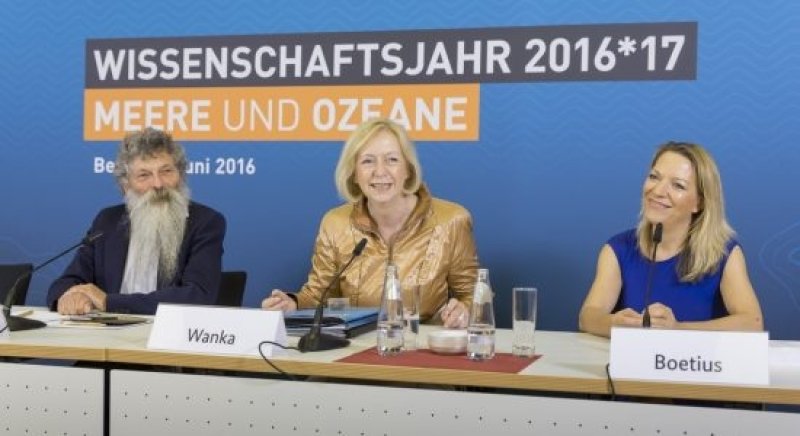
Federal Research Minister Johanna Wanka, Antje Boetius and Ulrich Bathmann Chairman of the German Marine Research Consortium, at the press conference to kick off the Year of Science 2016*2017: Seas and Oceans. (c) BMBF/Wissenschaftsjahr 2016*17

"The sea starts here": Federal Research Minister Johanna Wanka, Antje Boetius and Ulrich Bathmann Chairman of the German Marine Research Consortium, before the ROV Kiel 6000 at the opening of the Science Year 2016*2017: Seas and Oceans. (c) BMBF/Wissenschaftsjahr 2016*17
Bu makale otomatik olarak çevrilmiştir ve küçük hatalar içerebilir; şüphe duymanız durumunda lütfen orijinal İngilizce versiyona bakın.