Methane gas off Spitsbergen: climate change is innocent
environmentclimate changemarine sciencemethanepost-glacial processes
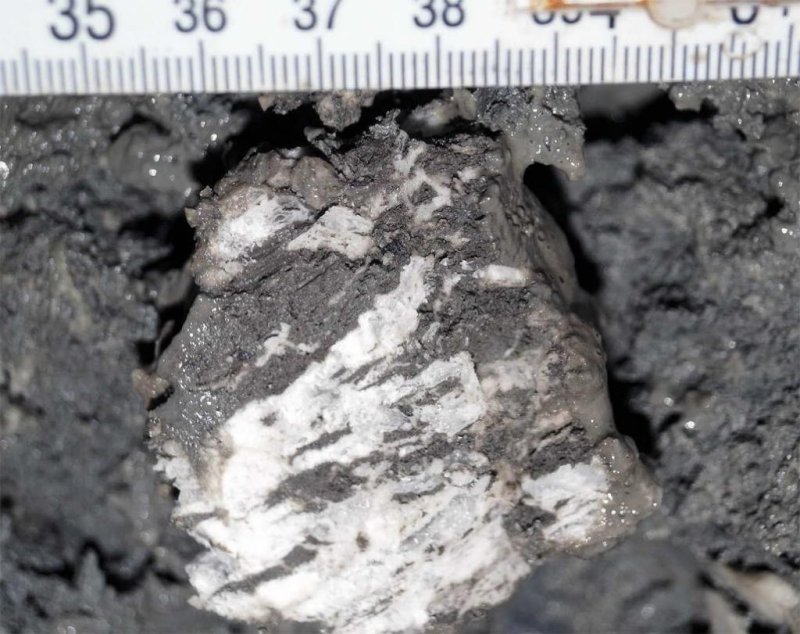
White methane hydrate layers pass through the sediments © MARUM - Center for Marine Environmental Sciences, University of Bremen; G. Bohrmann
New study identifies post-glacial processes as the cause For years, methane sources on the seabed have been observed in the Arctic Sea off Spitsbergen. The assumption that the warming of seawater caused by climate change is responsible for the release of methane has now proved wrong. New research shows that post-glacial uplift is the most likely cause of methane hydride dissolution. Methane hydrates, also known as burning ice, occur in many regions of the oceans. But only under high pressure and cold temperatures does the product of methane and water form a solid compound. If the pressure is too low or the temperature too high, the hydrates dissolve, the methane is released as gas and escapes from the soil into the water column. Spitsbergen has been experiencing severe outgassing for several years. Does the methane escape from decomposed methane hydrates? What is the cause of dissolution of methane hydrates? Warming due to climate change or other, natural processes? An international team of researchers has now been able to answer this question, recently published in the international journal Nature Communications. Our investigations show that in this region, due to the melting of the ice masses, probably in the region since the end of the last ice age, the dissolution of methane hydrate in the seabed has already been occurring for several thousand years, " explains Prof. Dr. Klaus Wallmann, first author of the study by GEOMAR Helmholtz Center for Ocean Research Kiel. "The region has lifted more than the sea level has risen, so there was a pressure relief, so dissolve the methane hydrates," Wallmann continued. For their investigations, the scientists conducted an expedition with the German research vessel "Maria S. Merian" under the direction of the Bremen Research Center MARUM - Center for Marine Environmental Sciences at the University of Bremen. The drilling rig "MARUM-MeBo70" was also used. " With this special device, we were able to gain long sediment cores for the first time in the marine area, which was not possible on many other expeditions, " explains Chief Scientist Prof. Dr. med. Gerhard Bohrmann from MARUM. " In it, we found significant amounts of freshwater that come from dissolved hydrates, " Bohrmann continued. This process, the researchers could prove, started 8,000 years ago, so it can not be caused by the global warming of the past decades. In addition to the geochemical analyzes, results of a model simulation of ice distribution in the Arctic since the last ice age were used. " The land has risen faster and stronger as the sea level rose, so that the pressure on the hydrates decreased and they finally became unstable ," said Prof. Wallmann. Therefore, the dissolution of hydrates to explain this process, especially since the warming of sea water in deep layers of the ocean is still low, the researchers The investigations off Spitsbergen show a methane release, which is not due to climate warming. Whether this applies to other areas of the Arctic or even in middle latitudes, further research efforts are necessary. Link to the study: http://dx.doi.org/10.1038/s41467-017-02550-9
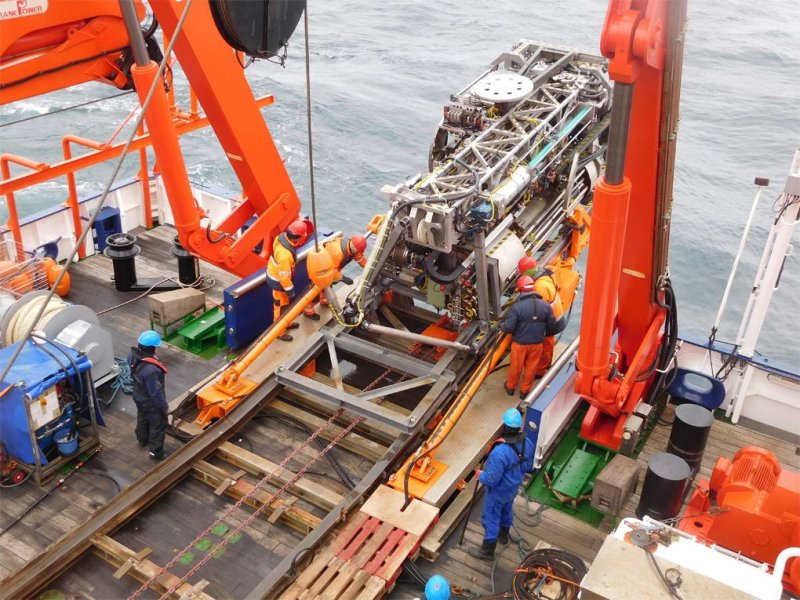
The seabed drill "MARUM-MeBo70" comes back on board after successful drilling © MARUM - Center for Marine Environmental Sciences, University of Bremen; G. Bohrmann
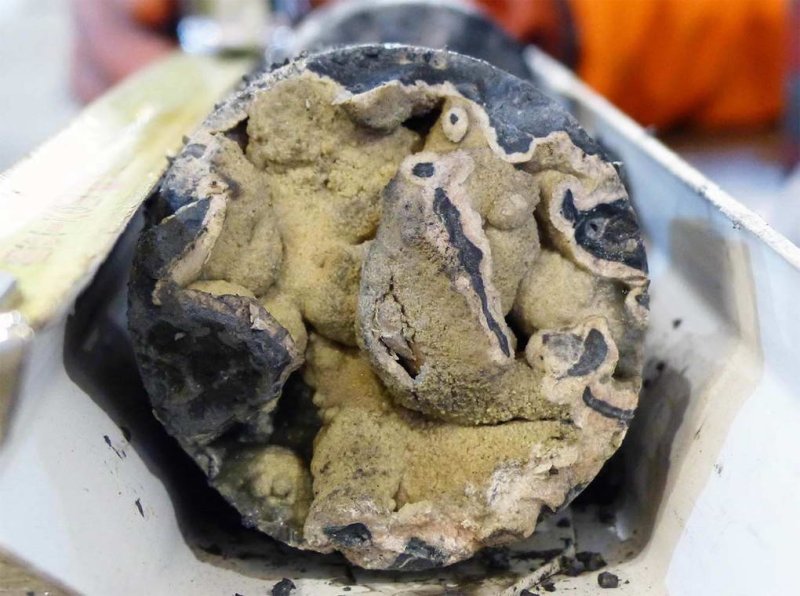
The rotary drill bit of the "MeBo70" has penetrated a layer of limescale activated in soft sediments. Bright Aragon cements typically fill the cavities of the sea carbonate © MARUM - Center for Marine Environmental Sciences, University of Bremen; G. Bohrmann
Bu makale otomatik olarak çevrilmiştir ve küçük hatalar içerebilir; şüphe duymanız durumunda lütfen orijinal İngilizce versiyona bakın.