How much methane comes from the ocean?
environmentmarine conservationoceanmethanegreenhouse gas

Ocean (c) Mehlauge/Wikipedia
New study reduces uncertainties in greenhouse gas emissions Methane (CH4) is a powerful greenhouse gas that has both natural and anthropogenic sources. The ocean also plays an important role here. A new study by German and American scientists with the participation of the GEOMAR Helmholtz Center for Ocean Research Kiel, which appeared in the journal Nature Communications, can reduce the uncertainties in global ocean methane emissions by two-thirds Methane (CH4) accounts for about 20% of the anthropogenic greenhouse effect. The anthropogenic impact on the atmospheric methane content is not only caused by direct emissions, but also by climate-induced changes in the natural CH4 cycle. The natural sources of methane include the ocean, but recent estimates of methane emissions from the ocean are associated with great uncertainties. This is because there are still very few measurements of CH4 concentrations in the ocean and the CH4 distribution in the ocean is very variable. While surface concentrations in biologically unproductive regions in the open ocean are almost in equilibrium with the atmosphere, they can be more than 1,000 times higher in some shallow coastal areas. The recent global estimates of the oceanic methane source have been compiled by aggregating the results of several regional studies. The recently published study presents the first global ocean methane emissions estimate based on the compilation of all available surface global ocean CH4 data. From this, a global climatology of the imbalance of methane between ocean and atmosphere (ΔCH4) was first created. These data were then used to train two different Artificial Neural Networks (ANNs) and Random Regression Forest (RRF) learning models that use the individual data to compute a continuous, global ΔCH4 distribution map. The resulting ΔCH4 distribution was used to calculate the global CH4 flux from the ocean. This calculation was supplemented by an estimation of the CH4 flow, which is complemented by the direct emission of methane bubbles that rise from the sediment to the water surface. Most of the data used to create the ΔCH4 maps comes from the MEMENTO database (MarinE MethaneE and NiTrous Oxide, https://memento.geomar.de), which is maintained by GEOMAR. "The study presented now shows the added value of compiling data from individual measurement campaigns into one comprehensive, harmonized dataset," Dr. Annette Kock from GEOMAR, coordinator of the database and co-author of the current study explained. The new estimate of methane emissions is between 6 and 12 teragrams (Tg) of CH4 per year, reducing the uncertainty in the oceanic methane source by two-thirds compared to previous estimates (5-25 Tg CH4 per year). "Our work contributes to better determining the atmospheric budget of methane," explains Kock.
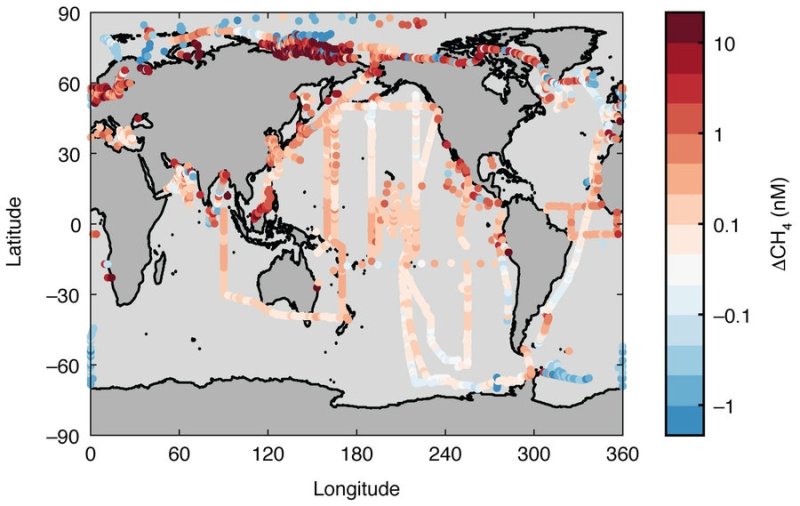
Distribution of ΔCH4 calculated from surface measurements, graphic: © Weber et al., 2019
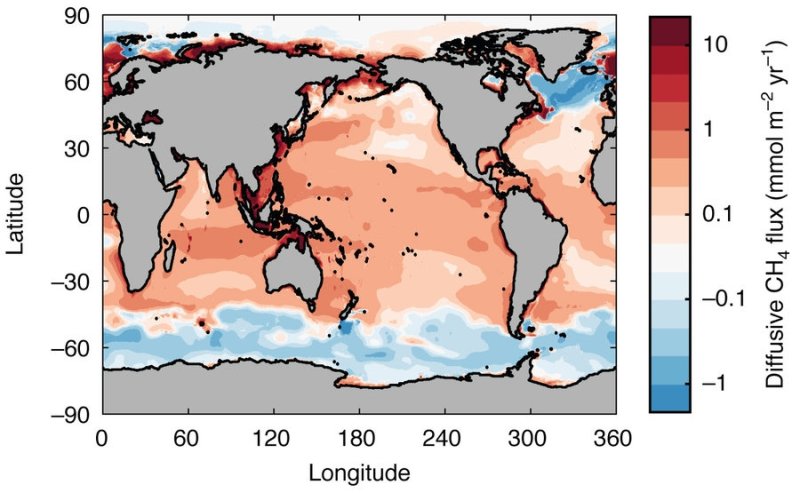
Distribution of Global Methane Flows Generated Using One of the Artificial Neural Networks (ANN), Graphic: © Weber et al., 2019
Ta članek je bil samodejno preveden in lahko vsebuje manjše netočnosti; v primeru dvoma si oglejte izvirno angleško različico.