Scientists get up to speed on the light-harvesting Secrets of photosynthetic algae
environmentphotosynthesisalgaerenewable energyquantum coherencemolecular sensors
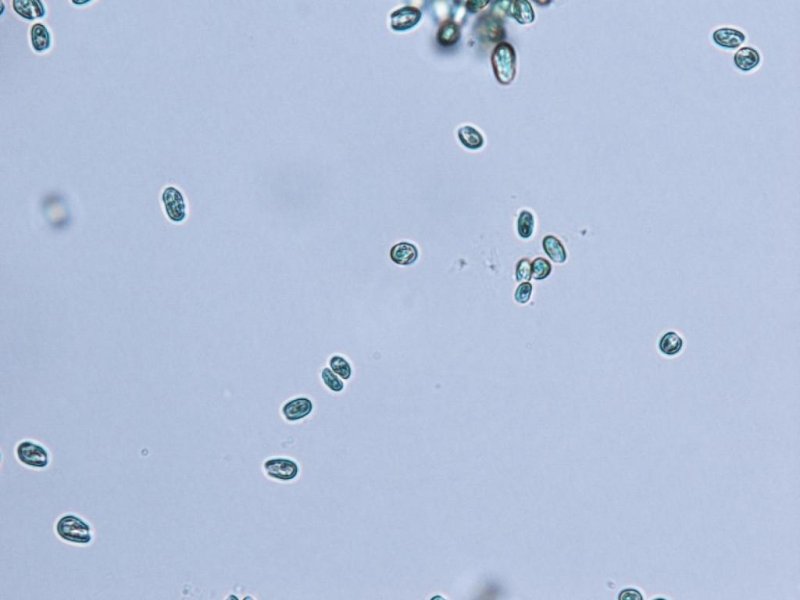
Microscopy Image of cryptophyte algae
(c) Desmond Toa
Since millions of years ago, photosynthetic algae have been refining their technique for capturing light.
As a result, their light-harvesting systems (proteins that absorb light
to be turned into energy) are so powerful that scientists have sought
to understand and mimic them to use in renewable energy applications.
Now, researchers at Princeton University have revealed a mechanism that
enhances the light-harvesting rates of the cryptophyte algae Chroomonas
mesostigmatica. Their findings, published in the Chem journal recently,
provide valuable insight for the design of artificial light-harvesting
systems like molecular sensors and solar energy collectors.
Cryptophyte algae often live below organisms that absorb most of the
sun's rays. As a result, they have evolved to thrive on those
wavelengths of light not sought after by the organisms above them –
mainly the yellow-green colors. They collect this yellow-green light
energy and pass it through a network of molecules that converts it into
red light, something that chlorophyll molecules need to perform
important photosynthetic chemistry.
The scientists have always been fascinated and intrigued by the speed
of the energy transfer. Their predictions were always about three times
slower than the observed rates. The timescales that the energy is
moved through the protein – we could never understand why the process
so fast, " said corresponding author Gregory Scholes, the William S Tod
Professor of Chemistry at Princeton University.
In 2010, his team discovered that these fast rates were due to a
phenomenon called quantum coherence, in which molecules shared
electronic excitation and transfer energy according to quantum
mechanical probability laws instead of classical physics. However, they
could not explain exactly how coherence worked to speed up the rates –
until now.
Using a sophisticated method enabled by ultrafast lasers, the
researchers measured the molecules' light absorption and tracked the
energy flow through the system. Normally the absorption signals would
overlap, making them impossible to assign to specific molecules within
the protein complex; however, the team was able to sharpen the signals
by cooling the proteins down to very low temperatures, said lead author
Jacob Dean, postdoctoral researcher in the Scholes lab.
The researchers observed the system as energy was transferred from
molecule to molecule, from high-energy green light to lower energy red
light, with excess energy being lost as vibrational energy. This showed
that a specific spectral pattern that was a "smoking gun" for
vibrational resonance (or vibrational matching) between the donor and
acceptor molecules, said Dean.
Thanks to the vibrational matching, energy was able to transfer much
faster than it otherwise would be by distributing the excitation
between molecules. The effect provided a mechanism for the previously
reported quantum coherence. With this in mind, the researchers
recalculated their prediction and arrived at a rate that was about
three times faster.
The Scholes lab intends to study related proteins to investigate
whether this mechanism is found in other photosynthetic organisms.
Eventually, the scientists hope to develop light-harvesting systems
with perfect energy transfer inspired by the robust light-harvesting
proteins. This mechanism is one more powerful statement of the
optimality of these proteins, " said Scholes.
Este artigo foi traduzido automaticamente e pode conter pequenas imprecisões; em caso de dúvida, consulta a versão original em inglês.