Great Barrier Reef: Researchers want to breed and colonize coral larvae
environmentmarine conservationoceangreat barrier reefcoral rehabilitation
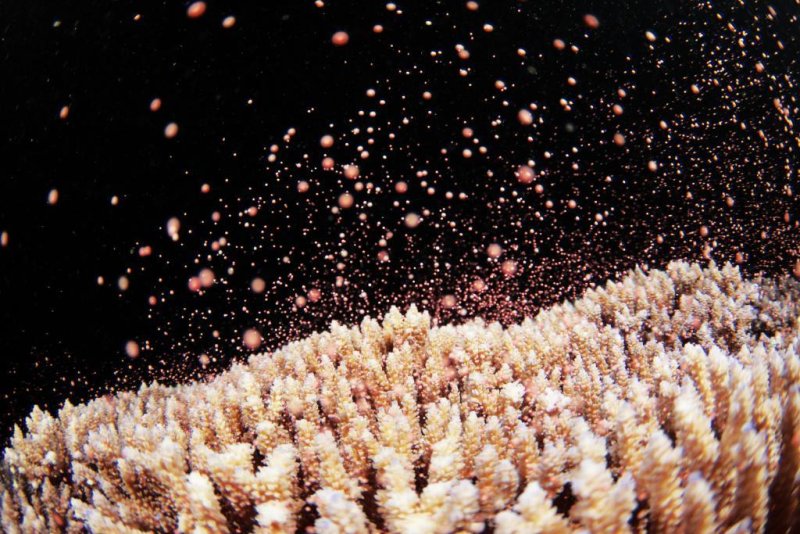
Coral Spawning (c) TU Delft
Coral breeding and rehabilitation in large-scale trial A team of researchers from TU Delft, Van Oord and the Australian National Science Agency CSIRO has set off to the Great Barrier Reef (off the coast of Australia) to test a new method for large-scale coral rehabilitation. The researchers are planning as folloes: coral eggs are collected from healthy parts of the reef and the resulting larvae are transported to the location on the reef where they should grow. The work with coral larvae has proven itself in small format and in special pools. The researchers will now investigate whether this process by collecting coral eggs on a much larger scale than previously possible. Pumps that can be used on excavators, for example, are being tested. Full moon At some point within the five days after the full moon in November, there will be a single moment when corals on the Great Barrier Reef will "dump" eggs into the ocean – they spawn. Shortly after spawning, the eggs float to the water surface, where they accumulate depending on the current. Using a light aircraft, the researchers locate these clouds of eggs from the air. " It's an exciting process, " says Professor Mark van Koningsveld of TU Delft, " because then, with the boat that carries our pumping and research equipment, we need to get to the eggs very quickly so we can do our tests; The next opportunity to test this process in the wild will come in 12 months, when the corals will spawn again. Fragile eggs It is important that the fragile eggs are still alive when they reach the storage tank. To make their journey as smooth and safe as possible, researchers at TU Delft and Van Oord have optimized their pumping systems in recent months. Thus, the pump must not cause turbulence during suction and must float on the water surface. In the coming weeks, on-site tests will show how the pumping systems work in currents and waves. Researchers will test two types of pumps and two types of storage tanks in Australia.
Coral rehabilitation If the pumps and storage tanks prove to be an effective way to collect large-scale coral eggs so they can later be released into the reef, this is an important step towards rehabilitating coral reefs. " With a single ship we could collect and transport about two billion eggs - that sounds like a lot, but on healthy parts of the Great Barrier Reef that's only a negligible part of the total number available, but if we can get the eggs developing larvae and then releasing them to areas where the reef is damaged would eliminate one of the major bottlenecks to rebuilding such reefs ," explains Van Koningsveld.
Videos: https://youtu.be/wRRKCNF1g64 https://youtu.be/v2obPSiREjM
이 기사는 자동 번역되었으며 약간의 오류가 포함될 수 있습니다. 의심스러운 점이 있으면 원문 영어 버전을 참조하십시오.