Dominica
scuba divingmarine lifessiadventuredominicaecotourism
(c) Steve Jones
Legend has it that when Christopher Columbus returned to Spain from the New World, he was asked to describe the island of Dominica. His response was to crumple a piece of paper and throw it on the table, replying "that's Dominica!" Apparently, the crumpled nature of the paper represented the sharp edges and folds that are so apparent in this country. This image was present in my mind as Dominica appeared on the horizon. The island was spectacular, looming like no other in the Caribbean. Mountainous, it was covered in rich green forests. Steep ridges rose from the coast, which then gave way to lush river valleys. Adventure beckoned as our light aircraft banked steeply over the sea before a final run through an emerald coomb towards Douglas-Charles Airport.
Over the years, Dominica has become known as the ‘Nature Island’, an ecotourist’s dream destination. Volcanoes, boiling lakes, rainforest hikes, over 160 bird species, towering waterfalls, whale watching and spectacular underwater scenery – Dominica has them all. Despite all these reasons to visit, Dominica has remained relatively unknown and is most definitely off the beaten track, largely due to the lack of an international airport. One of the windward islands of the Caribbean, the country is only 46 kilometres long and lies between Martinique and Guadeloupe. It’s not to be confused with the Dominican Republic, the much larger tour destination in the Northern Caribbean.
Douglas-Charles Airport lies in the northeast of the island. Choosing a self-drive so as to explore with freedom, I picked up a hired 4x4 which I had prearranged to be waiting for me. My destination was the capital of Roseau, which was some 35 km away in the southwest. Despite the relatively short distance, the journey took over 75 minutes. It took me on tightly winding roads through rich rainforest, banana plantations and the territory of one of the last settlements of the original inhabitants of the Caribbean, the Carib Indians, who still maintain their culture on the island. Throughout the trip, it was apparent just how unspoilt the island was. I arrived in Roseau with a smile on my face.
Roseau is a colourful town bursting with character and is traditionally West Indian. I felt I had taken a step back in time as I passed through its streets lined with old stone and wood buildings. Despite being a relatively poor area, it was well maintained, and the locals were friendly and welcoming. The dive operations on the island were well established. However, you will not find resorts on Dominica on the scale of those on St Lucia; accommodation is in the form of small hotels, guesthouses and inns. I based myself at the Castle Comfort Lodge, which benefits from being a 30-second walk from one of the island’s longest established dive centres, Dive Dominica. This is a centre equipped to cope with large groups of divers, having multiple purpose-built dive boats.
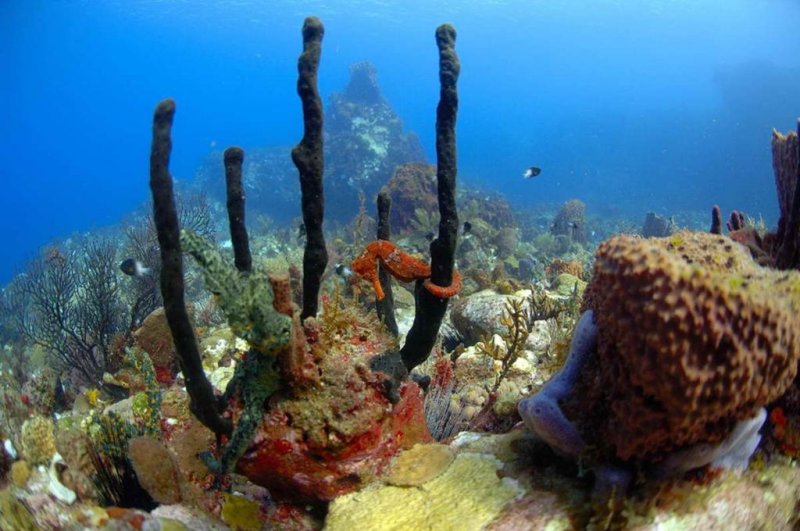
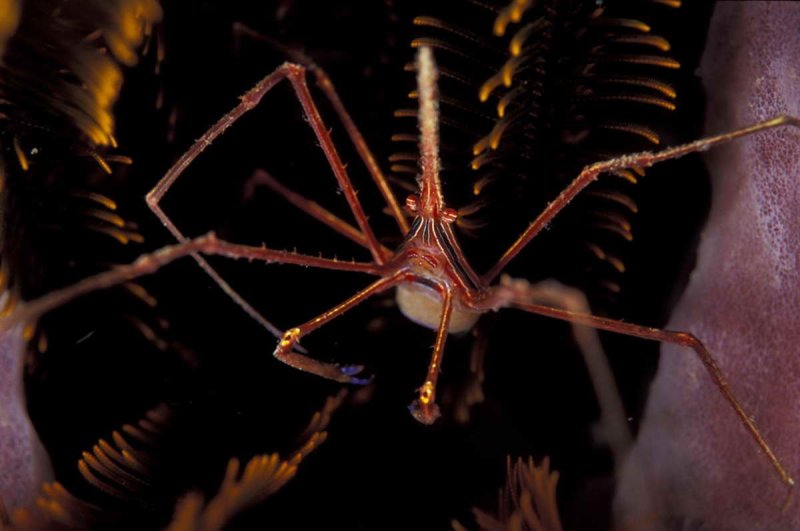
My first dive in Dominican waters exceeded all my expectations, proving to be one of the most spectacular dives I had done in the Caribbean. Scotts Head Pinnacle lies at the southwestern tip of the island, near a peninsula where the Caribbean Sea meets the Atlantic Ocean. Such nutrient-rich waters have nurtured a stunning reef which comprises a series of pinnacles, along with swim-throughs filled with soldierfish. The water was remarkably clear, with visibility exceeding 40 metres. The variety of reef life was rich – frogfish, mantis shrimp and seahorses can all be found here. The pinnacles stand on a plateau. In the distance, the edge of the drop-off can be seen. As with St Lucia, Dominica plummets into the abyss, with the seabed lying thousands of metres below.
Diving in Dominica is arranged in a way that gives you time to explore the delights of the island above water. Boat trips are scheduled so that two sixty-minute morning dives are completed by around 13:00. This leaves the afternoon free for other activities. Stunning scenic attractions such as the Emerald Pool and Trafalgar Falls are within half an hour’s car drive of Roseau, and are then easily reached on foot from the carparks. Dominica also boasts the world’s second largest actively boiling lake.
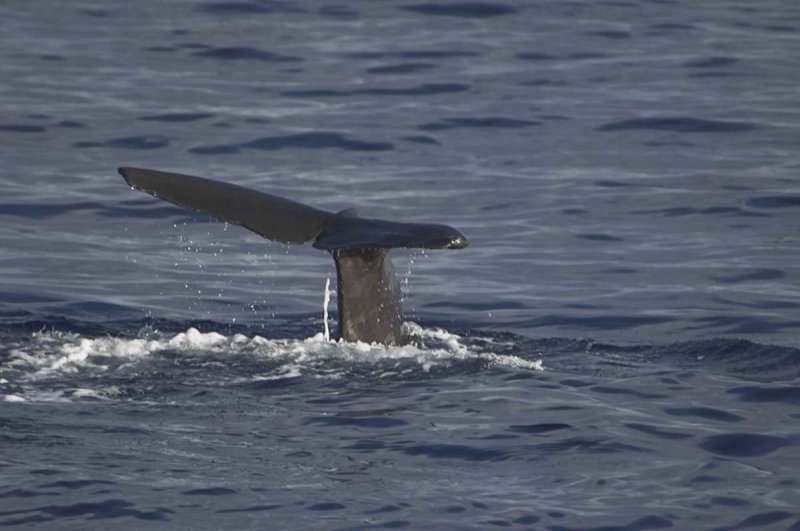
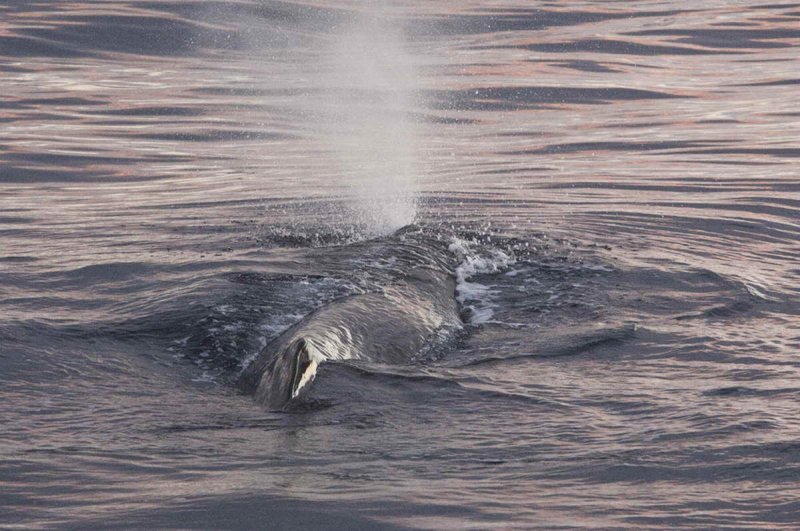
Besides its many attractions for the serious nature lover, Dominica has also earned a reputation as being one of the finest whale-watching destinations in the Caribbean. Its extremely deep waters provide a home for the giant squid which live over a thousand metres below. This in turn has attracted a permanent community of sperm whales. Whale watching is an activity not to be missed. With skilful boat captains and knowledgeable watch leaders, the experience is both exciting and informative. In the space of three hours, we encountered four different sperm whales at close range as well as schools of hundreds of dolphins. Orcas, false killer whales and pilot whales can also be seen here. In winter, baleen whales such as the humpback can sometimes be seen passing through.
A twenty-minute car journey down the narrow coastal road heading south will take you even further back in time. The village of Soufriere (named after the French word for "sulphur") lies in a bay that was formed when the walls of a volcanic crater collapsed into the sea. The whole area around the bay is now a marine reserve, managed by a friendly Londoner known to his friends as Izzy, a well-travelled gentleman who seems to know just about everyone in the diving industry. When not in the Caribbean, he spends his time diving the Red Sea. As an instructor and qualified marine biologist, it was comforting to see that Dominica takes the management of its natural heritage very seriously. This is a country that holds its environment in very high regard. Many more developed countries, in addition to some of our favourite diving destinations, could learn some valuable lessons from their approach.
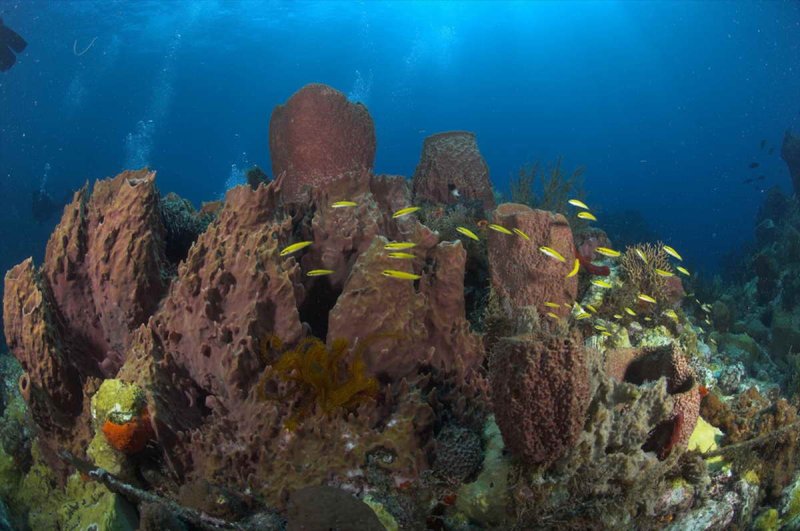
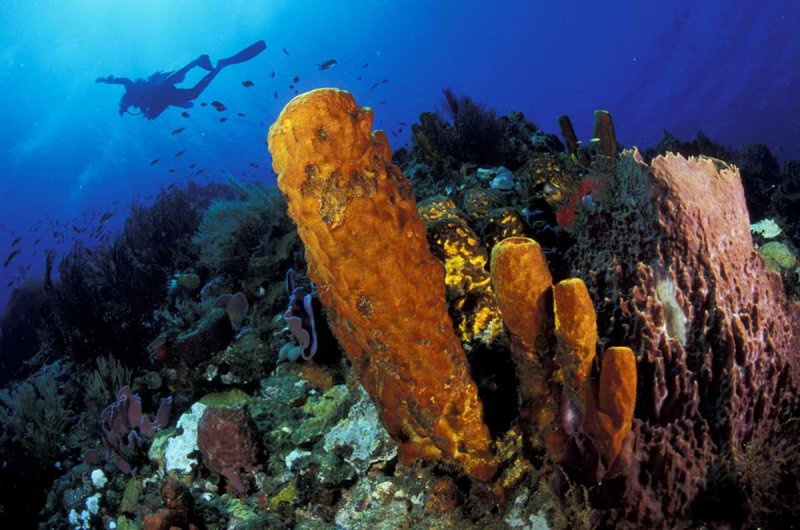
We jumped into the boat right in the centre of the Soufriere Bay Marine Reserve. After only a 10-minute boat journey, we descended onto the Danglebens Pinnacles. Upon descending to the bottom of the buoy line, I came across one of the largest barrel sponges I had ever seen. It’s interesting to note that the marine fauna of Dominica also possesses that "spectacular" element that describes so many of the other aspects of this island.
The journey back from Soufriere to Roseau allows one to take in some of the set of the soon-to-be released Pirates of the Caribbean 2 movie. One of the film’s main themes involves a village of cannibals that was filmed on the headland above Soufriere. "Cannibal huts" still dot the hill. The cannibals themselves had thankfully departed by the time I explored them. Many of the dive guides I met had been commissioned as extras for the film, which bought huge benefits for the local economy.
An hour’s drive north up to Portsmouth shows even more of the underwater diversity that Dominica has to offer. Here, the underwater scenery is very different. It lacks the huge abyssal drop-offs of the south, but contains gentle slopes with schooling fish. Finding a bubbling underwater spring with sand almost too hot to touch reminded me of Dominica’s volcanic attributes.
Dominica’s highlights are in its diving and hiking, both of which are world class. Mountain biking, canoeing the many rivers, and bird and whale watching also feature high on the list. It offers raw beauty with wonderful scenery both above and below water. I left with a definite feeling that I had seen a special place which has been totally unspoiled by industry and tourism. For anybody looking to experience tropical Caribbean nature at its purest, you need look no further than Dominica.
The contact details for all dive centres in Dominica can be found at the website of the Dominican Watersports Association .
Top Spots on Dominica
Scotts Head Pinnacle In the south of the island, Scotts Head Pinnacle is arguably one of the island's most famous dive sites. The dive begins on a large rock formation, prior to entering a large swim-through filled with soldierfish. The school of soldierfish part like a curtain to allow you to swim through, to emerge upon a large plain of coral encrusted outcrops. This leads you to the pinnacle itself. A swim-through cuts the pinnacle in two. On the other side, a spectacular drop-off to well below diving depth looms before you. Soldierfish and lobster intermingle amongst the sea fans as the reef drops away.
Crater’s Edge Continuing from Scotts Head Pinnacle in a north-westerly direction is a volcanic ridge that leads out to the site known as Crater's Edge. Looking out into the blue, masses of predatory fish, including tuna and snapper, can be observed swooping in on their prey. Barracuda also prowl the area. The pinnacle itself is covered in colourful corals and can be easily circumnavigated in one dive.
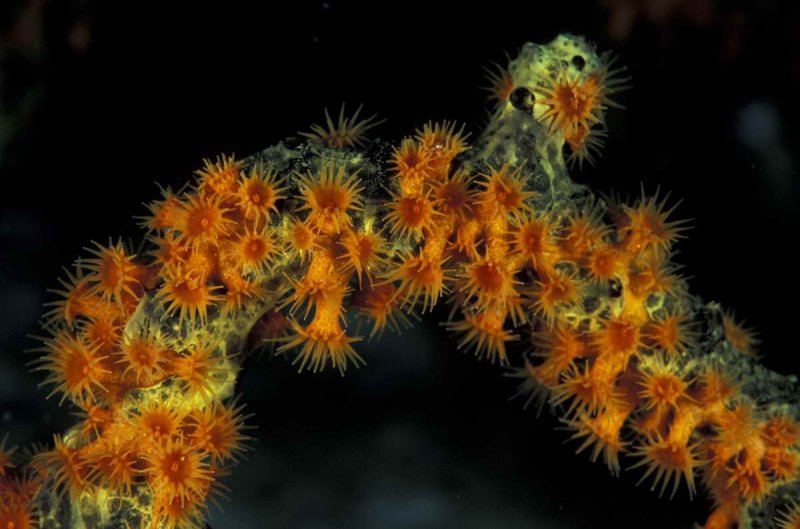
Dangleben's Pinnacles With a series of five pinnacles ranging in depths from 12 to 25 metres, this site is notable for its enormous barrel sponges. The pinnacles themselves are encrusted with a variety of colourful coral species. During the winter months, large schools of jacks can be seen hunting here. A spectacular dive and a favourite of many of the local guides.
Champagne Reef This reef lies in the northern area of the Soufriere Marine Reserve, and is a much raved about site by anyone who has visited it. In around five metres of water, a sub-aquatic hot spring jets out hot water. The bubbles seen rising from the reef in the surrounding area give it its name.
Toucari Caves This site lies in the north of the island and can be dived from Cabrits Dive Center. A beautiful and healthy reef, the high point of the dive is swimming through a cave and archway that are abound with lobster. The whole area is rich in fish life and ranges in depth from 10 to 30 metres, it is suitable for both beginner and advanced divers.
Useful websites for Dominica: Dominican Watersports Association Virtual Dominica Discover Dominica Authority
(c) Steve Jones
(c) Steve Jones
(c) Steve Jones
(c) Steve Jones
(c) Steve Jones
(c) Steve Jones
이 기사는 자동 번역되었으며 약간의 오류가 포함될 수 있습니다. 의심스러운 점이 있으면 원문 영어 버전을 참조하십시오.