"Zombie" shrimps with innovative strategy against predators
environmentmarine lifeoceanunderwater ecosystemresearchpredators
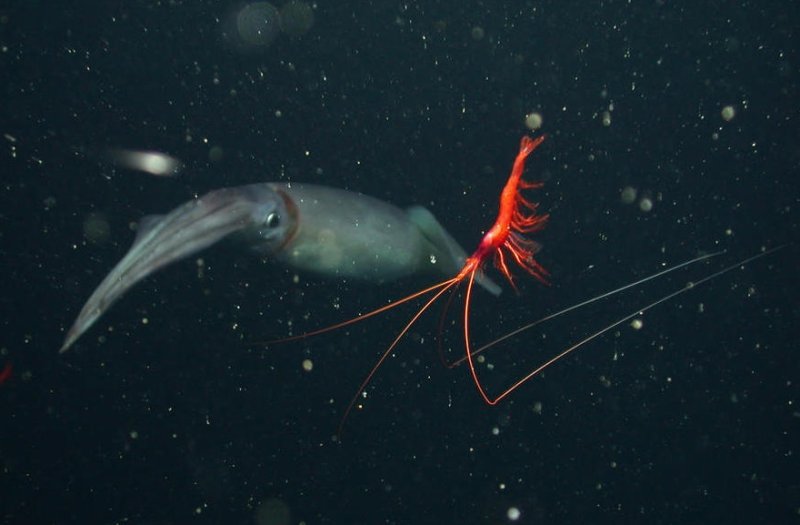
A small shrimp (Petalidium suspiriosum) swims in Monterey Bay while a Humboldt squid lurks in the background. These shrimp behave similarly to the "zombie" shrimp. (c) MBARI (2003)
Playing dead to avoid being eaten Exploring the depths of the Gulf of California with a UW robot, the researchers at the Monterey Bay Aquarium Research Institute (MBARI) saw an eerie sight: a small shrimp drifting upside down and motionless in the water. The shrimp looked dead, but as the submarine approached, it "woke up" and barely moved her antennae and legs. These movements were enough to keep the head down when slowly descending Later during the same dive, the researchers observed other shrimp behaving the same way. Ben Burford, a former intern at MBARI (now a graduate student at Stanford University), was fascinated by these "zombie" prawns and has now published a research paper on the behaviour of shrimp in the scientific journal PLOS One. Most shrimp regularly shed their hard outer skeleton, and the immovable "zombie" prawns looked like a discarded exoskeleton slowly sinking through the dark waters of the Gulf. Burford and his colleagues speculate that shrimp, pretending to be empty skeletons, could increase their chances of being eaten by predators. The shrimp could also save energy as they live at a depth where seawater contains very little oxygen. In waters without much oxygen, many animals have difficulty moving quickly or over a long period of time. The researchers also found that three "zombie" prawns drift directly under large mucous membranes Many deep-sea animals use mucus nets to nourish ocean snow (small particles that drift down from the surface), but the researchers do not know if the "zombie" shrimps have created the mucous membranes or if they only float around in their vicinity. After watching many shrimp looking like zombies in the Gulf of California, they scoured the MBARI video archive and discovered that some of the deep-sea shrimps filmed at Monterey Bay were very similar. Link to the study: https://journals.plos.org/plosone/article?id=10.1371/journal.pone.0207249 Video: https://youtu.be/yH6ZVkzE8-A
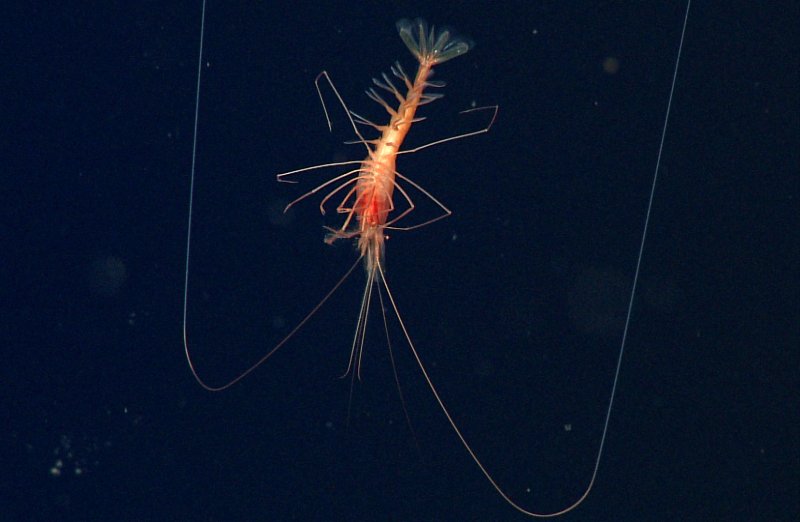
Close up image of a "zombie shrimp" (Hymenopenaeus doris) drifting motionless in the Gulf of California. While "playing dead" the shrimp makes small adjustments to its appendages so that it remains in a vertical position. (c) MBARI (2015)
この記事は自動翻訳されており、多少の不正確な点が含まれている可能性があります。不明な点がある場合は、元の英語版を参照してください。