Ocean Acidification And Marine Communities
environmentmarine lifeocean acidificationplanktonecological balance
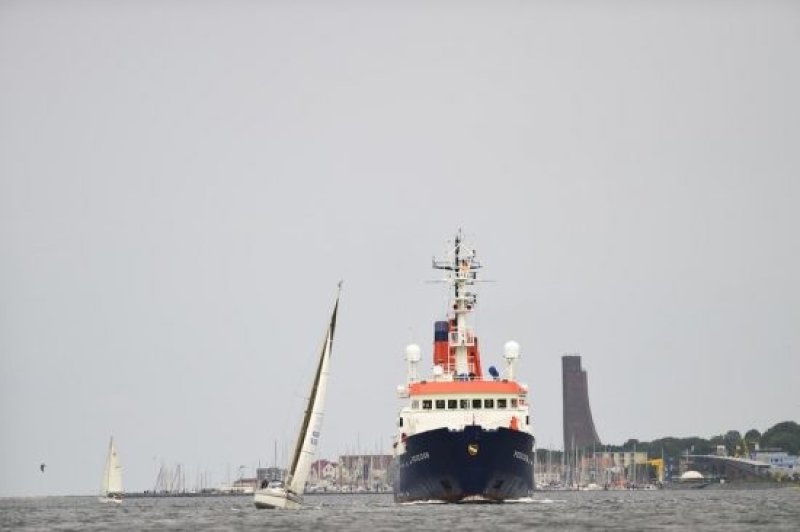
The research vessel POSEIDON brought the mesocosms back from Bergen to Kiel. (c) Solvin Zank
When Ocean Acidification Intensifies, Which Species Will Be The Ultimate Survivor?
What impact does ocean acidification have on the plankton community and the material fluxes in the marine ecological food chain?
After two months of research at at the Raunefjord in Bergen (Norway), scientists from GEOMAR Helmholtz Centre for Ocean Research Kiel now have the answers to these questions. Apparently, it depends on which species you belong to.
Using eight floating experimental KOSMOS (Kiel Offshore Mesocosms for Future Ocean Simulations) mesocosms, scientists studied how the complex marine communities responded to different levels of carbon dioxide uptake from the atmosphere. Four of these mesocosms had elevated carbon dioxide concentrations. According to Professor Ulf Riebesell, professor of biological oceanography at GEOMAR and the experiment's coordinator, " None of the previous studies has revealed as clearly as this one how interactions within the food web determine the sensitivity of the plankton community towards ocean acidification. To test whether the single-celled Emiliania huxleyi could adapt, scientists used subjects that had been living in the laboratory after more than 2,500 generations under acidic conditions. After so many generations, had the organisms evolved sufficiently enough to enable them to survive in the acidic conditions inside the mesocosms?
The answer was no. The organism still suffered elevated loss rates and lowered population densities. As the Emiliania huxleyi has the ability to store carbon and also produce the climate-cooling gas dimethyl sulphide (DMS), having less of them in our environment would be bad news.
Another organism that would suffer dire consequences is the pteropod Limacina helicina, which form an important part of the diets of marine mammals, fish and seabirds. Sometimes known as 'sea butterfly', their shells are made from aragonite, a calcium carbonate which dissolves easily under acidic conditions.
"If the pteropod suffers from ocean acidification, an important link within the food web might get lost," said Dr Silke Lischka, a marine biologist at GEOMAR.However, it is not all doom and gloom, some species like the pico-phytoplankton and the larger zooplankton Oikopleura dioica thrived inside the mesocosms with higher carbon dioxide concentrations. "Oikopleura dioica is an abundant planktonic tunicate with global distribution," explained Jean-Marie Bouquet, research engineer at the Sars International Centre for Marine Molecular Biology and a PhD student at the University of Bergen. He added that it lived inside a complex gelatinous structure that enabled it to capture a broad variety of food particles efficiently, and that its population could rapidly increase in favourable conditions. "In this way, large populations can develop, and they have the power to change the whole food web around."This was precisely what the scientists observed inside the mesocosms. The data and analyses from the two-month research covered the whole spectrum, from the smallest to the largest plankton and fish larvae, as well as the exchange of substances and interactions at different levels of the food web.Needless to say, there will definitely be consequences for marine
biodiversity, the ecological balance and the material exchanges in the sea as a result of ocean acidification. How serious they turn out to be would depend on how successful we are at reducing carbon dioxide emissions at the present time.
Further information: http://www.geomar.de
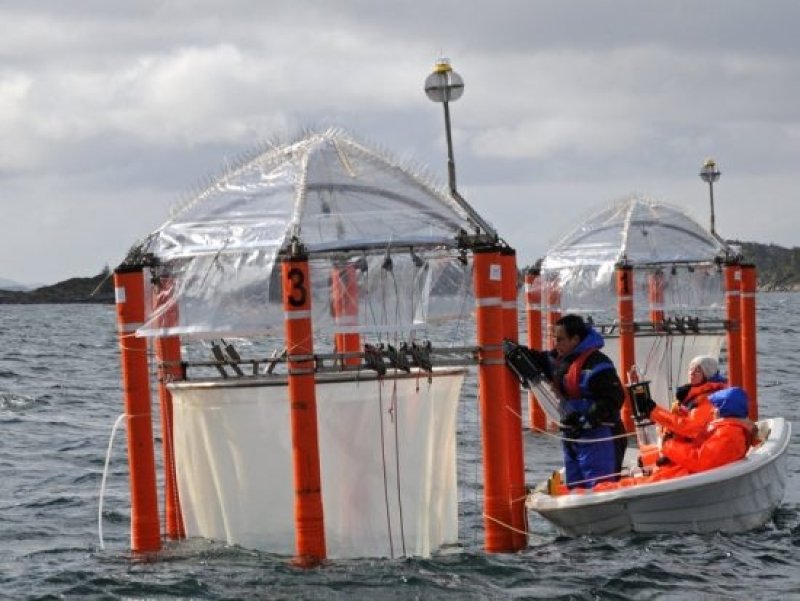
Researchers taking a water sample from a mesocosm. (c) Maike Nikolai
この記事は自動翻訳されており、多少の不正確な点が含まれている可能性があります。不明な点がある場合は、元の英語版を参照してください。