Increased Ocean Temperatures Lead to Higher Rainfall Extremes
environmentmarine conservationclimate changeocean temperaturesextreme weather
The rise of ocean temperatures in our oceans, caused by climate change, has in turn led to more rain, according to scientists from Germany and Russia. The recent bout of heavy rain in June 2015 – as much as 175 litres of rain per square metre within 12 hours – in Sochi, Russia, has strengthened this theory and shows the relevance of research into this topic.
Led by the GEOMAR Helmholtz Centre for Ocean Research Kiel, the scientists studied the impact of this ocean warming on extreme precipitation.
It is no secret that temperatures on our planet are rising, as greenhouse gas emissions continue to increase. Nevertheless, the
effects of global warming on the water cycle remain poorly understood, even as extreme summer storms become more severe as a result. In the coastal areas of warm seas, it was found that surface temperatures of the sea played a direct role in the intensity of summer storms. Since the 1980s, the Eastern Mediterranean and Black Sea have become warmer by about two degrees Celcius.
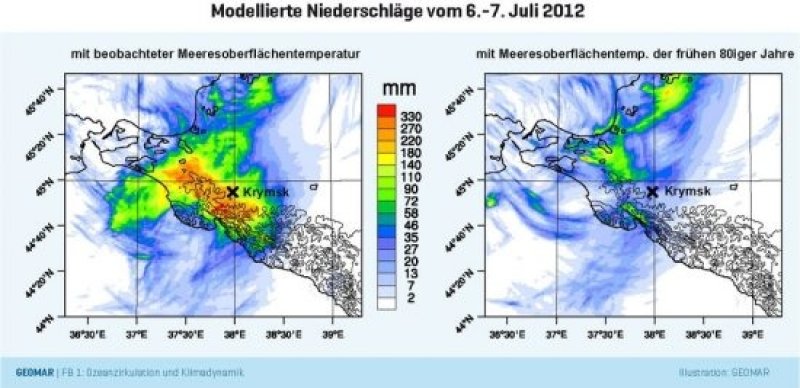
Citing the example of the heavy rains in July 2012 in the Black Sea town of Krymsk (Russia) which led to flash floods that killed 172 people, lead author Edmund Meredith said that the team used "a number of very-high-resolution simulations with an atmospheric model to investigate the impact of rising sea surface temperatures on the formation of intense convective storms, which are often associated with extreme rainfall."
The comparison of these simulations with the fictitious cooler sea surface temperatures as they would have prevailed in the 1980s, with those with the actual warm conditions showed a 300% increase in precipitation intensity.
Professor Douglas Maraun, leader of the study, added that they had been able to identify a very significant change, which indicated that the convective precipitation showed a strong, non-linear response to the temperature changes.
"Due to ocean warming, the lower atmosphere has become more unstable over the Black Sea and eastern Mediterranean. We therefore expect that events like those in Krymsk or Sochi will become more frequent in the future, "said Maraun.
この記事は自動翻訳されており、多少の不正確な点が含まれている可能性があります。不明な点がある場合は、元の英語版を参照してください。