Effects of climate change in Arctic driven by seasonality of sea ice
environmentmarine conservationclimate changearcticsea ice
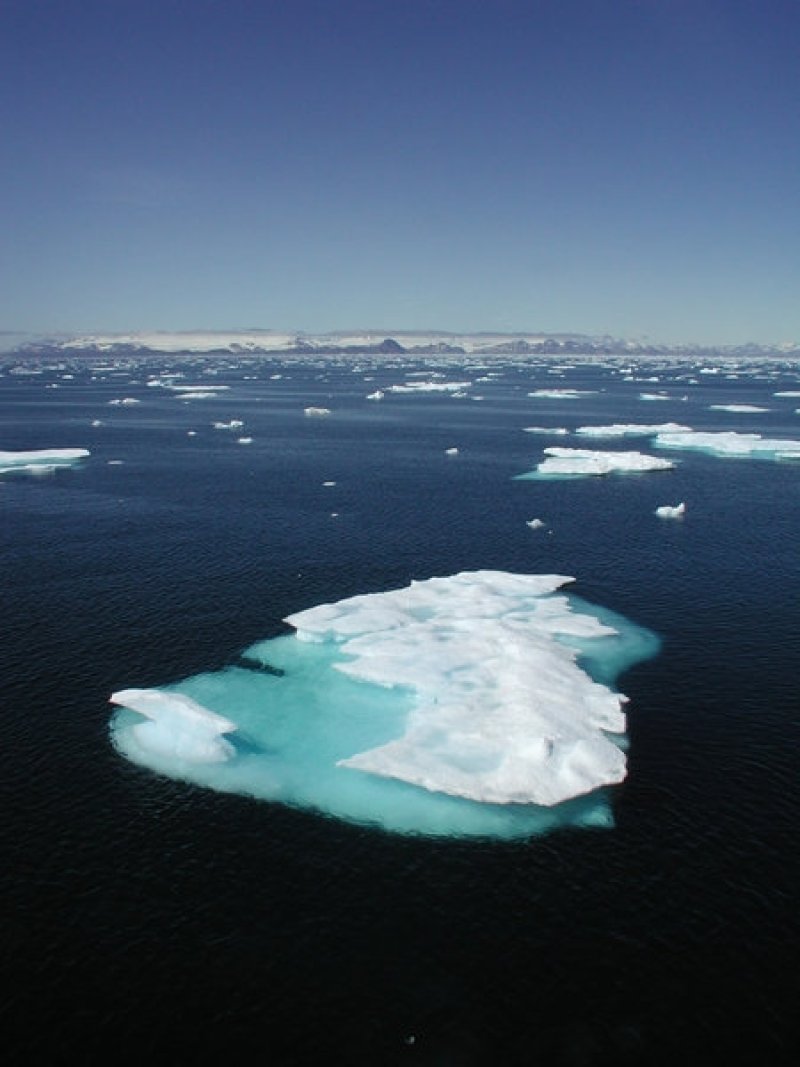
Polar ice (c) Tom Haine
Dramatic changes to take place prematurely within next decade At the Arctic Ocean, the sea ice cover shrinks, with the most ice loss observed during the summer months. A team of scientists have discovered that this reduction has become increasingly seasonal, with the most changes in the Arctic expected to be in the next decade.
During the last autumn and winter in the Arctic, the highest temperatures on record were experienced, with some days plagued with anomalies of up to 16°C. The reduction of the sea ice cover is typically at a minimum during the summer. It facilitates the warming up of surface waters during the summer, and this delays it from being frozen up during the autumn. This in turn shortens the growing season of the ice and, as a result, the ice is thinner and more vulnerable to melting during the coming summer. Every year, this cycle repeats itself.
A recent study by two scientists from The Johns Hopkins University in Baltimore, USA and the GEOMAR Helmholtz for Ocean Research Kiel used observational data and model simulations to show that major changes are already taking place in the polar seas on the Northern Hemisphere, and will continue to do into the next decade. This is a different projection from other climate models which predict the change to take place in the second half of the 21st century, in the form of an ice-free ocean during the summers.
The findings of the study was published in the Scientific Reports journal.
Lead author Professor Thomas Haine said, " Observations show the Arctic is changing over a few decades from a year-round sea ice cover to an ocean that is largely ice-free in summer. For the Earth system, that’s a very rapid pace. "
" The Arctic sea ice cover has now reached the same degree of seasonality as in the Antarctic, which is known to have been seasonal as long as observations exist, " he added.
A seasonality index was used so that an unbiased comparison between the Arctic and Antarctic sea ice for the 20th and 21st century could be done. This was achieved through the use of reconstructions and satellite observations of the sea ice coverage for both locations. In addition, the results of a modelling project (CMIP – Coupled Model Intercomparison Project) was also taken into consideration to show how sea ice seasonality would develop in the future.
Hence, it appears that we are witnessing the transition to a new Arctic.
Co-author Dr. Torge Martin concluded, " In our study, we show that the observed faster warming of the Arctic compare to the global mean – known as "Arctic Amplification" – varies in time and can be expected to decline slowly over the next decades. Further, the current transition of the Arctic sea ice toward a seasonal regime results in a peak in Arctic Amplification. This means the warming rate (not the warming itself) in the Arctic will slowly decrease in the future. "
" We thus anticipate that we currently, and over the next decade, witness the most extreme changes in the marine Arctic under anthropogenic climate change – long before the Arctic is projected to be ice-free in summer.
この記事は自動翻訳されており、多少の不正確な点が含まれている可能性があります。不明な点がある場合は、元の英語版を参照してください。