Polar Regions: Hotspots of Species Genesis
environmentmarine biologybiodiversityspecies developmentpolar regions
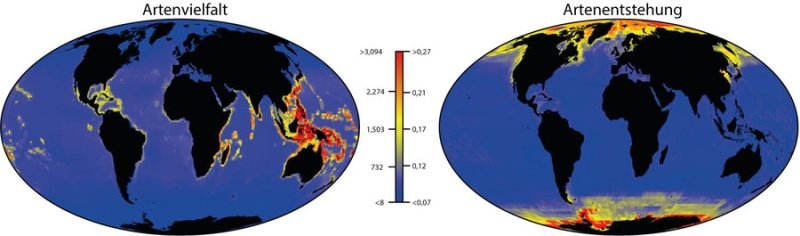
Global maps of biodiversity (left) and speciation (right). According to Rabosky et al., 2018
Not warm coral reefs but icy polar seas are centres of species development for marine fishes Warm tropical coastal seas are home to up to 1,000 times more species of fish than the cold polar seas. The decrease in the number of species from the tropics to the poles has long been known in research and is explained in most textbooks with a higher rate of species development in warm coral reefs, lagoons or mangrove forests. A new study has now found that in the last million years, the development of new species in cold waters at high latitudes was about twice as high as in the tropics. The tropics are considered to be particularly species-rich, whether on land in the rainforest or in coral reefs under water. By contrast, the Polar Regions with their hostile climate on land and in the water are only populated by a few organisms. Therefore, it seems only logical to assume that new species are more likely to emerge in the warm regions of our planet than in the Polar Regions. A new study, which has now appeared in the journal Nature, comes to the opposite conclusion: just the polar icy areas are considered in marine fish as the centres for the emergence of new species. "Our results are unexpected and counterintuitive," says Prof. Dr. med. Daniel Rabosky, evolutionary biologist at the University of Michigan, USA and lead author of the study openly. "Actually, one would expect that a high rate of species emergence also leads to a high number of species," continued Rabosky. But this rate depends on the balance between the emergence of new species and the extinction of existing species. A higher rate of extinction in cold waters, for example due to the loss of habitat during the ice ages, could explain the supposedly contradictory result of high species emergence rate and low number of species. However, rates of extinction are difficult to determine and are not yet available for marine fish. "Of particular importance to this study was the availability of as much data as possible on the global distribution of marine fish," says Dr. Rainer Froese, marine biologist at the GEOMAR Helmholtz Center for Ocean Research in Kiel. GEOMAR, together with international partners, has set up the world's largest database for marine fish http://www.fishbase.org. "We provided their information for the study," continues Froese. "More than 12,000 maps have been included in this study," explains Cristina Garilao, marine biologist and co-author of the study. She is responsible for cooperation with the FishBase Information System at GEOMAR. "This study is a milestone in explaining the distribution of biodiversity on our planet. Without an understanding of how this diversity arises, namely through biological evolution, no effective protection is possible. This study provides further important arguments for improved protection of the Polar Regions, in which the speciation rates are apparently very high, "summarizes Professor Thorsten Reusch, evolutionary biologist at GEOMAR. Link to the study: https://www.nature.com/articles/s41586-018-0273-1

Global species number of bony fishes, with over 3,000 species in coral reefs in the tropics (dark red) and less than 50 species in the polar seas (yellow), Source: www.aquamaps.org
Ez a cikk automatikusan lett lefordítva, és apróbb pontatlanságokat tartalmazhat; kétség esetén kérjük, tekintsd meg az eredeti angol változatot.