New way of getting air and water samples
environmentocean researchdrone technologyatmospheric chemistrycoastal waters
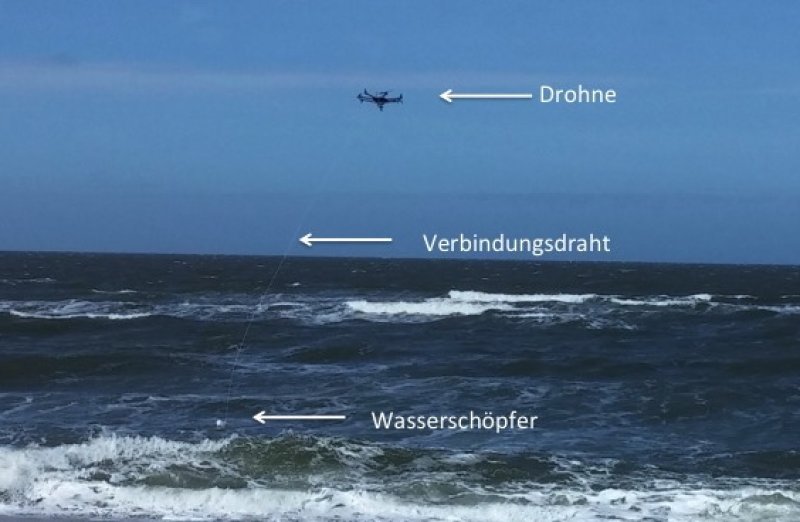
Using the drone to collect water samples.
(c) B. Quack, GEOMAR
Kiel researchers use drone for first time in sample collection
For the first time, a drone has been successfully used by scientists at GEOMAR Helmholtz Center for Ocean Research Kiel to collect air and water samples. This took place during a study to better understand the role of coastal waters as a source of reactive trace gases, which are essential for chemical processes in the climate and atmosphere.
These days, unmanned aerial vehicles (or drones) are no longer just the toys of hobbyists. They are also being used to accomplish complex tasks, in the workforce and industry, and now, in research as well.
A team of scientists from GEOMAR recently used a medium-sized drone to extract air and water samples in the inaccessible surf zone. Samples were taken by a DJI Matrice 600 drone on the western coast of the island of Sylt at the beginning of April.
According to project manager Dr Birgit Quack from GEOMAR, " We had very variable weather conditions with wind speeds of more than 10 m/s, where the drone proved to be very good. On the first mild day, a stroller asked if it wouldn’t be easier to do this in summer with a swimmer. On the following stormy days with high surf waves no one asked again, in fact except for us, almost nobody was there. "
" We were able to fly both horizontal and vertical profiles to take samples of atmospheric parameters in the coastal zone, "
said Dr. Steffen Fuhlbrügge, a meteorologist at GEOMAR and controller of the drone.
The drone collected 120 air samples and 40 water samples, as well as recording images of the sea surface.
Prof. Dr. Christa Marandino, an atmospheric chemist from GEOMAR, explained that the gas exchange between the ocean and atmosphere was enhanced by wave breaking, which was detectable via whitecap coverage. " With our field study, we want to better understand the role of coastal waters as a source of reactive trace gases that are important for tropospheric and stratospheric chemistry and the climate, " she continued.
The samples obtained are currently being studied. An American scientist is analysing the air samples for more than 50 trace gases including halocarbons (e.g. bromoform, dimethlybromide, methyl iodide), non-methane hydrocarbons (e.g. isoprene), and sulfur-containing compounds (e.g. dimethyl sulfide). The scientists at GEOMAR are focussed mainly with analysing water samples and interpreting aerial photographs.
At the same time, the scientists are already looking to the future.
" We want to further optimise air and water sampling in order to be able to cover a larger area with more flexibility, as well as to integrate additional sensors (e.g. for meteorological data) on the drone package, " said Dr. Quack.
Furthermore, the sampling and image recording should be combined with direct gas transfer measurements so as to improve the estimation of the gas exchange between the atmosphere and ocean.
He added, " In the end, we would liketo use this measurement method also for ship expeditions on open ocean, in particular in the tropics and subtropics, as the concentrations of the marine trace gases are often even higher in these regions. "
See here for further information
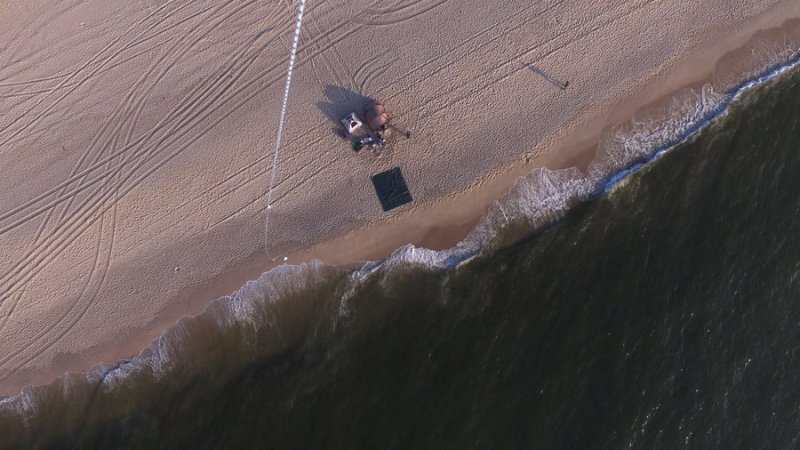
View of the beach camp from the drone.
(c) GEOMAR
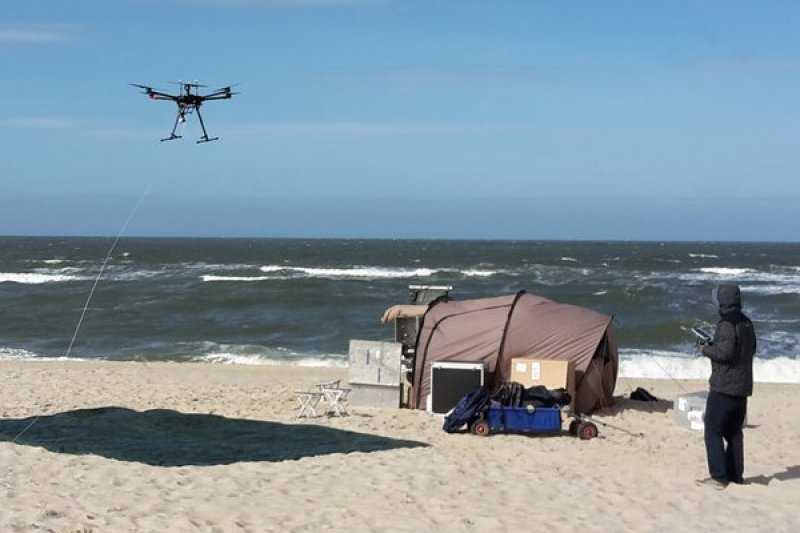
Drone experiment on the beach of Sylt.
(c) B. Quack, GEOMAR
Ez a cikk automatikusan lett lefordítva, és apróbb pontatlanságokat tartalmazhat; kétség esetén kérjük, tekintsd meg az eredeti angol változatot.